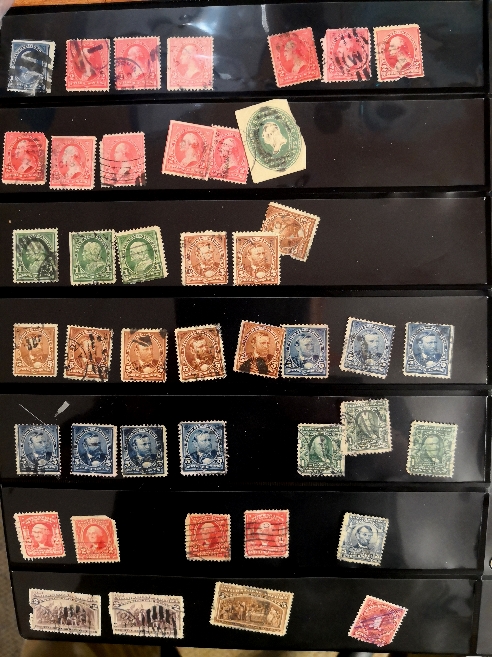
These stamps are better than what is found in an average
inherited collection,
but the highest value stamp is worth about $4 at best.
Most are in the 3c to 50c range.
So it's not bad, but no gold mine.
The most accurate source of value information is prices for "Sold items" on
ebay,
because it has the highest volume of sold stamps.
You can look them up there if you know the Scott catalog number.
The most valuable one (assuming it's in good condition with no paper thins, creases, etc.)
is the 10c in the bottom row of your first photo.
This is from the 1898 "Trans Mississippi" set.
It is Scott catalog #290 .
If you search on "Scott #290" on
ebay, and then select "Sold items" in the lower left column,
you should see prices they have sold for.
My guess is that used examples like yours sell for $3 - 4, based on 15% of the price in the catalog I have on hand.
You might see some that sold for less if they are not in good (aka "sound") condition and have paper thins, creases, tears, missing perforations, etc.
You can use stampworld.com to look up "catalog values" which are good for identifying the more valuable vs. less valuable stamps.
You will need to know or guess the approximate year(s) the stamp was issued.
All the stamps in your photos were made from 1890 to 1903, so that should speed up your search.
stampworld.com does not show the Scott catalog numbers.
but the stampsmarter.org identifier shows them.
The stampsmarter.org site has a very convenient feature,
where you can click on the "Details" link,
and then on the "
ebay 'Sold' Values" link
and directly show the
ebay Sold items for accurate pricing data!
When I do it for Scott #290,
I see used values from $2 (with big torn area)
to $13.29.
Your stamp is very much off center,
and you can see those have sold for around $4 in the above Sold listings.
One advantage of stampworld.com over stampsmarter.org for identifying stamps if you are not already familiar with them
is that stampworld.com puts more photos on a screen,
and you can quickly browse all stamps within a decade,
while on stampsmarter.org ("All Stamp Finder / View By Year") you essentially have to guess the year, and then reselect the next year, etc.
The "All Stamp Finder / View By Year" could be made a bit faster to use
by having "next year" and "prior year" buttons to get to an adjacent year.
The "Visual Finder" ("Visual ID 1870-1890") is very good for beginners who don't already know the year.
If it was extended to 1903 and included commemoratives, it would be about ideal, in my opinion.
It could also be helpful if it was labelled "Beginners - try this first", as there are so many ID options on that page.





 Posted 07/15/2023 5:58 pm




 Lucas983,
