| Author |
 Replies: 11 / Views: 839 Replies: 11 / Views: 839 |
|
|
Valued Member
Australia
28 Posts |
|
|
After some info,comments,opinions on the scarcity of these colour variations. The one on the left is what I call normal, the middle one has a bluish tinge to the scrolling,(also retouched top left) and the one on the right has light blue scrolling. The only ones I normally see are the one on the left. The ACSC states the colours are Yellow/Magenta/Light Blue/Grey. Any help would be appreciated. 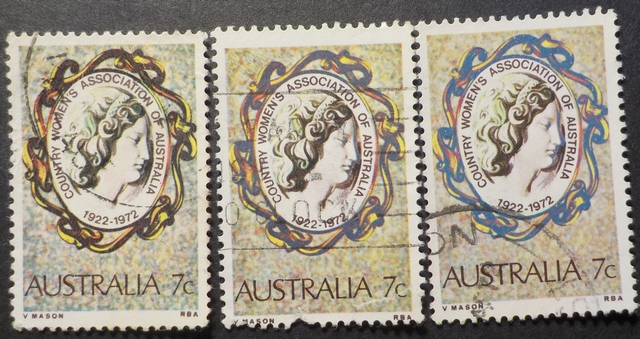 |
|
Send note to Staff
|
|
|
|
|
Pillar Of The Community
Australia
1692 Posts |
|
|
As the stamps have been used, it looks like there are two stages of fading which is expected in used stamps. |
Send note to Staff 
|
|
|
Valued Member
Australia
28 Posts |
|
|
Can't detect any fading on any of the other colours or the postmark so not convinced of the theory it is a fading issue. |
|
Send note to Staff
|
|
|
Valued Member
Australia
67 Posts |
|
|
Hi airgem, There are many examples of the fading of colours on exposure to sunlight, as Rob041256 says. Here's a good example to make the point:  The stamp on the left is the faded one. The one on the right is the normal. In this case the ACSC says: " exposure to sunlight causes background colour to turn into an olive shade."In the case of your CWA 50th Anniversary issue, the ACSC (2002 edition) has some further comment on this stamp: 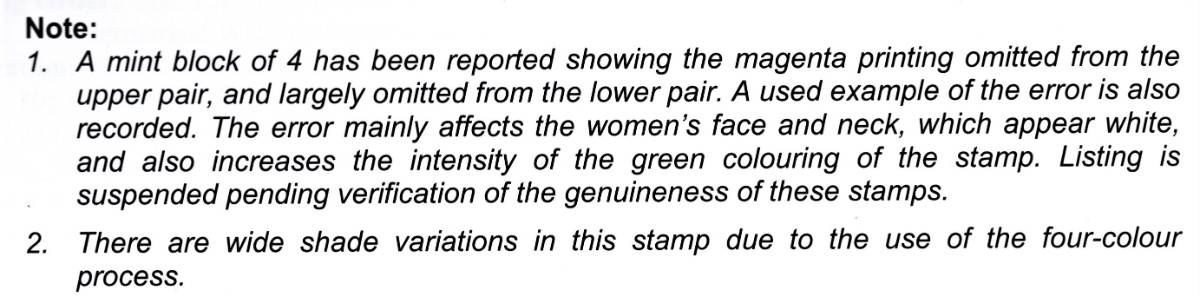 So, if it's not fading, it is probably captured under the Note 2. s hade variations due to the use of the four colour process. Although I do notice that the woman's face on the stamp at the right has a whitish face - but Note 1. questions the genuineness of these; and does not provide any examples for comparison purposes. |
|
Send note to Staff
|
| Edited by Black Swan - 07/25/2023 03:06 am |
|
|
Moderator

United States
12330 Posts |
|
|
In my opinion it is a color changeling.
But one way to test is to take another stamp, put it in a sunny windowsill, cover half of it with a piece of paper, and let it sit there for about 2-3 weeks. Then examine the stamp and see if the colors have changed on the half of the stamp which was exposed.
Don |
|
Send note to Staff
|
|
|
Pillar Of The Community
Canada
879 Posts |
|
|
Rob: Quote:
As the stamps have been used, it looks like there are two stages of fading which is expected in used stamps. Adding to Rob's comment, remember that different colours may fade at greatly different rates, or even imperceptibly. |
|
Send note to Staff
|
| Edited by itma - 07/25/2023 05:16 am |
|
|
Pillar Of The Community
Netherlands
6647 Posts |
|
|
 Would it be correct to state these four are CYM-B? If so, Y, M, and B appear obvious to me in all stamps. That leaves the cyan that might be missing. All four show greenish hair strains. That requires cyan and yellow. Consequently, all four also have cyan printing and none of the four colours is missing. Also, just above the inscription, there appear to be printed background areas in cyan. If I understand correctly, it is the right stamp that would be missing a colour. But that is the one that most clearly shows CYM-B all over the stamp. |
|
Send note to Staff
|
| Edited by NSK - 07/25/2023 06:35 am |
|
|
Valued Member
Australia
67 Posts |
|
|
NSK asks:
Would it be correct to state these four are CYM-B?
'
"-B" being Black (or K: Key).
ACSC states that the printing order was: "Yellow, Magenta, Cyan and Sepia".
And, that "the design was camera-separated and the stamp printed using tricolour inks".
This is getting a way above my pay grade. I don't know how Black or Key relates to Sepia. |
|
Send note to Staff
|
|
|
Pillar Of The Community
6366 Posts |
|
|
But, but, but ... you're still trying to make heads or tails about shade variants of used stamps, which have led uncertain lives. It is a fool's game. |
|
Send note to Staff
|
|
|
Pillar Of The Community
Australia
1692 Posts |
|
|
As Don said in a better description of the term, they are changelings.
Rob |
|
Send note to Staff
|
|
|
Valued Member
Australia
28 Posts |
|
|
So while examining the light blue stamp and holding it up against a bright light(a desk lamp) looking from the back the scrolling is clearly the normal colour. And looking at the front of the stamp and tilting it a bit the blue changes to the normal colour. Can anyone explain that?. |
|
Send note to Staff
|
|
|
Valued Member
Australia
67 Posts |
|
|
Pigments, are the culprits. Pigments.
They're made up of atoms - in a matrix.
Matrixes both absorb and reflect light. Matrixes have surfaces. Some have surfaces at different angles to each other and reflect light differently. Think of a sapphire. Depending on the angle you observe it at, or the light used to study it, you may see different colours - usually blue/green. These are colour change stones.
Under daylight equivalent (fluorescent or LED daylight-balanced) light, the typical colour change sapphire's basic colour ranges from blue to violet. Under incandescent light, it ranges from violetish purple to strongly reddish purple. Some rare colour change sapphires change from green in daylight to reddish brown in incandescent light.
Many objects contain atoms capable of either selectively absorbing, reflecting or transmitting one or more frequencies of light. The frequencies of light that become transmitted or reflected to our eyes will contribute to the colour we perceive.
Physics. Everything else is just stamp collecting (to paraphrase Rutherford).
Your CWA lady is a chameleon. A changeling. Lots of ladies are like that.
|
|
Send note to Staff
|
| Edited by Black Swan - 07/29/2023 03:17 am |
|
| |
Replies: 11 / Views: 839 |
|



 Posted 07/22/2023 4:46 pm


