Stamp Community Family of Web Sites
Thousands of stamps, consistently graded, competitively priced and hundreds of in-depth blog posts to read


Stamp Community Forum
 
Username:
Password:
Save Password
Forgot your Password?

This page may contain links that result in small commissions to keep this free site up and running.

Welcome Guest! Registering and/or logging in will remove the anchor (bottom) ads. It's Free!

What Is The Definition Of A Roller Flaw?

 
To participate in the forum you must log in or register.
Author Previous TopicReplies: 6 / Views: 815Next Topic  
Moderator
Learn More...
United States
5094 Posts
Posted 08/01/2023   3:17 pm  Show Profile Bookmark this topic Add Partime to your friends list Get a Link to this Message
There has been some recent discussion about roller flaws on some Australian Stamps, and I must admit that a general search in various areas tends to always come back to Australian stamps. However, that can't be true, right? In 2014 Pagoda wrote:

Quote:
Roller Die flaws exist as there was damage to the Die when it was being rolled onto to the plate and succeeding entries from the Die are impressed from the damaged Die onto the plate. The damage to the Roller Die often changes due to more damage as the impressions are laid down and the various positions show different stages of the damage,

Pagoda

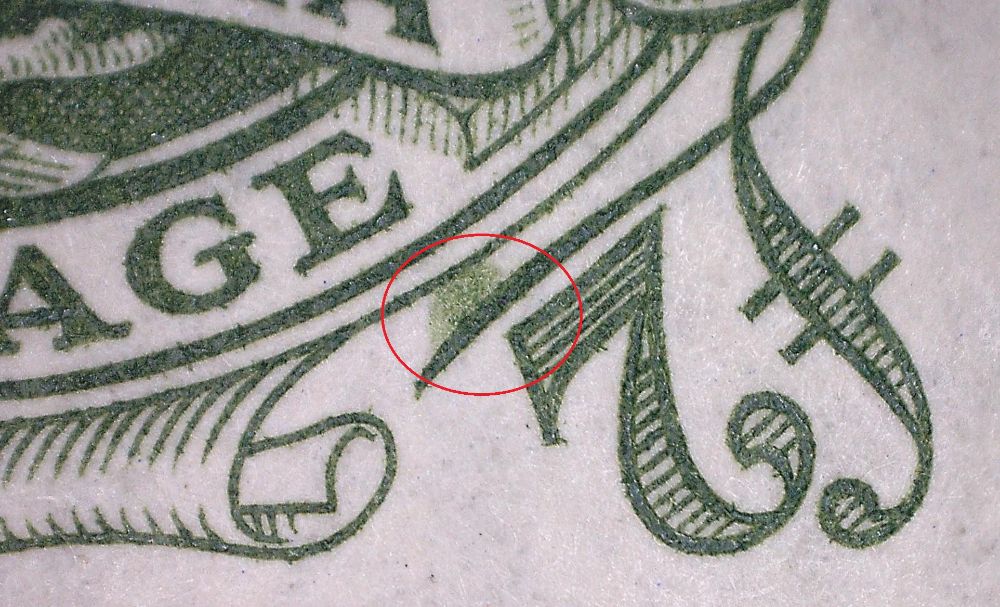
Recently, we have been locking at the 2 pound Roo in this thread: https://goscf.com/t/84758
I have a copy of such stamp, and have circled the roller flaw:
But several years ago, I found similar markings on some Newfoundland stamps. I have multiple copies of each, and at first it was thought to be just some ink-drip. But now, having reopened this topic, I am more leaning towards roller flaws. Here are the examples, all from Newfoundland 254:
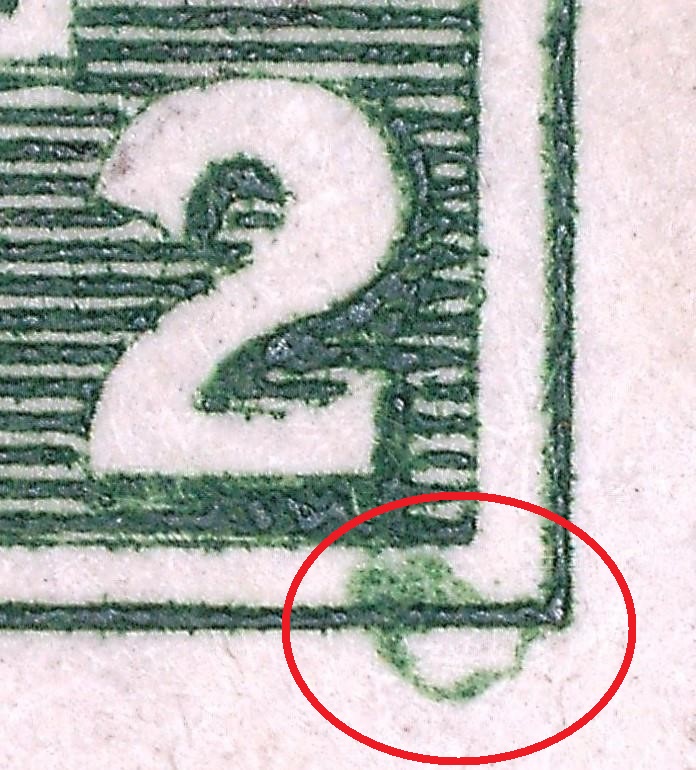
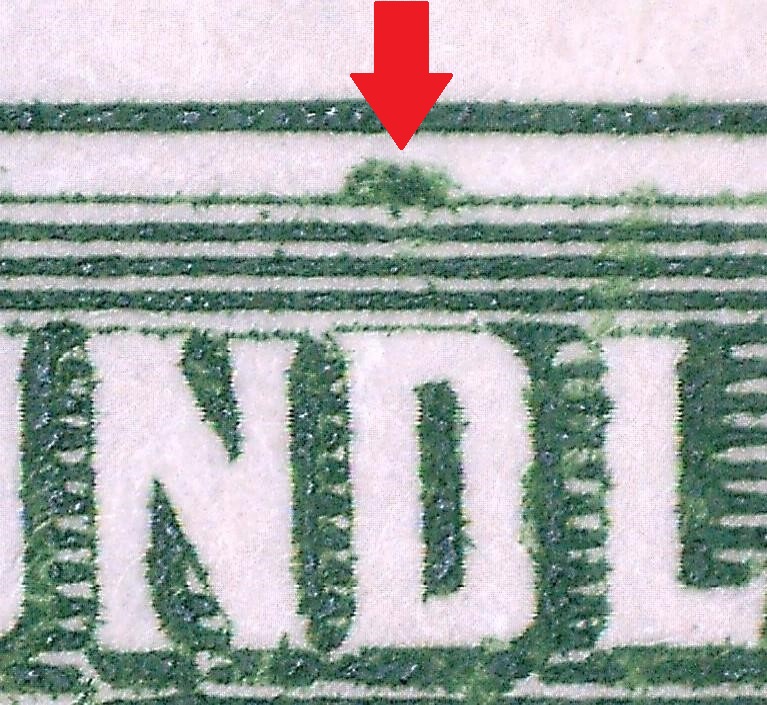
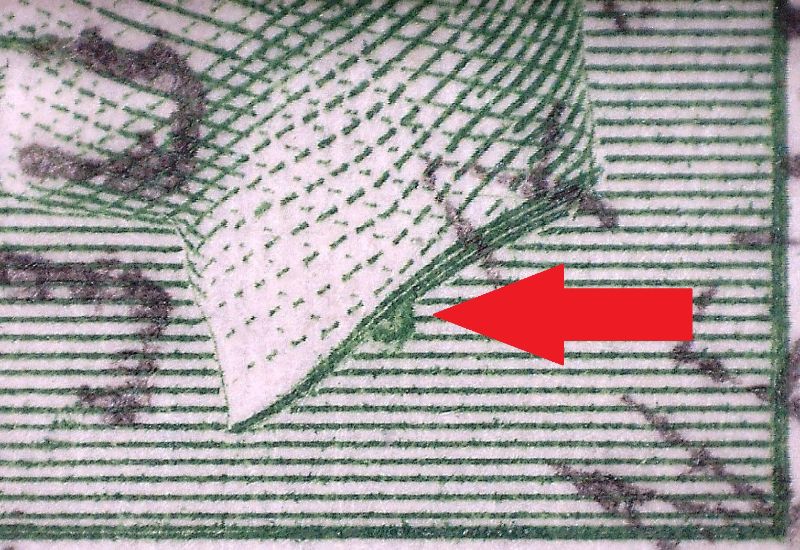
Any better definitions of roller flaw?
Send note to Staff
Edited by Partime - 08/01/2023 3:19 pm

Pillar Of The Community
Netherlands
6530 Posts
Posted 08/01/2023   3:39 pm  Show Profile Bookmark this reply Add NSK to your friends list  Get a Link to this Reply
The plating of the Penny Black, Twopence Blue, and Penny Reds is one big study of roller die flaws, combined with the check letter positions.
Send note to Staff  Go to Top of Page
Moderator
Learn More...
United States
5094 Posts
Posted 08/01/2023   3:42 pm  Show Profile Bookmark this reply Add Partime to your friends list  Get a Link to this Reply
All good points, NSK. But is Pagoda's definition as good as we can get? Essentially, the Die was damaged when being rolled onto the plate, and subsequent examples can get worse with use until repaired? Just wondering.
Send note to Staff  Go to Top of Page
Pillar Of The Community
6329 Posts
Posted 08/01/2023   3:43 pm  Show Profile Bookmark this reply Add John Becker to your friends list  Get a Link to this Reply
In the US, this is more traditionally referred to as the "transfer roll", as an intermediate cylindrical steel disc containing one or more images to transfer engraving between the die to the plate. No doubt the wording could be polished to an even better state of clarity if one were to start over, but pagoda's text above could read more like the following:

Transfer roll flaws exist when there was damage to the transfer roll, so that when it was being rolled onto to the plate, the succeeding entries from the transfer roll are impressed from the damaged roller onto the plate. The damage to the transfer roll can be progressive and may changes due to more damage as the impressions are laid down and the various positions show different stages of the damage (or fixing).

Two additional points: The damage to the transfer roll producing multiple positions on the plate which show the damage, not just a single position, which would more likely be a plate flaw of some sort if repetitively printed, or an inking oddity if not.

Also, I think it is important to be sure there is a clear distinction between the plain word "die" and "roller die" or "transfer die" as precise terminology is important.
Send note to Staff  Go to Top of Page
Pillar Of The Community
Netherlands
6530 Posts
Posted 08/01/2023   3:52 pm  Show Profile Bookmark this reply Add NSK to your friends list  Get a Link to this Reply
The Pagoda definition is sloppy for the reason given by John Becker. It is damage to the transfer roller and not the die that causes a roller flaw.
Send note to Staff  Go to Top of Page
Moderator
Learn More...
United States
5094 Posts
Posted 08/01/2023   4:17 pm  Show Profile Bookmark this reply Add Partime to your friends list  Get a Link to this Reply
Please note that I was using Pagoda's very old definition as it was the only one I could find on short notice. Sorry to Pagoda if you are watching this thread.

Quote:
It is damage to the transfer roller and not the die that causes a roller flaw.

OK, so if the transfer roller was damaged and this causes the roller flaw as shown in the 2 pound Australian, are we seeing the same effect on the three different Newfoundland 254 examples ... i.e., these are all potential transfer/roller flaw issues, assuming that you have a few confirming copies? These issues would continue and possibly worsen on subsequent copies until repaired?
Send note to Staff  Go to Top of Page
Pillar Of The Community
6329 Posts
Posted 08/01/2023   7:05 pm  Show Profile Bookmark this reply Add John Becker to your friends list  Get a Link to this Reply

Quote:
are we seeing the same effect on the three different Newfoundland 254 examples?


I know very little about Newfoundland, but a typical transfer roll has 1-3 stamp impressions. Each rolling into the plate would enter 1-3 stamp impressions, with multiple rollings required to fill an entire plate. Thus there would be multiple stamps on each pane with the same transfer glitch. This is not the case here, or these would be cataloged, etc.

Additionally, no platemaker would do such shabby work, nor would the plate have passed inspection and gone to press. Your 3 examples are either transient inking oddities, transient dirt contamination, or minor progressive damage to the plate during its use. I note you say you have multiple copies of these, which would point to progressive plate damage/wear.
Send note to Staff  Go to Top of Page
  Previous TopicReplies: 6 / Views: 815Next Topic  
 
To participate in the forum you must log in or register.

Go to Top of Page

Disclaimer: While a tremendous amount of effort goes into ensuring the accuracy of the information contained in this site, Stamp Community assumes no liability for errors. Copyright 2005 - 2026 Stamp Community Family - All rights reserved worldwide. Use of any images or content on this website without prior written permission of Stamp Community or the original lender is strictly prohibited.
Privacy Policy / Terms of Use    Advertise Here
Stamp Community Forum © 2007 - 2026 Stamp Community Forums
It took 0.15 seconds to lick this stamp. Powered By: Snitz Forums 2000 Version 3.4.05
