| Author |
 Replies: 9 / Views: 919 Replies: 9 / Views: 919 |
|
|
Pillar Of The Community

United States
814 Posts |
|
|
Stamp of the "Postgebiet Oberbefehlshaber Ost," i.e., for use in Baltic states during German occupation 1916-8 (MiNr 3; Scott 1N3). Can't determine the location named in the cancellation. Any ideas?  |
|
Send note to Staff
|
|
|
|
|
Pillar Of The Community
6364 Posts |
|
|
Coln = Koln = Cologne, Germany (Is this late for this spelling?)
Is there a Coln elsewhere? |
Send note to Staff 
|
| Edited by John Becker - 09/28/2023 9:37 pm |
|
|
Pillar Of The Community
United States
1434 Posts |
|
|
Coln = Köln only makes sense if the stamp snuck under the radar and was used domestically, over 1,000km from the intended Ober Ost. Possible, but I think still worth looking a little harder before settling on that. |
|
Send note to Staff
|
|
|
Pillar Of The Community
United States
7105 Posts |
|
|
Use some magnification and see if you can verify that the overprint is under the cancel. |
|
Send note to Staff
|
|
|
Pillar Of The Community
United States
1434 Posts |
|
|
Quote:
Use some magnification and see if you can verify that the overprint is under the cancel. That's an excellent point, since the move from Coln to Koln happened with the reform of 1901; if it's meant to be the city English speakers know as Cologne, then either the overprinted stamp and cancel are entirely genuine and the cancel hadn't yet been modernized (along with the domestic use issue), or the overprint is a fake on top of a genuine domestic cancel. The latter is the simpler explanation and thus more likely. |
|
Send note to Staff
|
|
|
Pillar Of The Community
United States
814 Posts |
|
|
Thanks to everyone. It does seem unlikely that a genuinely overprinted stamp would be used domestically, i.e., outside of, and so far from, the official Postgebiet of the Eastern high command.
After a night's sleep I'll try better magnification to see whether the overprint is indeed under the cancel. If not, I'll wonder, why would anyone bother to fake a common overprint on an already common stamp?
Meanwhile it seems possible that there's an umlaut over the "o," making "Cöln" almost inescapable. And thanks especially to Classic Paper for the date when that city's spelling changed: another reason why this cancel isn't likely to have been applied to a stamp of 1916-18. Tho' the date of the cancel appears to be something in the 'teens,' no?
|
|
Send note to Staff
|
| Edited by EMaxim - 09/28/2023 10:48 pm |
|
|
Pillar Of The Community
United States
2941 Posts |
|
|
I wouldn't rule out it being a valid cancel applied at a receiving PO based solely on the date of the spelling change. That particular cancel was still in use until at least 1915, and possibly later. Cancellers from the same PO (Cöln 4) but a different letter canceller ("m" in this case) were used as late as the end of WWI. |
|
Send note to Staff
|
|
|
|
Pillar Of The Community
United States
814 Posts |
|
|
Pillar Of The Community
Romania
596 Posts |
|
|
I found Köln on "wikipedia" (in German): "…Prussian rule, spelled "Cöln" / On the spelling from 1857 to 1919…" The cancellation appears as genuine (see "stampsx" site -Postmark database): 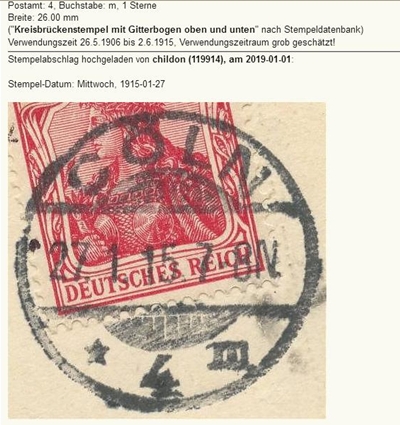 |
|
Send note to Staff
|
|
|
Pillar Of The Community
United States
814 Posts |
|
|
Thank you, Cupram. Nice image of the cancel and further support for the date when the spelling of Köln officially changed.
As for increased magnification: it hasn't yet produced a conclusive result. (The cancellation is a bit too faint.) Nevertheless, to my eye it appears that the cancel has been properly applied on top of the overprint. If so, both the overprint and cancel could be genuine. In that case, PostmasterGS has provided a neat solution: The stamp was affixed to mail from the occupied Baltic region but cancelled only upon receipt in Köln, which didn't officially adopt that spelling with a "K" until 1919. In a war zone cancellation at the point of departure can be difficult.
Thanks again to all who responded. Once more I'm grateful for the knowledge that this Forum makes available. Also, I appreciate the times when a seemingly common stamp turns out to have interest that far exceeds its minimal catalogue value.
|
|
Send note to Staff
|
|
| |
Replies: 9 / Views: 919 |
|




 Posted 09/28/2023 8:20 pm


