To participate in the forum you must log in or register.
| Author |
 Replies: 34 / Views: 2,979 Replies: 34 / Views: 2,979 |
|
|
|
Pillar Of The Community

United States
1773 Posts |
|
|
Pillar Of The Community
United States
3532 Posts |
|
|
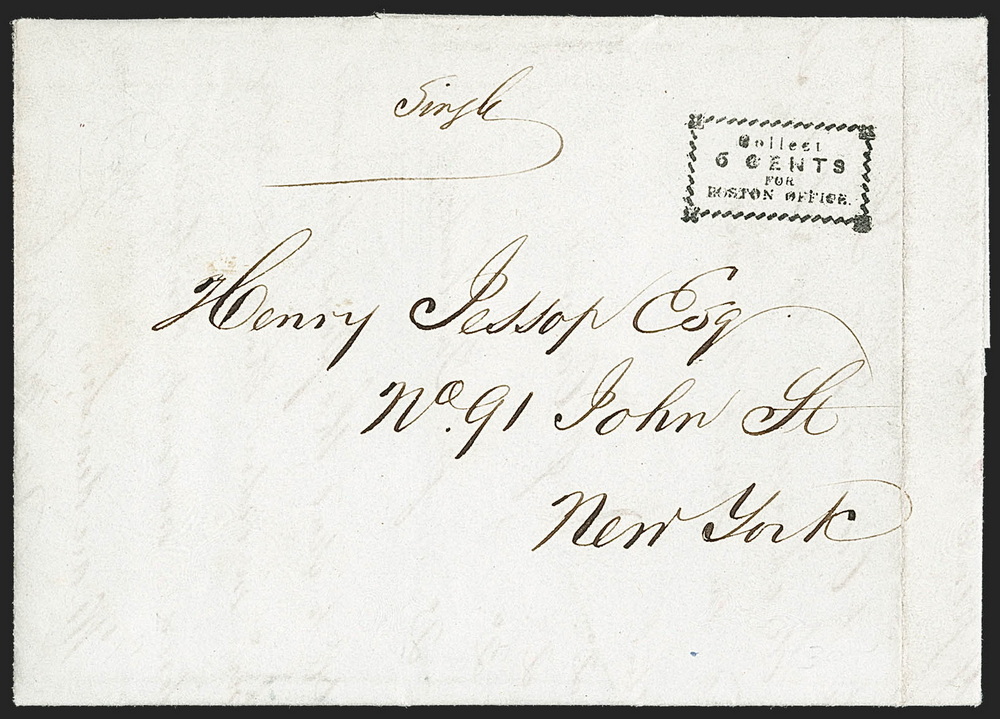
So the collect marking pretty clearly says Boston Office.
So that's where it was applied indicating unpaid letter.
Probably ALM marking.
edit: krelyea just saw your post. That looks right. |
Send note to Staff 
|
| Edited by txstamp - 11/26/2023 8:02 pm |
|
|
Valued Member
United States
181 Posts |
|
|
Wow awesome everyone, what a team!! Do we know if the collect 6 cents was AML Co. Or if it was a different outfit? Either way very cool. I appreciate all the help, I hope others were as entertained in the hunt as I was. Something about these old letters excites me. The lot this one came from was supposed to be all German stuff. There is one other US from 1843 with a nice Burlington VT red cancel, no stamp. Other than that the rest are German, well one with stamps from wutemburg and 5 2 cent postage due US. Such a fun time going through these. |
|
Send note to Staff
|
|
|
Pillar Of The Community
United States
1773 Posts |
|
|
Pillar Of The Community
United States
3532 Posts |
|
|
Bates & Co also used a rectangular collect.
Hale usually had their name in theirs.
ALM used generic markings w/o name like this one. |
|
Send note to Staff
|
|
|
Pillar Of The Community
United States
3532 Posts |
|
|
Valued Member
United States
181 Posts |
|
|
I'm also pretty sure one of the documents said ALM didn't do postage due. |
|
Send note to Staff
|
|
|
Pillar Of The Community
United States
3532 Posts |
|
|
Yep that is what it says. What I don't follow, is the 'collect' terminology. Collect-ed?
They had a PAID handstamp, but instead used 'collect'.
Clearly Hale did the same.
Also, ALM definitely has '6' handstamps which are/were used.
I'll speculate one more time and then just give up, but it kind of looks to me like they may have reduced their rate to 6c from 1/2 bit (6 1/4) just before or around the time Spooner sold out - again that's based on looking at markings and not source material -- always a problematic approach.
I do have a larger write-up on Hale. Sometime I'll study that and see if its clearer on the procedures. |
|
Send note to Staff
|
|
|
Pillar Of The Community
United States
3532 Posts |
|
|
Pillar Of The Community
United States
3532 Posts |
|
|
After reading those three exhibits, my current thoughts are that your cover:
- was presented to Hale, unpaid, marked collect 6c - from addressee
- for whatever reason was transferred to ALM who carried it by train.
- recipient probably paid ALM 6c .. since it came from them and not Hale.
Not sure if this can be determined for sure, but Hale and ALM apparently didn't get along so it seems unlikely that ALM would forward money back to Hale & ALM transited it anyway. |
|
Send note to Staff
|
| Edited by txstamp - 11/27/2023 11:18 am |
|
|
Pillar Of The Community
United States
4465 Posts |
|
|
Do not be to wedded to the 6 1/4 rate for Spooner's ALMC as he altered rates as needed going lower, thus 6 cents is not out of the question. Quote:
Spooner, feeling that his efforts and his company were doing a great deal of good for the citizens of the land, wasn't through fighting. His counteraction caused even greater consternation to his opponents - he lowered his rates. |
|
Send note to Staff
|
|
|
Pillar Of The Community
United States
3532 Posts |
|
|
I agree.
I think my last summary is likely correct, "if" the attached exhibits are correct.
One of them clearly attributes the collect in question to Hale. |
|
Send note to Staff
|
|
|
Pillar Of The Community
United States
4465 Posts |
|
|
I am surprised about the interest in this thread so I have chosen to include the long reference I mentioned earlier. Here is Spooner in his own words from 1850. I must break it into a number of sections. This is part 1. Quote:
Who Caused the Reduction of Postage?
Ought He to be Paid?
by Lysander Spooner
Boston: Wright & Hasty's Press, No. 3 Water Street., 1850
TO THE PUBLIC
LETTER to M.D. PHILLIPS, by Lysander Spooner
STATEMENT. Including -
1. - The Constitutional Question - the opinions of the press, the certificates of Hon. Rufus Choate, Hon. Simon Greenleaf, Hon. Franklin Dexter, Hon. Benjamin F. Butler, Hon. William Kent, Hon. William H. Seward, and Hon. Robert Rantoul Jr., the inimation of Juedge Sotry, the declaration of Senators Woodbury, Allen, and Simmons, and of Hon. Mr. Dana, of the House of Representatives
2. - Mr. Spooner's Private Mails
3. - Action of the Government
4. - First Resolution of the House of Representatives
5. - First Report of the P.O. Committee of the House
6. - Second Resolution of the House of Representatives
7. - Report of the Postmaster General
8. - Second Report of the P.O. Committee of the House
9. - Report of the Minority of the P.O. Committee of the House
10. - Report of the P.O. Committee of the Senate
11. - Debates in Congress, in 1844 and 1845
12. - The action of Congress in 1843, contrasted with that in 1844 and 1845
13. - The Example of English Postage
14. - Hale & Co.'s Letter mail
TO THE PUBLIC
The reduction of postage, which was made in 1845, was forced upon Congress, against the determined opposition of that body, by the establishment of private mails, and such an exposure of the unconstitutionality of the laws prohibiting private mails, as satisfied Congress of their inability to suppress the competition, and preserve the revenues of the Post-Office Department, otherwise than by the reduction of the government postage. And they accordingly reduced the postage to a point that made competition unprofitable, without even bringing the constitutionality of their prohibitory laws to the test of a decision by the Supreme Court.
The further reduction, made by the law of 1851, is but a natural consequence of the former one-it being proved, by the surplus revenue that accrued under the act of 1845, that a low rate of postage will pay the expenses of the Department.
The first reduction was forced; the second was the result of the surplus revenue that accumulated under that forced reduction.
Whoever, therefore, caused the first reduction, is the real author also of the second - and thus of the whole reduction - that is, from the original rates of 6 ¼, 10, 12 ½, 18 ¾, and 25 cents, for each piece of paper, (less than four,) to an uniform rate of three cents, the half ounce, for all distances, within the United States, if prepaid, or five if not prepaid.
The law of 1851 also provides that so soon as the revenue of the post office Department shall exceed the expenditures by five per cent in a year, the postage shall be reduced to two cents the half ounce.
The laws both of 1845 and 1851 also make large reductions in the postage of newpapers, circulars, periodicals, and pamphlets.
The subscribers present to the public the following "letter" and "Statement" of Lysander Spooner - together with a copy of his argument of the " Unconstitutionality of the Laws of Congress Prohibiting Private Mails," - as proof that Mr. Spooner has been the principal, and by far the most efficient agent in effecting the reduction of postage.
Our object, in presenting this evidence, it to submit to the public the question, whether the accomplishment of so great a service, by Mr. Spooner, does not demand some compensation at the hands of those who are enjoying the fruits of his exertions?
The English people, by voluntary contribution, gave to Rowland Hill, a munificent testimoniral of their gratitude for his services in reducing postage. The English government also honorably rewarded him. Shall Mr. Spooner go entirely unrewarded?
Mr. Spooner's claims to a compensation, are enhanced by the fact that, in his contest with the government in 1844, (which caused the first reduction of postage,) he became involved in debts which he has hitherto been unable to discharge. We cannot believe the public will be content to enjoy the fruits of such a service, and make no remuneration for the exertions and losses by which it was accomplished.
It will be seen by the "Letter " and "Statement " of Mr. Spooner, and the evidence he produces in support of them, that he published his argument in January 1844, and established his private mails in the same month - avowing, in his public advertisements, his "intention thoroughly to agitate the question, and test the constitutional right of free competition in the of carrying letters," if he should be sustained in his business enterprise by the patronage of the public. This patronage was not extended to him, in a sufficient degree to meet the expenses of his mails, and of the conflict which the government carried on against him. And in six or seven months he was obliged to surrender the business - but not until the principle which he had established by argument, had become so far fixed in the public mind as to make the suppression of the private mails impossible, otherwise than by a reduction of the postage.
The merit of Mr. Spooner consists in his being the first to establish by argument the unconstitutionality of the laws prohibiting private mails, and the first to establish mails on that principle, and challenge the government to test the question whereby a reduction of the postage was coerced.
That Mr. Spooner's argument, and the establishment of his mails, had the merit and the efficacy we have ascribed to them, we subjoin the following opinions expressed by the press, and by distinguished legal gentlemen:
The New York Express (January 13, 1844,) says of the argument "The writer has certainly made out a very strong case."
January 30,1844, the same paper called it "A very able argument,' and said " We do not see how it can be got over."
February 7th, 1844 the same paper said, "Mr. Spooner has discussed that great question with surpassing ability."
The New York Tribune (January 18, 1844,) said, "This pamphlet deserves attention. It is certainly an able statement of one side of the subject, and the people may find after all that the Postmaster has stretched a point in the constitution."
The New York Evening Post (January 29, 1844,) called it "A very able pamphlet," and said, "We hold with Mr. Spooner in this matter."
The New York Journal of Commerce (February 29, 1844,) said, ":It has been concurred in by the general voice of the legal gentlemen who have examined it."
Hon. Rufus Choate certifies that he "had occasion to examine it carefully," and that "the author's leading and important position, that all laws prohibiting private mails were unconstitutional, was maintained with a force and cogency, calculated under the obvious limitations applicable to it, to convince every unbiassed judgment."
Hon. Franklin Dexter certifies that he "considers it as quite unanswerable;" that "as U.S. District Attorney," he "had occasion to consider it carefully, and could make no answer to it satisfactory to himself."
Hon Simon Greenleaf, (late Law Professor in the Cambridge Law School,) certifies that he has read it, and "should think it a very difficult work to refute it."
Hon. Benjamin F. Butler, (late U.S. Attorney General,) although, out of deference to he practice of the government, he forbears to say the laws prohibiting private mails are unconstitutional, yet says that Mr. Spooner's argument does very far to show that no power to pass any such laws has been delegated to the Congress of the United States. If the questions were a new one, I should expect the courts to repudiate the claim of the Federal Government to any such authority.
Judge Story, in June 1844, (five months after the publication of Mr. Spooner's argument,) on the trial of a case for the iolation of the Post-office laws, said, (as reported in the Boston Daily Advertiser of June 18,) that "there were many difficulties in maintaining in the United States any exclusive right to establish post-offices and post roads."
Senator (now Judge) Woodbury, February 6, 1845, (about one year after the publication of Mr. Spooner's pamphlet,) said in the Senate of the U. S.: "Were the question a new one at this moment, the whole restrictions on private enterprise and private competition in carrying letters themselves, could not stand an hour."
Senator Simmons said February 6, 1845, in the Senate of the U. S. . "The power to establish a mail was not given to enable the government to make exorbitant charges for service, much less to enable it to enforce a compliance with them, if made."
Hon. Mr. Dana, M. C. of New York, said in the U. S. House of Representatives, February 25, 1845. "The validity of that (the government) monopoly is not beyond all doubt. Stake not the Department, under present circumstances, upon the hazard of a law suit. Prejudice is too strong against you. Success is almost impossible; victory is useless; defeat ruin."
We think these opinions of Messrs Story, Woodbury, Simmons, and Dana, are fairly to be attributed to Mr. Spooner's argument - inasmuch as such opinions, (so far as we know,) had never before been heard from the Bench, or in Congress.
We think also, that the reduction of the government rates, without bringing the constitutional question before the Supreme Court, is a virtual admission, on the part of Congress themselves, that they did not feel it safe to subject the constitutionality of their prohibitory laws to the investigation of that tribunal; otherwise they would not have succumbed to such a defiance of their authority, without bringing the question to a judicial decision, as the Postmaster General was invited by Mr. Spooner to do.
Mr. Spooner's "Statement," which follows this card, will be found to contain numerous extracts from debates in Congress, and from reports of the Post-office Committees, all showing, conclusively that the necessity of getting rid of the competition of the private mails, and the acknowledged impossibility of doing it otherwise than by a reduction of postage, were the motives which induced Congress to make the reduction in 1845.
It is on these grounds that we think that Mr. Spooner's argument, and the establishment of his private mails, (with other private mails, which grew up, as we think, mainly under the, protection of his argument and example,) were the immediate and most efficient causes of that reduction.
Hon. Simon Greenleaf certifies that "the reduction of postage (in 1845) seems justly attributable to his (Mr. Spooner's) exertions."
Judge Kent, of New York, certifies that "one thing is certainly evident, that Mr. Spooner has displayed talent and energy in obtaining a reduction of the charges of postage, and deserves the gratitude of all of us for the obtaining of a great public benefit."
Hon. Benjamin P. Butler says, "That your (Mr. Spooner's) efforts have largely contributed to awaken attention to this great interest, no man can deny. And whatever I may have thought of them, before my recent perusal of your pamphlet, (published by you in 1844,) I am now satisfied that you were induced to engage in those efforts under a deep conviction of the unconstitutionality of the laws with which they conflicted, and that you may, therefore, be regarded as having rendered, in this matter, good service to the country."
Hon. Robert Rantoul, Jr., says, "I think Mr. Spooner entitled to the gratitude of his country for his able and efficient abors to illustrate the constitution, and to facilitate correspondence."
Hon. William H. Seward also says, in reference to the same services, "I am quite satisfied that Mr. Spooner deserves well of the country, and of the age."
For further evidence of the efficiency of Mr. Spooner's efforts in effecting the reduction that was made in 1845, we must refer to his "Letter " and "Statement," which follow this card; and especially to the extracts he has given from the report of the Postmaster General, the reports of Committees, and the Debates in Congress. And we take leave to repeat that the reduction of 1851 is a legitimate result of the reduction of 1845, and is therefore attributable also to Mr. Spooner's exertions.
It is due to Mr. Spooner to say that he was not the first to suggest this contribution. At the time the new postage law went into operation, in 1845, it was proposed to him that the public be called upon to remunerate him for his services in bringing it about; and he was requested to prepare such a statement of the facts as was necessary to be laid before the public for that purpose. He then declined, from motives of delicacy, to furnish the statement, and the matter was necessarily dropped. It has since been proposed to him again; and a sense of duty to himself and his creditors, has induced him to furnish the "Statement" which follows.
From the mercantile, manufacturing, banking, and professional community, who have already realized large sums from the reduction of 1845, and who will realize similar profits from the one of 1851, we are confident something liberal may be expected. We trust also that other persons, whose savings have been, and will be less, will yet feel it a pleasure and a duty to contribute such small sums, (one dollar each, for instance,) as, if numerous as we think they ought to be, will, in the aggregate, make, up a testimonial that will honorably mark the public gratitude for so great a service as the reduction of the postage.
As it will necessarily be impossible for agents to visit all those, who may be disposed to contribute, we invite each person, without waiting for further solicitation, to send his contribution, by mail, to "Lysander Spooner; Boston, Mass."
In the cities we invite the merchants to move in the matter, by sending their contributions individually, or by acting collectively, as may seem to them proper.
In each village, where many will be disposed to contribute sums too small to be sent singly by mail, will not some public spirited individual take it upon himself to act as a collector of contributions, and forward them as above directed?
To ensure the success of the objects in view, it is important that each one should feel the obligation to do his own part, and not omit it, in the confidence that others will be more just or liberal than himself.
P. S. Will not editors, whose interests have been largely promoted by the reduction of postage, give the foregoing card an insertion, with such comments as the facts given in the following "Letter " and "Statement" may seem to them to justify ? |
|
Send note to Staff
|
|
|
Pillar Of The Community
United States
4465 Posts |
|
|
Spooner Part 2 Quote:
LETTER
Boston 1851
M. D. PHILLIPS, Esq.,
DEAR SIR: - You were pleased to suggest to me, as have many others, that the public were indebted to me for the Cheap Postage Law, that was passed in 1845. And you and others have proposed that those persons who have realized large savings from the reduction of postage, be requested to recognize the obligation. With this view you have desired me to put on paper the facts necessary to enable the public to understand my agency in the matter.
The question of indebtedness and obligation, on the part of the public, is one to be settled by each individual for himself; but the following pages will probably satisfy those who may read them, of these facts, viz: That I was the first to prove by argument - certainly the first to prove to the satisfaction of any considerable portion of the public -t hat Congress had no Constitutional power to forbid the establishment of mails, by the States, or by private individuals, in competition with the mails of the United States; 2, that I was the first to establish mails on that principle, and invite the government to test the question before the judicial tribunals; 3, that these events were followed by a recognition of the correctness of the principle, by an important portion of the bar, the press, the people, and, in one instance, by the bench, (Judge Story,) and, - in another instance, in the Senate, (by Levi Woodbury; 4, that numerous other private mails were speedily established, whose operations, by diminishing the revenues of the general Post office, threatened the Department with bankruptcy ; and, finally, that Congress were compelled, in order to save the Department from becoming a burden upon the treasury, to reduce the postage to a rate that would rid the Department of the competition of the private mails; and that these were the immediate causes that led to the passage of the cheap postage act of 1845.
The importance of the Constitutional principle I contended for, whether viewed politically, socially, 6r commercially, will be in some measure appreciated, wheat it is considered that, if the government of the United States have the power to forbid the States and individuals carrying letters, newspapers, and other mailable matter, it can, at will, suppress, to any extent it pleases, all written and printed communications between man and man. Theoretically, this absolute power - was claimed by the government; practically, it was exercised to a very injurious and tyrannical extent.
The right of the States and individuals to establish mails has not yet been fully established by judicial decisions. The act of 1845, in terms, denies it; although the act itself was practically a concession to it - for it is not to be supposed that Congress would have yielded to a competition so destructive of their revenues, and based, as the Post-office Committee of the House of Representatives said, "upon the impudent assumption that the government of the United States have no authority to restrain or punish" the competitors - it is not, I say, to be supposed that Congress would have been so regardless, both of their own dignity, and of the duty of maintaining their Constitutional prerogatives inviolate, as to have thus succumbed to the usurpations of a few private persons, without so much as bringing the case before the Supreme Court, if they had had any real confidence that their authority would there have been sustained. They would naturally have vindicated their authority first, and considered the reduction of postage afterwards.
It was my intention - had I been sufficiently sustained by the public - to carry the question to the last tribunal. But after a contest of some six or seven months, having exhausted all the resources I could command, I was obliged to surrender the business, and with it the question, into the hands of others, who did not see sufficient inducement for contesting the principle, after the reduction of postage had taken place.
But, great as was the relief afforded by the act of l845, the value of my movement did not end there. That act, by the proof it afforded that a low rate of postage will support the Department, became but a preparatory step to the still further reduction made by the act of 1851.
I understand that my claim to be remunerated for my services and losses, has been objected to, on the ground that I engaged in the enterprise with a view to make money; that, so far as I was concerned, it proved to be a losing business - that, in this respect, it stands but on a level with enterprises generally that prove unfortunate, presenting no claim for indemnity or compensation from the public. The error of this objection consists in this, that it leaves entirely out of view the benefits the public have received from my unrewarded labors. Those benefits distinguish this case from all those unfortunate private adventures, which propose no benefit to the public, in which the public have no interest, from which they derive no advantage, and whose authors they are consequently under no obligation to compensate.
It is true I hoped to realize a profit from the enterprise-, although I trust I had also a proper sense of pride and duty in the establishment of so important a principle. But no person - no one certainly in my circumstances - would have been justified in entering upon so expensive a contest with the government, unless he had trusted to come out of it, at least without loss.
With reference to my prospects of profit, it is also to be considered, that although the legal idea, and the argument sustaining it, may have had as much originality as any of those mechanical or chemical ideas, which the government protects by securing to their authors an exclusive property in them and although my ideas were of far greater value to the public than almost any one of those that have ever been thus guaranteed to their authors; still, being legal ones, I could obtain for them no patent, and secure for them no monopoly. All persons, who could read my argument, or hire a lawyer to read it for them, were at once free to avail themselves, as many did, of my thoughts, and establish themselves in competition with me in carrying them into practice. The idea and the argument were therefore necessarily a free gift, on my part, to the public, because the public were sure to get the benefit of them, without being under any compulsion to make any payment to me.
Nevertheless, I looked for a profit from the undertaking -a legitimate profit from the business of carrying letters in the midst of free competition-for I could not believe that the public would be so unmindful of one who should vindicate for them so great a right - a right so vital to civil liberty, so important in a pecuniary view, and the establishment of which was sure to result in the reduction of the government postage to the lowest rate to which free competition could bring it - as to give him no preference in business over those who had done nothing for them in that behalf. Probably such would not have been the case, had not the fact of my being the first to establish mails in avowed defiance of the authority of Congress, and the fact that my mail arrangements were at the outset more extensive than those of any other person, (to wit, from Boston to Baltimore,) induced the Postmaster General to direct nearly or quite all his efforts, for the suppression of private mails, against me alone. By employing a large police in the cities and on the roads, he was enabled occasionally to detect and arrest my carriers, and thus obstruct my mails. In this way the confidence of the public in the certain transmission of their letters through my mails was diminished, and their patronage accordingly withheld. In the mean time, other private mails were allowed to pursue their business, either in entire, or comparative, quiet; and their mails being the surer conveyance, they secured the larger share of business, and their proprietors reaped the profits which should have been the reward of my labors.
The consequence was that, after having sustained the conflict for some six or seven months, and placed the principle, on which I acted, so fully before the public as that it finally compelled the concession of Congress to it, I was obliged, by want of means, to abandon the business, after having incurred debts which to this day I have been unable to discharge.
I subjoin the following "Statement," and a copy of my argument. The two embrace the proofs of all the more important assertions made in this letter.
With these remarks I leave the question of obligation, on the part of the public, to be determined by each person individually, to whom application may be made for contributions.
Very truly,
Your Obt. Servt.,
LYSANDER SPOONER
STATEMENT
THE CONSTITUTIONAL QUESTION.
My argument on the "Unconstitutionality of the Laws of Congress Prohibiting Private Mails," was published in January, (about the 10th,) 1844.
Copies were sent to most of the members of Congress, and to the Postmaster General.
On the 6th of Feb., 1844, it was published at length, in the New York Express.
Of this argument the New York Express said, (January 13th, 1844,)- "The writer has certainly made out a very strong case."
January 30th, the same paper called it, "A very able argument," and said, "we do not see bow it can be got over."
February 7th, the same paper said, "Mr. Spooner has discussed that great question with surpassing ability."
The New York Tribune, (January 18th, 1844,) gave an extended synopsis of the argument, and said:
"This pamphlet deserves attention. It is certainly an able statement of one side of the subject, and the people may find, after all, that the Postmaster has stretched a point in the Constitution."
The New York Evening Post, (January 29th, 1844), called it "A very able pamphlet," and said, "we hold with Mr. Spooner in this matter.
The New York Journal of Commerce, (February 29th, 1844), said, "It has been concurred in by the general voice of the legal gentlemen who have examined it."
Hon. Rufus Choate, Hon. Simon Greenleaf, Hon. Franklin Dexter, Hon. Benjamin P. Bittler, Hon. William Kent, Hon. William H. Seward, and Ron. Robert Rantoul, Jr., give the following certificates :
"I have been requested to express an opinion respecting a pamphlet entitled "The Unconstitutionality of the Laws of Congress Prohibiting Private Mails, by Lysander Spooner,' published in 1844. Having had occasion to examine this pamphlet carefully, soon after it appeared, I am happy to say that I was impressed with the ability and research displayed in it. The arguments it presented were, to a great extent, original, and the author's leading and important position, that all laws prohibiting private mails were unconstitutional, was maintained with a force and cogency, calculated, under the obvious limitations applicable to it, to convince every unbiased judgment.
"Boston, 9 Feb. 1849. RUFUS CHOATE."
"Andover, May 2, 1849.
GENTLEMEN, - have received your favor of April 27, requesting, my opinion on the constitutionality the laws against private mails. "My attention has never been specially called to that question, and it is out of my power, at present, to command the time necessary for a thorough examination of it. I can only say that, having read over Mr. Spooner's argument, I have been deeply impressed with its cogency, and the research it displays, and should think it a very difficult work to refute it. In effecting a reduction of the postage, which seems justly attributable to his exertions, he has performed a service deserving not only the gratitude of the community, but a remuneration of the expenses it must have cost him.
"Respectfully, your Obedient Servant, "
S. GREENLEAF."
"To Messrs. John W. Wetherell, John C. Wyman, and Oliver H. Blood."
"Boston, January 31, 1850.
SAMUEL E. SEWALL, Esq., - Dear Sir, - In answer to the inquiry contained in Mr. Lysander Spooner's letter to you, I very willingly state that I consider his printed argument, against the power of Congress to prohibit private mails, as quite unanswerable.
"That argument was produced, and substantially repeated, in the defence of certain prosecutions which I was, as U.S. Dist. Attorney, specially required to institute against persons who had set up private mails. I had, of course, occasion to consider it carefully, and I could make no answer to it satisfactory to myself. Since that time my attention has been again drawn to the subject, as Lecturer on Constitutional Law at the Cambridge Law School, and I felt obliged to state the opinion that Congress possessed no such power.
"FRANKLIN DEXTER."
(Hon. B. P. Butler's letter discusses the question, at too great length to be inserted entire. I give the more important portions.)
New York, Feb. 26, 1850.
"LYSANDER SPOONER, Esq., - Sir, - * * * I regard the provisions of the existing Acts of Congress, creating a government monopoly in the transmission of 'mailable matter, ' as inexpedient and oppressive; and, so far as those provisions impose penalties on individuals for carrying, for hire, on their persons, or in their vehicles or vessels, by land or water, letters, newspapers, or packages, your argument goes very far to show, that no power to pass any such laws has been delegated to the Congress of the United States. If the questions were a new one, I should expect the courts to repudiate the claim of the Federal Government to any such authority. * * * * *
"I am not prepared to say the the several Congresses that passed, and the several Presidents that approved, these laws, transcended their powers, and violated the Constitution. *
"That your efforts have largely contributed to awaken attention to this great interest, no one can deny; and, whatever I may have thought of them before my recent perusal of your pamphlet, (published by you in 1844,) 1 am no-w satisfied that you were induced to engage in those efforts under a deep conviction of the unconstitutionality of the laws with which they conflicted, and that you may therefore be regarded as having rendered, in this matter, good service to the Country.
"Very Respectfully, your Obedient Servant,
"B. F. BUTLER."
New York, May 18, 1849.
"My DEAR MR. HOWE - I return the pamphlet containing the argument of Mr. Lysander Spooner, on the Unconstitutionality of the Laws Prohibiting Private Mails.
"That he has established this point, I am not prepared to say, while I appreciate the force of his reasoning." " One thing is certainly evident, that Mr. Spooner has displayed talent and energy in obtaining a reduction of the charges of postage, and deserves the gratitude of all of us for the obtaining of a great public benefit.
"I am Faithfully Yours,
"W. KENT."
"Auburn, June 2, l849.
"GENTLEMEN, - My engagements leave me no leisure to examine the interesting question discussed by Mr. Spooner in the pamphlet you have submitted to me. It seems clear enough, however, that his opinion of the Unconstitutionality of the Laws Prohibiting Private Mails was adopted by him in good faith, and upon at least plausible grounds, while it has been discussed with great ability and fairness. Inasmuch as the agitation of the question, very proper under such circumstances, contributed to the reformation of our Post system and the establishment of cheap postage, I am quite satisfied that Mr. Spooner deserves well of the country and of the age.
"I am, with great Respect, your Humble Servant,
"WILLIAM H. SEWARD."
"To Messrs. John W. Wetherell, Oliver H. Blood, and John C. Wyman."
"Beverly, Dec. 27, 1849.
"I have read and examined with some care Mr. Spooner's pamphlet on the supposed power of Congress to prohibit private mails. His argument against the existence of such a power is lucid and thorough - indeed it seems to exhaust the inquiry on that side of the question.
"As it is of transcendent importance that the constitutional limits of the action of the Federal Government should be clearly defined and settled by general acquiescence, and as this can only be done by a consideration of the whole argument for and against every questionable claim of Federal power; as nothing can contribute more towards the progress of civilization and social improvement, and to perpetuate and strengthen the bonds of our glorious Union, than the cheap, rapid, safe and unrestricted intercommunication of thought, through written or printed vehicles, over the whole territory comprised in this group of republics, I think Mr. Spooner entitled to the gratitude of his country, for his able and efficient labors to illustrate the Constitution, and to facilitate correspondence.
"ROBERT RANTOUL, JR."
The public will judge whether this argument, or the agitation of the question produced by it, and by the establishment of my mails, had any thing to do in calling out the following opinions.
Judge Story's Opinion.
In June, 1844, (five months after the publication of my argument,) the first intimation, so far as I know, that ever came from the Bench, that the laws prohibiting private mails were unconstitutional, came from Judge Story, on the trial of Winsor Hatch.
After giving the case to the defendant, on the ground that the facts proved, did not bring the case within the letter of the statute, Judge Story, (as he is reported in the Boston Daily Advertiser of June 18th,) said :
"That there was a very grave and important question behind all this, which was not raised by this case, but which had been of late agitated and whenever a case occurred, requiring its decision, must be decided at Washington, by the Supreme Court of the United States. This was, whether the United States had any exclusive right to establish post offices and post routes. This was a question of great importance, and there were many difficulties in maintaining that power in the United States."
As reported in the Boston Mail, of June 17th, Judge Story said:
"That a still more important question lay behind all these, and that was, whether the government had, by the Constitution, any exclusive right to set up post offices and post roads, or whether its jurisdiction extended any farther than the right to make laws regulating the conductor those actually employed in the service of the United States mail. This question, he said, he should embrace the first proper opportunity to carry before the full bench of the Supreme Court, plainly intimating that his own opinions were opposed to any such exclusive right on the part of the government."[1]
Senator Woodbury's Opinion.
February 6th, 1845. In a debate in the Senate, on the new postage bill, pending an amendment to restrict the transmission of newspapers out of the mail, Senator Woodbury, now Judge Woodbury, of the Supreme Court of the United States, (as reported in the Globe, and the report copied in the Boston Times of Feb. 14,) said:
"How abhorrent, also, was the principle involved in such a prohibition! We choose to become common carriers, on tile great highways of the nation, of letters, and newspapers, and periodicals, and therefore assume the power to punish all others who choose to exercise their individual rights to be likewise common carriers. * * *
"What, sir! - are we to interfere in this way with the mails in which our constituents shall carry or send their own property ? Are we to regulate the prices of labor or freight, or the private rights of the people in any thing, merely by construction? No power was ever given in the old Confederation, or in the present Constitution, to exercise such officious and restrictive interference.
"He was alarmed at the progress of the government in setting up such a monopoly, as well as officious interference. WERE THE QUESTION A NEW ONE AT THIS MOMENT, THE WHOLE RESTRICTIONS ON PRIVATE ENTERPRISE AND PRIVATE COMPETITION IN CARRYING LETTERS THEMSELVES, COULD NOT STAND AN HOUR.[2] Government should be left to carry its own letters, at its own prices; and individuals placed in the same position, or both hire others who would do it best or cheapest."
Senator Woodbury made other remarks of a similar character, too long to be quoted at length. |
|
Send note to Staff
|
|
|
Pillar Of The Community
United States
4465 Posts |
|
|
Spooner Part 3 Quote:
Senator Allen's Opinion.
February 6, 1845. Pending the same amendment, on which Senator Woodbury expressed the opinions just quoted,
Senator Allen said,
"It was very easy to see that, if the United States had a right and absolute control over the printed matter of the country, and therefore absolute power to make it circulate through one channel, they likewise had a right to say how much should circulate through that channel, and consequently had entire control over the press of the United States. That was the consequence. If Congress could prohibit the editors of newspapers from circulating their journals except through the public mail, so Congress could prohibit them from circulating more than a given number of their ' journals, or circulating them upon particular roads, and thus put the entire business under the administration of the Congress of the United States. *
* * * * * If that power exist in the Constitution, it ought not to exist there, and the Constitution ought to be amended for that reason. He had no idea of allowing this government to put its hand upon the press of the country, and interdict, between it and the country, any communication."
January 27, 1845.
Senator Merrick said, "It is known to all who hear me, that this (exclusive) power on the part of Congress to control this system, has of late been called into question in some quarters of the country." * *
"Some (Senators) have ridiculed the idea of resorting at all to the use of penal enactments, as being, under any clircumstances, unavailing and incapable of execution."
Why "incapable of execution under any circumstances?" Because unconstitutional. It is not to be supposed that Senators would "ridicule " the idea that constitutional laws could be enforced.
Senator Simmons' Opinion.
February 6, 1845. Senator Simmons said,
"The power to establish a mail was not given to enable the government to make exorbitant charges for service, much less to enable it to enforce a compliance with them, if made."
Hon. Mr. Dana's Opinion.
February 25, 1845. Hon. Mr. Dana (of New York) said, (in the House of Representatives,)
"But it may be said that the constitutionality of the penal laws, to suppress the expresses, may be easily ascertained by a trial. Sir, the Post Office is too great a blessing to this country to be lightly put in jeopardy. Your monopoly and exorbitant charges are extremely odious. The validity of that monopoly is not beyond all doubt. Stake not the department, under present circumstances, upon the hazard of a law-suit. Prejudice is too strong against you. Success is almost impossible; victory is useless; defeat ruin."
When such opinions as have now been cited were expressed by the Press, the Bar, the Bench, in the Senate and in the House of Representatives, it is easy to see, (as, it will hereafter appear, was repeatedly asserted in Congress,) that the reduction of postage was the only thing that could save the Post Office Department from complete prostration.
MY PRIVATE MAILS.
On the 23d day of January 7 1844, my mails were started from New York, to Philadelphia, Baltimore and Boston, as will appear by my advertisements in several of the New York papers of that date.
In my advertisements I stated,
"The Company design, (if sustained by the public,) thoroughly to agitate the question, and test the constitutional right, of free competition in the business of carrying letters. The grounds on which they assert this right are published, and for sale (at the offices) in pamphlet form."
Some days before starting my mails, I wrote to the Postmaster General, informing him that I was about to establish mails, and inviting him to try the constitutional question.
The enterprise was strenuously supported from the beginning, by the New York Express, Journal of Commerce, and Evening Post. Other papers subsequently advocated the principle. Many stood neutral for a time. Few opposed, so far as they came tinder my observation, except those that had the patronage of the Post-office Department.
THE ACTION OF THE GOVERNMENT.
The action of the government in relation to the matter will be seen by the following extracts from the reports of Committees, the resolutions of the House of Representatives, the debates of the Senate, and the report of the Postmaster General.
The interesting epithets, which some of them apply to my conduct, would indicate that they had sufficient spirit, and a sufficient appreciation of the enormity of my offence, to have induced them to carry the question before the Supreme Court, before condescending to yield by reducing the postage, if they had not been overruled by others, or if, in their cooler moments, they had not themselves doubted what the decision of that Court might be.
The effect, which a little time and reflection had upon the feelings and language of some of the members, is quite noticeable, as, for example, in the case of Mr. Merrick, the Chairman of the P. 0. Committee of the Senate. Those persons, who, on the 22d Feb., 1844, were described by him as "destitute of all patriotic or moral priniples," are, on the 27th Jan., 1845, spoken of as "private competitors, sustained by public opinion." And their acts, which, at the former date, were designated by him as "such flagrant outrages," and "such flagitious conduct," became at the latter date, "private enterprise. " And "the conclusion, to which he comes " is, that after all Congress themselves have been the great sinners, and their first duty is to reform their own legislation, and thus satisfy and propitiate an enlightened public.
FIRST RESOLUTION OF THE HOUSE OF REPRESENTATIVES.
On the 29th of January, 1844, six days after my mails were started, the House of Representatives
"Resolved, That the Committee on the Post Offices and Post Roads be instructed to inquire if any person or persons have, in opposition to the laws of the United States, established offices, and provided conveyances for transporting letters, papers, and other mail matter, in violation of the regulations adopted by Congress, from time to time, for the government of the Post Offices of the United States; and report to this House the result of their inquiry."
FIRST REPORT OF THE P. 0. COMMITTEE OF THE HOUSE.
On the 28th of February, 1844, the Committee reported, in answer to the foregoing resolution, that they
"Have become satisfied from information which has reached them through the public press, through letters, pamphlets, and other sources, that the laws of the United States, establishing and regulating the Post Offices of the Union, passed in pursuance of the Constitution, are daily violated and evaded. These infractions of existing laws, prompted by a sordid feeling of selfishness and avarice, are now openly and wantonly perpetrated by individuals, under the impudent assumption that the government of the United States have no authority to restrain or punish them. They claim the right, in contempt of all existing law, and in open defiance of its sanctions, to establish 'offices, and provide conveyances for transporting letters, papers, and other mail matter.' And they further contend that the power 'to establish Post Offices, and Post Roads, delegated to the government of the United States, is not exclusive, but may be exercised either by the States or private individuals. In conformity to these opinions, real or pretended, extensive combinations have been formed, and are now daily violating existing laws, to the evident injury of the revenue of that important branch of the national service.
The committee are unanimously of opinion, that the power granted by the Constitution, to establish Post Offices and Post Roads, and the laws passed in pursuance of it, are both fraudulently evaded, and wantonly violated and defied, and that the government ought without hesitation to interpose its strong arm to arrest, and forever suppress such lawless conduct. The power to do this, if ever before questioned, has hitherto been regarded as the constitutional prerogative of Congress; for, from the foundation of the Post Office Department, the power has been exercised: and, in other times, the exercise of such a power has been submitted to in a it of loyalty and patriotism. That time has gone by; and the recent discovery, that a power that has been exercised by this government from its infancy, without a question, and without a doubt, may be violated with impunity, renders further legislation necessary to protect the public service, and presents a question no less momentous than this: Whether the Constitution and Laws of the country, or a lawless combination of refractory individuals shall triumph?
These outrages are of daily occurrence upon the principal lines of intercommunication between the important cities and towns of the Union, and, in some instances, are carried on under a belief, or pretence, that the existing laws cannot be enforced; and one of the active agents in their perpetration, and who is represented to be irresponsible in a pecuniary point of view, has even challenged a prosecution, in order to test the power of the government to restrain, prevent, or punish him for offences of that kind."
SECOND RESOLUTION OF THE HOUSE OF REPRESENTATIVES.
On the 5th March, 1844, the House of Representatives
"Resolved, That the Postmaster General be requested to report to this House, what steps have been taken to prevent and punish the infractions of the laws of the United States prohibiting the establishment of any private mail or post, for the transportation of letters and packets: and whether in his opinion the existing laws are adequate to the suppression of such offences."
REPORT OF THE POSTMASTER GENERAL.
On the 30th March, 1844, the Postmaster General made a report in answer to the call of the preceding resolution. The following are extracts.-
"One Lysander Spooner, at the head of what he has been pleased to denominate the 'American Letter Mail Company,' openly established his headquarters in New York, and commenced the business of transporting letters between that city and Baltimore, and to other points. He professed to do this business openly, and defied the existing laws; invited a prosecution to test their constitutionality; and (as he supposed generously) offered to admit all facts necessary to establish his guilt. This offer, however, was coupled with a condition, that he was to be permitted to pursue his business unmolested until the Supreme Court of the United States had decided his acts illegal, and the laws of Congress referred to constitutional.[3] I could not consent thus to countenance for a single moment this open and lawless movement; and declined the conditions of Mr. Spooner, and gave orders and took the necessary steps to have him and his agents arrested by appropriate writs. When his agents could be certainly identified, they were denied a transit in the railroad cars, engaged in the transportation of the mail.[4]
One of these cases has been decided in the District Court of Maryland, and Mr. Spooner's agent subjected to a fine of fifty dollars. * * * *
"Upon the decision of this case in Maryland, the head of the 'American Letter Mail Company,' issued his card, announcing his intention to confine his operations in the free States; alleging as his reason, that he was of opinion that no judge or jury in a free state would sustain the opinion of Judge Heath. Entertaining an opinion that the law was the same in both States, and equally confident that the result would be the same, whether tried in Maryland or Pennsylvania, New York or Massachusetts, [5] I have caused Mr. Spooner and his coadjutors to be arrested in all those States, whenever they have been found violating the law.
"This Company does not desist, and await the event of the suits instituted, but is still, as the reports of the agents inform me, in the daily violation of the existing laws. The daily expense of keeping up a police to detect these men is very considerable, and will not, I apprehend, be met by all the penalties which may be recovered. Who constitute this American Letter Mail Company,' besides Mr. Spooner, is a fact heretofore concealed from the public.
"I have deemed it unnecessary to accompany this report with any of the numerous letters and reports from postmasters, and the agents of the department, connected with this subject. I wish I could say, in answer to the resolution, that the 'American Letter Mail Company,' are the only persons engaged in this business of transporting letters over mail routes, for hire, to the very great injury of the revenue of the department. Other persons, in various parts of the United States, are engaged in this business, against whom prosecutions have been ordered, where the proof could be obtained. The extent of the business thus carried on, can only be measured by the evident decline in the revenue of the department, which, I regret to say, from present appearances, will fall below the expenditures of the current year, notwithstanding the utmost economy has been pursued." |
|
Send note to Staff
|
|
|
Replies: 34 / Views: 2,979 |
|
|
To participate in the forum you must log in or register. | |
Disclaimer: While a tremendous amount of effort goes into ensuring the accuracy of the information contained in this site, Stamp Community assumes no liability for errors. Copyright 2005 - 2026 Stamp Community Family - All rights reserved worldwide. Use of any images or content on this website without prior written permission of Stamp Community or the original lender is strictly prohibited.
Privacy Policy / Terms of Use Advertise Here |
| Stamp Community Forum |
© 2007 - 2026 Stamp Community Forums |
| It took 0.23 seconds to lick this stamp. |
 |
|



 Posted 11/26/2023 7:27 pm