| Author |
 Replies: 101 / Views: 5,772 Replies: 101 / Views: 5,772 |
|
Valued Member
United States
103 Posts |
|
|
|
Looking at stamp pricing in the Scott Specialized Catalog, what does it mean when it gives a value for a particular stamp that has "single franking on airmail cover"? Are they referring to any plain envelope that was used to send the airmail letter, or does it have to be the special airmail envelopes with the blue and red border design along with the wording " via air mail"? I'm just a beginner here, and trying to understand the terminology in the catalog.
*** Moved by Staff to a more appropriate forum. ***
|
|
Send note to Staff
|
|
|
|
|
Bedrock Of The Community
United States
10886 Posts |
|
|
"Single franking" means that only one single example of the stamp in question was used on the cover. By itself. In some cases that can be quite scarce. |
Send note to Staff 
|
|
|
Valued Member
United States
103 Posts |
|
|
Yes, I understood the franking part, but can the airmail cover itself be any kind of envelope or does it have to be a special airmail envelope with the red and blue border? I'm thinking it doesn't matter, but just wanted to be sure I understand what the catalog means. |
|
Send note to Staff
|
|
|
Pillar Of The Community
6366 Posts |
|
|
Valuing postal history is more of an art than a science. The Scott "value" is a typical ballpark value for a nice clean cover/card with commercial (non-philatelic) solo use to a common destination. The envelope border won't matter as much as the +/- factors of overall attractiveness (one might call this exhibitability), the size of the mail piece to mount on a page, opened neatly, clear and readable cancels, undamaged stamp, unusual destination, auxiliary markings, etiquette labels, etc. These factors could make the retail value substantially more or less. Add: As a simple example, Scott lists #1044A at $5 in the 2020 Specialized catalog for "Single franking on international airmail postcard". Here are two similar cards, one to Austria and one to Ethiopia. I would expect the one to Ethiopia to be priced higher in a dealer's stock, despite the toning. 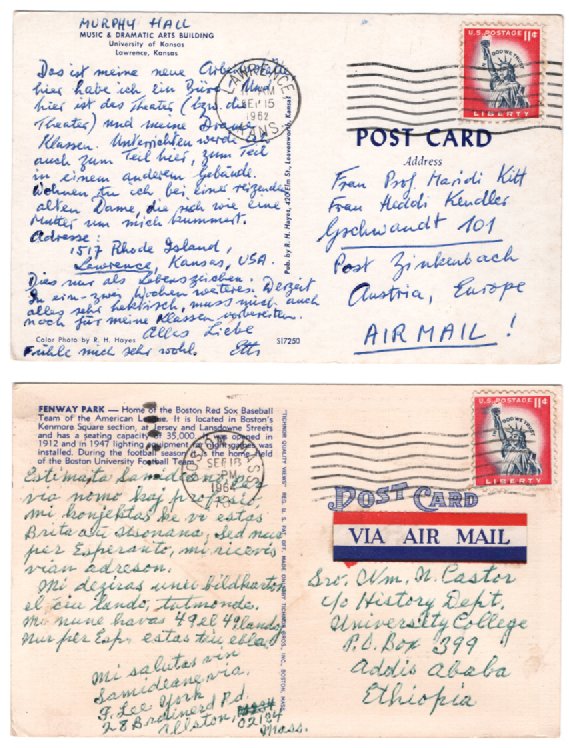 |
|
Send note to Staff
|
| Edited by John Becker - 11/26/2023 10:36 pm |
|
|
Pillar Of The Community
United States
4194 Posts |
|
|
No, it does not have to be a special airmail envelope with the red and blue border |
|
Send note to Staff
|
|
|
Valued Member
United States
103 Posts |
|
|
Pillar Of The Community
6366 Posts |
|
|
And a later example where Scott is silent on "solo" use: Let's look at Scott C81. Two solo uses, but different rate/time periods 21 cents was the international letter rate per half ounce to most of the world July 1, 1971 to March 1, 1974, and 21 cents was the international postcard rate to most of the world Jan 3, 1976 to Dec 31, 1980. 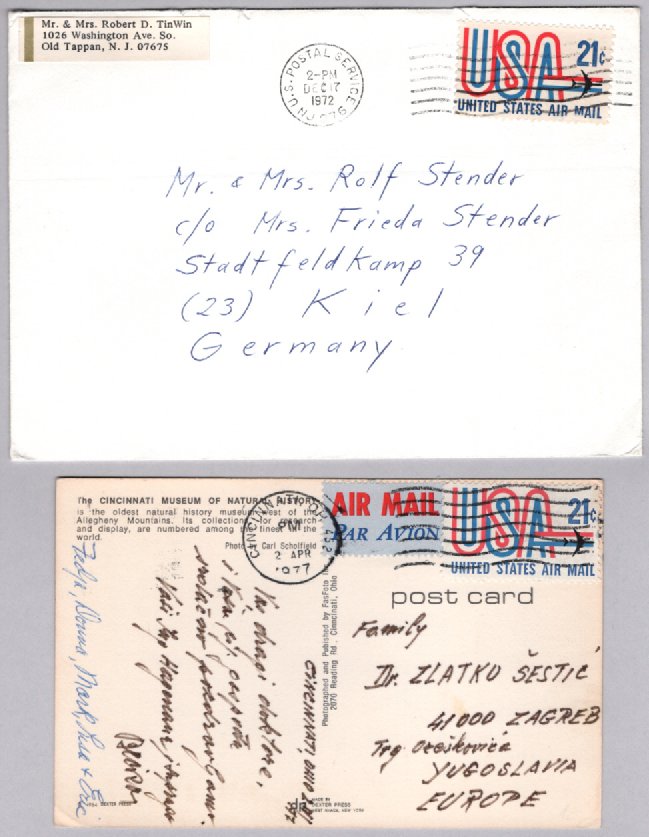 Solo uses get a certain amount of hype. I would encourage every postal history collector to look beyond the solo hype. Many rates/destinations can't be paid with a solo franking and to not overlook combinations. Here is a C81 cover which was overweight and was returned to the sender for a second half-ounce payment as detailed by the nice auxiliary marking. I like it more than the solo use above. 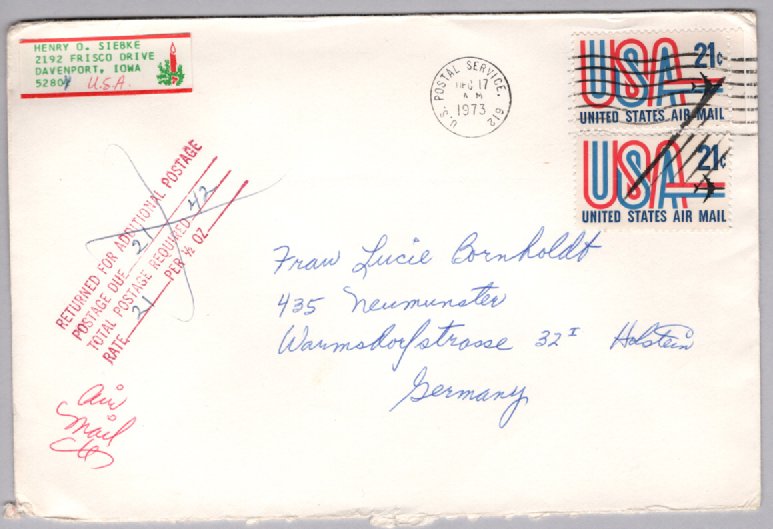 Thus the impossibility for Scott to value every possible combination. They can provide only a general starting point. |
|
Send note to Staff
|
|
|
Valued Member
United States
103 Posts |
|
|
Quote:
Solo uses get a certain amount of hype. I would encourage every postal history collector to look beyond the solo hype. I realize that there are some stamps which are hard to find solo, so it can be a challenge to locate them, but I understand what you are saying about going beyond the solo hype. Quote:
Many rates/destinations can't be paid with a solo franking and to not overlook combinations. Sure, I personally like looking at covers which have a couple stamps on them to make the rate. Quote:
Here is a C81 cover which was overweight and was returned to the sender for a second half-ounce payment as detailed by the nice auxiliary marking. I like it more than the solo use above. I agree, this cover is more interesting because it has a little bit more of a story to it. Overall, a nice, clean, organized looking cover. |
|
Send note to Staff
|
|
|
Pillar Of The Community
United States
4474 Posts |
|
|
Quote:
Looking at stamp pricing in the Scott Specialized Catalog, what does it mean when it gives a value for a particular stamp that has "single franking on airmail cover"? It means just one stamp, paying the correct airmail rate exactly on an envelope of any size which is marked for airmail service. As you do not mention what stamp or period your listing is from, I will add that airmail service would include if an airmail letter was forwarded by train (RPO) for some leg(s) or the entire route if quicker. Their would be an endorsement to that fact on the envelope applied by a postal worker. In the cases where the airmail rate is to a foreign destination you prefer proof it actually went there as shown my transit or received markings. It does not include a FDC marked airmail for which no service was given. Additionally in the cases where the FDC airmail rate is to a foreign destination you need proof it actually went there, just an address will not do, transit or receiving marking are needed If the listing is for a post card use, the listing will say post card if or when the post card airmail rate was different from the letter rate. |
|
Send note to Staff
|
|
|
Pillar Of The Community
United States
4474 Posts |
|
|
As you seem to be exploring the Scott catalog (good for you  ). I will add that with airmail postal cards, those listing are for the card without additional stamps and used during the correct rate period. That is also true for domestic use postal cards. This is called generally, "in period" use. In philately "in period" can range from one day to decades depending upon the stamp in question. |
|
Send note to Staff
|
|
|
Valued Member
United States
103 Posts |
|
|
Quote:
It means just one stamp, paying the correct airmail rate exactly on an envelope of any size which is marked for airmail service. As you do not mention what stamp or period your listing is from, I just happened to be looking at the Prexie series, and the 7 cent stamp which would have paid the airmail rate at the time, which I believe was 6 cents. Actually I failed to quote the catalog completely, it should have included the word "domestic". Thanks for the information! |
|
Send note to Staff
|
|
|
Pillar Of The Community
6366 Posts |
|
|
Thanks! Always best to talk specifics rather than generalities. The domestic airmail rate was 7 cents/ounce from Aug 1, 1958 to Jan 6, 1963. By the time this rate went into effect, the 7 cent prexie would have been almost replaced by the 7 cent Woodrow Wilson stamp from the Liberty Series issued 2.5 years earlier on Jan 10, 1956. Thus the scarcity of late use of the 7 cent prexie for anything. And the importance of obtaining copies of the Beecher/Wawrukiewicz domestic and international rate books if you want to dig a bit deeper into rates.. Add: I will chance running off onto a tangent of the 7 cent Wilson from the Liberty Series. Scott lists simply a value of $1 on cover. Yet would these 3 solo uses be priced the same by a dealer? I doubt it. Domestic airmail rate of Aug 1, 1958 to Jan 6, 1963. Business reply mail, 5 cent domestic letter rate of Jan 7, 1963 to Jan 6, 1968 + 2 cents BRM fee. International surface rate postcard, rate of July 1, 1961 to April 30, 1967. 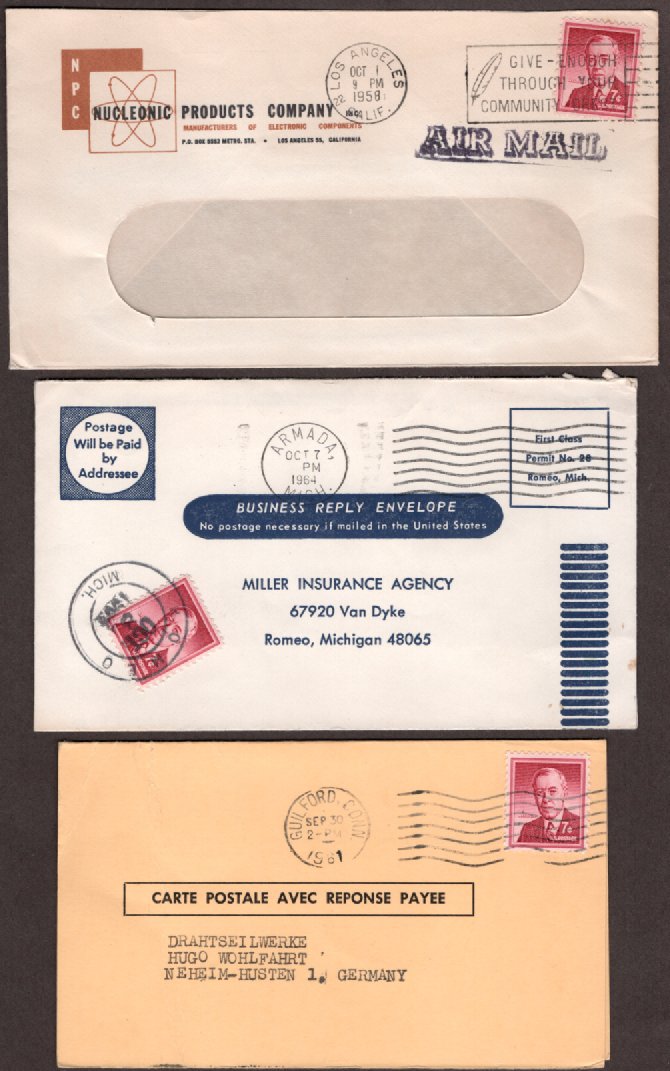 |
|
Send note to Staff
|
| Edited by John Becker - 11/27/2023 8:45 pm |
|
|
Pillar Of The Community
United States
4474 Posts |
|
|
Just to add to what John Becker was talking about, above he showed a number of 11 cent Liberty stamps as solo usage on international airmail post cards. The same international airmail rate paid by an 11 Presidential prior to the release of the Liberty 11 cent and after the rate changed to 11 cents is catalog listed as $150. The same 11 cent used to Europe paying the 3 cent and 8 cent domestic airmail surcharge is $1150. That rate was in effect when the 11 cent was first issue and thus there are FDC of the 11 cent Prexie going to Europe and are just as rare any any other date. But for the FDC, anyone can write an address on the envelope years after it was FD cancelled and returned unaddressed. It was that example I was thinking about when I posted above that such an example required routing and or receiving marking to prove transit abroad. Like wise the 3 ounce UPU surface rate was 11 cents and those FD usages must show proof of transit to claim the solo catalog value for that usage. It is priced between the first two examples.
May I suggest you review the prices of usages of the Prexie series. Doing so will show many different ratings for solo usages as well as a few very specific combination usages. The "solo mania" was created by the Prexie collectors trying to find exactly paid examples with a solo stamp of each Prexie denomination issued. Now it has spread to other collecting periods, for good or for bad. |
|
Send note to Staff
|
|
|
Pillar Of The Community
United States
4194 Posts |
|
|
"I just happened to be looking at the Prexie series, and the 7 cent stamp which would have paid the airmail rate at the time, which I believe was 6 cents"
Using a 7c to pay a 6c rate is a "convenience" overpayment and doesn't really qualify as a proper solo usage. |
|
Send note to Staff
|
|
|
Valued Member
United States
103 Posts |
|
|
Quote:
Using a 7c to pay a 6c rate is a "convenience" overpayment and doesn't really qualify as a proper solo usage. Oh ok, I got it. Thanks! |
|
Send note to Staff
|
|
|
Valued Member
United States
103 Posts |
|
|
Quote:
And the importance of obtaining copies of the Beecher/Wawrukiewicz domestic and international rate books if you want to dig a bit deeper into rates.. I have a copy coming in the mail right now. |
|
Send note to Staff
|
|
|
Replies: 101 / Views: 5,772 |
|




 Posted 11/26/2023 8:42 pm


