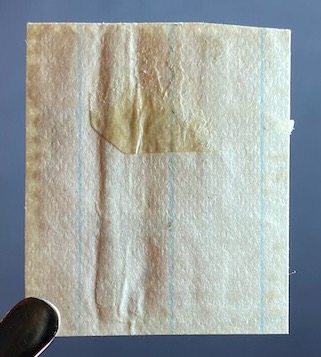
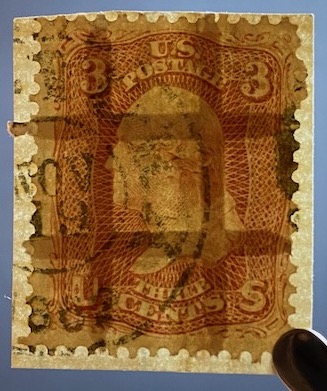
I was breaking down a collection and ran across a #65 on paper that looked a little lumpy and creased so I was about to throw it away when I saw a note next to the stamp that said "Leeds Lattice". I held the stamp up to a light and saw a tic-tac-toe pattern between the stamp and the paper it was adhered to. Now I am intrigued.

A Google search led me to a Frajola exhibit on Patent Envelopes,
https://www.rfrajola.com/patent/patent.htmand a USPCS article from 2007
http://chronicle.uspcs.org/pdf/Chro...14/12891.pdfand updated in 2012.
https://rockymountainphilateliclibr...ibblings.pdfIn 1861, Lewis Leeds applied for a patent for an envelope with a notched-out window where the stamp would go. The idea was, when you attach the stamp to the envelope over this window hole, the stamp also attaches to the document inside the envelope. When the envelope is opened and the contents removed, the lattice breaks away from the envelope and the stamp remains attached to the document so that the document is essentially notarized with the date of mailing, and the remains of the envelope can be discarded.

(Picture of unused cover from the 2012 article linked earlier)
It turned out to be an epic failure for a couple of reasons. First, the receiver is given no instructions how to properly open the envelope to cleanly release the stamp, so most often the result was probably a torn document and torn up cover.
Secondly, new USPS instructions at the time requested clerks to obliterate the stamp with a killer cancel and apply the date stamp postmark elsewhere on the cover so that the date stamp is readable. This results in a document that has a stamp attached with maybe a nice fancy cancel but no date stamp which defeated the entire purpose of the idea.
Intact copies of the Leeds & Franklin Lattice Window Patent Envelope are apparently quite scarce. Frajola estimates fewer than 25 exist. Siegel PowerSearch locates about a dozen covers sold in the past 30 years (including duplication) and two singles. The covers sell on the order of $1000 plus or minus depending on condition, and singles about $100.
Most of time for me buying collections results in disappointment with some of the better stamps having hidden faults. It is nice when a collection produces an unexpected discovery.





 Posted 12/31/2023 12:21 am


