Stamp Community Family of Web Sites
Thousands of stamps, consistently graded, competitively priced and hundreds of in-depth blog posts to read


Stamp Community Forum
 
Username:
Password:
Save Password
Forgot your Password?

This page may contain links that result in small commissions to keep this free site up and running.

Welcome Guest! Registering and/or logging in will remove the anchor (bottom) ads. It's Free!

1955 UK 3-P Strip, Watermark?

 
To participate in the forum you must log in or register.
Author Previous TopicReplies: 13 / Views: 1,321Next Topic  
Pillar Of The Community
543 Posts
Posted 01/16/2024   5:13 pm  Show Profile Bookmark this topic Add Murasama to your friends list Get a Link to this Message
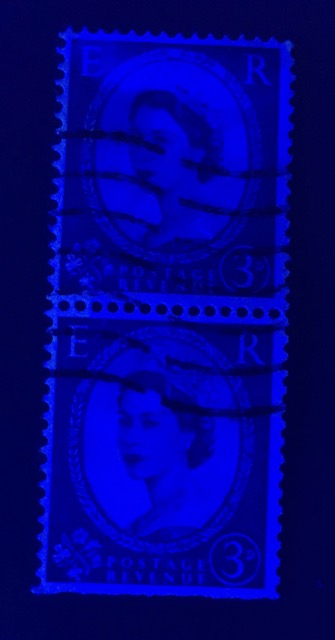
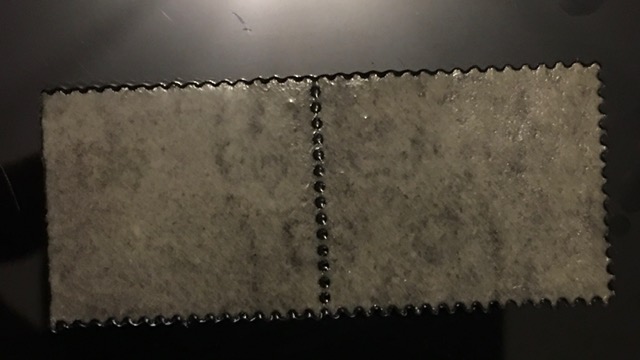
I would like to show you this British couple stamps from 1955, which reacts to UV Light, I am not able to clearly distinguish the watermark, in the rest of my stamps UK 3p 1955 I do see the crowns of the brand perfectly, but in this one I am not able to distinguish it well...could be in vertical orientation but I'm not sure...


Send note to Staff

Pillar Of The Community
United Kingdom
8577 Posts
Posted 01/16/2024   5:21 pm  Show Profile Check GeoffHa's eBay Listings Bookmark this reply Add GeoffHa to your friends list  Get a Link to this Reply
Sideways, from a booklet, rather than vertical, I think.
Send note to Staff  Go to Top of Page
Pillar Of The Community
Netherlands
6526 Posts
Posted 01/16/2024   5:26 pm  Show Profile Bookmark this reply Add NSK to your friends list  Get a Link to this Reply
What you are seeing is a lack of fluorescence.

Edit: the spot at the top is contamination.

Were you using a shortwave or longwave UV lamp?

The stamp has the 'Multiple Crowns' watermark sideways. These come from the sideways-delivery coils.
If they do not have two phosphor bars, they are Stanley Gibbons nr. S70d (specialised)/ 575a (Concise) (24 October 1958). You need a shortwave lamp to detect the phosphor bars. I think it has phosphor bars. There are a couple of varieties of those.

Phosphor bars bring booklet stamps into scope.
Send note to Staff  Go to Top of Page
Edited by NSK - 01/16/2024 5:30 pm
Pillar Of The Community
Australia
3282 Posts
Posted 01/16/2024   5:27 pm  Show Profile Bookmark this reply Add Bobby De La Rue to your friends list  Get a Link to this Reply
Is the rough separation at the base an indication of a booklet stamp?
Send note to Staff  Go to Top of Page
Pillar Of The Community
Netherlands
6526 Posts
Posted 01/16/2024   5:32 pm  Show Profile Bookmark this reply Add NSK to your friends list  Get a Link to this Reply
It is possible, but it also could be due to the cutting from a coil.
Send note to Staff  Go to Top of Page
Pillar Of The Community
Australia
3282 Posts
Posted 01/16/2024   5:34 pm  Show Profile Bookmark this reply Add Bobby De La Rue to your friends list  Get a Link to this Reply
Thanks NSK - always something to learn!
Send note to Staff  Go to Top of Page
Pillar Of The Community
543 Posts
Posted 01/16/2024   6:12 pm  Show Profile Bookmark this reply Add Murasama to your friends list  Get a Link to this Reply
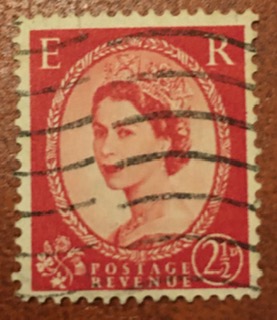
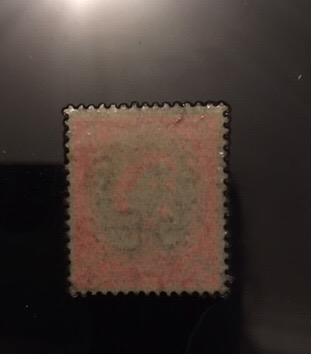
Thanks for your help!! I'll investigate those lines...I honestly don't know what type of UV it is, it's a large fluorescent tube...let's see if I can find out. Right now I was watching this other one from the same series, with this other watermark, it doesn't look like the one with crowns, but an E...


Send note to Staff  Go to Top of Page
Pillar Of The Community
Netherlands
6526 Posts
Posted 01/17/2024   12:41 am  Show Profile Bookmark this reply Add NSK to your friends list  Get a Link to this Reply

Quote:
The stamp has the 'Multiple Crowns' watermark sideways. These come from the sideways-delivery coils.
If they do not have two phosphor bars, they are Stanley Gibbons nr. S70d (specialised)/ 575a (Concise) (24 October 1958).


I do not know what I was thinking. These can only be booklet stamps. As I wrote 'sideways delivery.' The pair should have been horizontal. Being vertical, it leaves only a booklet as a source.
Send note to Staff  Go to Top of Page
Pillar Of The Community
Netherlands
6526 Posts
Posted 01/17/2024   02:22 am  Show Profile Bookmark this reply Add NSK to your friends list  Get a Link to this Reply

Quote:
Thanks for your help!! I'll investigate those lines...I honestly don't know what type of UV it is, it's a large fluorescent tube...let's see if I can find out. Right now I was watching this other one from the same series, with this other watermark, it doesn't look like the one with crowns, but an E...


1. The 'large fluorescent tube' sounds like it is a longwave UV lamp. That is good for detecting fluorescence on British stamps. It can detect phosphor bars from the 1990s onwards. However, for the earlier 'Machins' and 'Wildings,' you should use a shortwave lamp to detect phosphor. The phosphor bars come in two widths and three fluorescent colours.

2. This is called 'St. Edward's Crown' watermark. It has the Crown of St. Edward over the cipher 'E2R.' Without the royal cipher of Queen Elizabeth II, it is called '(Multiple) Crowns' watermark. The cipher was dropped in the late 1950s, when regional stamp were first issued. Since Elizabeth Tudor never was Queen of Scotland, the Scots were not too happy to have a watermark on their stamps that referred to the first monarch of Scotland named Elizabeth be called Elizabeth II.
Send note to Staff  Go to Top of Page
Edited by NSK - 01/17/2024 02:26 am
Pillar Of The Community
543 Posts
Posted 01/17/2024   04:20 am  Show Profile Bookmark this reply Add Murasama to your friends list  Get a Link to this Reply
Thank you so much! I must look at this calmly...how should I classify them? By phosphorescence and different watermarks? Is each brand from a different series than the others?
Send note to Staff  Go to Top of Page
Pillar Of The Community
Netherlands
6526 Posts
Posted 01/17/2024   04:37 am  Show Profile Bookmark this reply Add NSK to your friends list  Get a Link to this Reply

Quote:
brand


Or you translating from another language that uses something like 'marka' or 'Marke'? In English, these are (postage) stamps.


Quote:
Is each brand from a different series than the others?


Some of us are quite mad an collect all types. (Guilty as charged!)

Stanley Gibbons Concise will list

Watermark
- With / or without graphite lines
- With graphite lines and phosphor bars
- With phosphor bars only
As separate sets.

The 'Wildings' know many variations. These are listed in the Stanley Gibbons GB Specialised and organised by value and then, chronologically, by variety. And for Each variety, you can also find whether from sheets, stamp books, or coils and with different watermark orientations.

Most basically, they are listed by watermark
1. Tudor crown (a simpler, flatter crown than on your stamp that also has the E2R cipher),
2. St. Edward's Crown (the correct crown for Elizabeth Windsor's reign, as on your stamp and with the E2R cipher),
3. Crowns (like St. Edward's Crown, but without the E2R cipher).

Some, not all watermarks have graphite lines on the back (below the gum) these are black lines that run from top to bottom.
These graphite lines can also have phosphor bars on the front.
The 'Crowns' watermark stamps also exist with phosphor bars on the front, but these never have the graphite lines on the back.
These 'Crowns Phosphor' come in three fluorescent shades
1. green
2. blue
3. violet.

The ones with violet phosphor bars come from phosphor bars with a width of either 8, or 9 1/2 mm. that were applied over adjoining stamps. They can be identified as singles as the latter have a shorter distance between the side bars. Some stamps have just one bar, but those always can be assigned to the same types.

So, take your pick:
You can collect them as 'Wildings', by watermark, by watermark with graphite lines, graphite lines and phophor bars, and phosphor bars, or as the latter but with phosphor types and widths. In the latter case, reserve a room at the local madhouse: there are hundreds.
Send note to Staff  Go to Top of Page
Edited by NSK - 01/17/2024 04:45 am
Valued Member
United Kingdom
439 Posts
Posted 01/17/2024   10:52 pm  Show Profile Bookmark this reply Add Noocassel to your friends list  Get a Link to this Reply
Murusama, get a Stanley Gibbons great Britain concise, catalogue unless you are bothered about nominal vlue a used one will do.I have the SG specialist catalogues but I find them way to complicated for most purposes. There is not much concise about the concise one. It shows the watermarks, perf details issue date etc. When trying to distinguish between a Tudor crown watermark, and a ST Edward crown watermark note the top of the Tudor crown is one curve, a St Edward crown dips in the middle. I always think of a Tudor crown as looking like a cartoon of a meat pie. finding the watermark on a Wilding stamp is always difficult sometimes you can only see a tiny bit of the watermark. by the way the original Wildings of the 1950s and 60s are in values denoted by d from the pre decimal era of shillings and pence. The d was still an abbreviation for penny. only after 1971 when decimal currency arrived was a penny shown as P. Until recently the old pennys were callled pennys and the new decimal Penny was referred to as a P pronounced Pee. Old pennys were 240 to a pound where new pennys are a 100 to the same pound.
Send note to Staff  Go to Top of Page
Pillar Of The Community
543 Posts
Posted 01/19/2024   2:50 pm  Show Profile Bookmark this reply Add Murasama to your friends list  Get a Link to this Reply
Finally I have organized them in this way following your advice
1952 watermark letters with Tudor crown
1955 watermark letters with Edwardian crown
1958 watermark of Eduardo crowns, non-phosphorescent
1960 watermark of Eduardo crowns, phosphorescent
I have also pointed out those with the crooked or inverted mark. I do not have any with a line of graphite. I still don't have both types of UV light, but I hope to get them soon.
I am really very grateful for everything I am learning with you, I am enjoying my stamps more than ever...
Send note to Staff  Go to Top of Page
Edited by Murasama - 01/19/2024 2:51 pm
Pillar Of The Community
Netherlands
6526 Posts
Posted 01/19/2024   3:02 pm  Show Profile Bookmark this reply Add NSK to your friends list  Get a Link to this Reply
That sounds good.

One small thing:

Quote:
1955 watermark letters with Edwardian crown
1958 watermark of Eduardo crowns, non-phosphorescent
1960 watermark of Eduardo crowns, phosphorescent


'Edwardian' is often used to refer to the reign of a King Edward, most commonly, King Edward VII. The crown in the watermark is that of Saint Edward, called 'Saint-Edward's Crown.' Saint Edward, or King Edward the Confessor wore the crown in the 11th century. It was destroyed and a similar crown was made in the seventeenth century. It is one of the Crown Jewels.
Send note to Staff  Go to Top of Page
  Previous TopicReplies: 13 / Views: 1,321Next Topic  
 
To participate in the forum you must log in or register.

Go to Top of Page

Disclaimer: While a tremendous amount of effort goes into ensuring the accuracy of the information contained in this site, Stamp Community assumes no liability for errors. Copyright 2005 - 2026 Stamp Community Family - All rights reserved worldwide. Use of any images or content on this website without prior written permission of Stamp Community or the original lender is strictly prohibited.
Privacy Policy / Terms of Use    Advertise Here
Stamp Community Forum © 2007 - 2026 Stamp Community Forums
It took 0.19 seconds to lick this stamp. Powered By: Snitz Forums 2000 Version 3.4.05