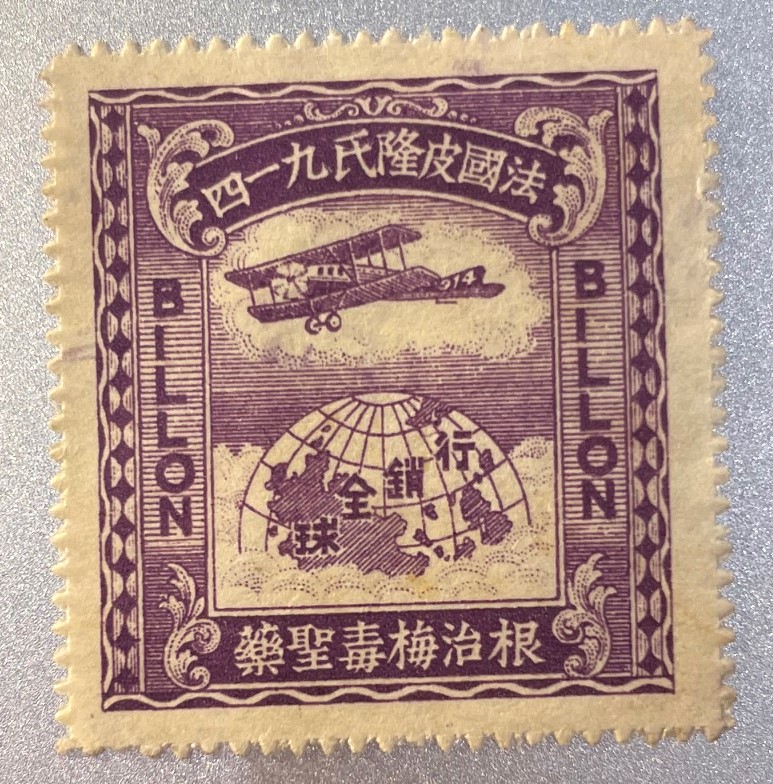
There are eight Chinese characters at the top. Read from right to left:
First 2 characters -->
FranceNext 3 characters -->
BillonLast 3 characters -->
914There are six Chinese characters at the bottom. Again, reading from right to left, it loosely translates to '
Miracle drug for treatment of syphilis'.
Putting all together and googling leads one here -->
https://www.tandfonline.com/doi/ful...-009-9083-8. Key extracts (I hope I did not infringe on any copyright laws; emphasis are mine):
Founded in 1895, Rhône-Poulenc was present in Vietnam as early as the turn of the 1910s, at the time when Fourneau's laboratory at the Institut Pasteur was just starting up and compound 606 undergoing tests in different clinical contexts and countries. Indeed, the firm was among the first companies to manufacture 606 under different commercial names, including Arsénobenzol Billon (named after another of the firm's close collaborators, Francis Billon), used for the first time in Vietnam during an epidemic of recurrent fever in Tonkin in 1912.... ...
1.1.2 The First "Miracle Drugs"
By the turn of the twentieth century, the pharmaceutical industry, in collaboration with the chemical industry and early medical research—especially bacteriological—laboratories, was introducing the first effective synthetic medicines against various infectious diseases, thus ushering in the era of chemotherapy. The beginning of this era is generally associated with the discovery of "606" (an arsenical compound or arsenobenzol that was first commercialised under the trade name Salvarsan by Hoechst) by the German physician and bacteriologist Paul Ehrlich in 1909–1910. Identified as the first "magic bullet" (CitationParascandola 1997:78–79), this compound was soon found to have a curative effect on diseases caused by trepanoma parasites (such as syphilis) and trypanosomes (sleeping sickness). In 1912, compound 914 (Néosalvarsan) confirmed the value of arsenobenzols.
Additional information from Wikipedia (
https://en.wikipedia.org/wiki/Magic..._(medicine))The normal treatment procedure of syphilis at the time involved two to four years routine injection with mercury. Ehrlich, after receiving this information, performed experiments on human patients with the same success. After convincing clinical trials, the compound number 606 was given the trade name "Salvarsan", a portmanteau for "saving arsenic". Salvarsan was commercially introduced in 1910, and in 1913, a less toxic form, "Neosalvarsan" (Compound 914), was released in the market. These drugs became the principal treatments of syphilis until the arrival of penicillin and other novel antibiotics towards the middle of the 20th century.





 Posted 02/14/2024 4:14 pm