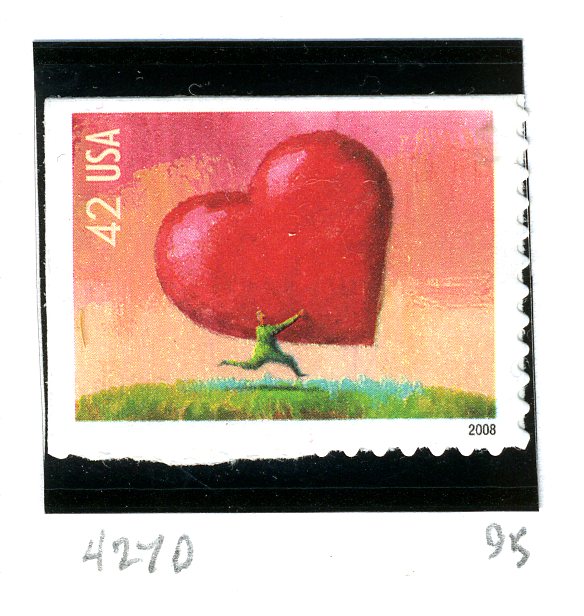
Scott 4270, 2008 US Love stamp, man lifting heart. A while back I obtained a beginner's stamp album that contained this cancelled 2008 US Love stamp. It appears to be missing the red ink, which was the main ink color on this stamp.
Is this a known error? I have uploaded my MNH copy of this stamp issue. The stamp in this posting was in an album of only 100-200 very common US stamps. It is unlikely that the original owner of the album was even aware that there was a branch of the hobby that included errors and oddities. The man and the green ground in the stamp do not appear to have artificially bleached or lightened.
Second Edit: I have collected stamps since the early 1950s and until last month my collection activities had been on hold for over 15 years. This is my first post on this forum.The comments received are welcomed and understood. I looked at the "missing red" ink stamp and the MNH stamp with both a 10X eye loop and an American Optical Spencer inspection microscope (40X I believe). There is no red ink residual anywhere on the "missing ink" stamp and the MNH stamp is densely covered with red ink. The green, blue and yellow inks are strong and about equal on both stamps. Commenters have suggested there is substantial fading accounting for the "missing red ink" condition. If that is so, why are the green, blue and yellow inks still strong on both stamps? Is there evidence that the modern red inks used in stamp printing are subject to fading, but the other colors resist fading?
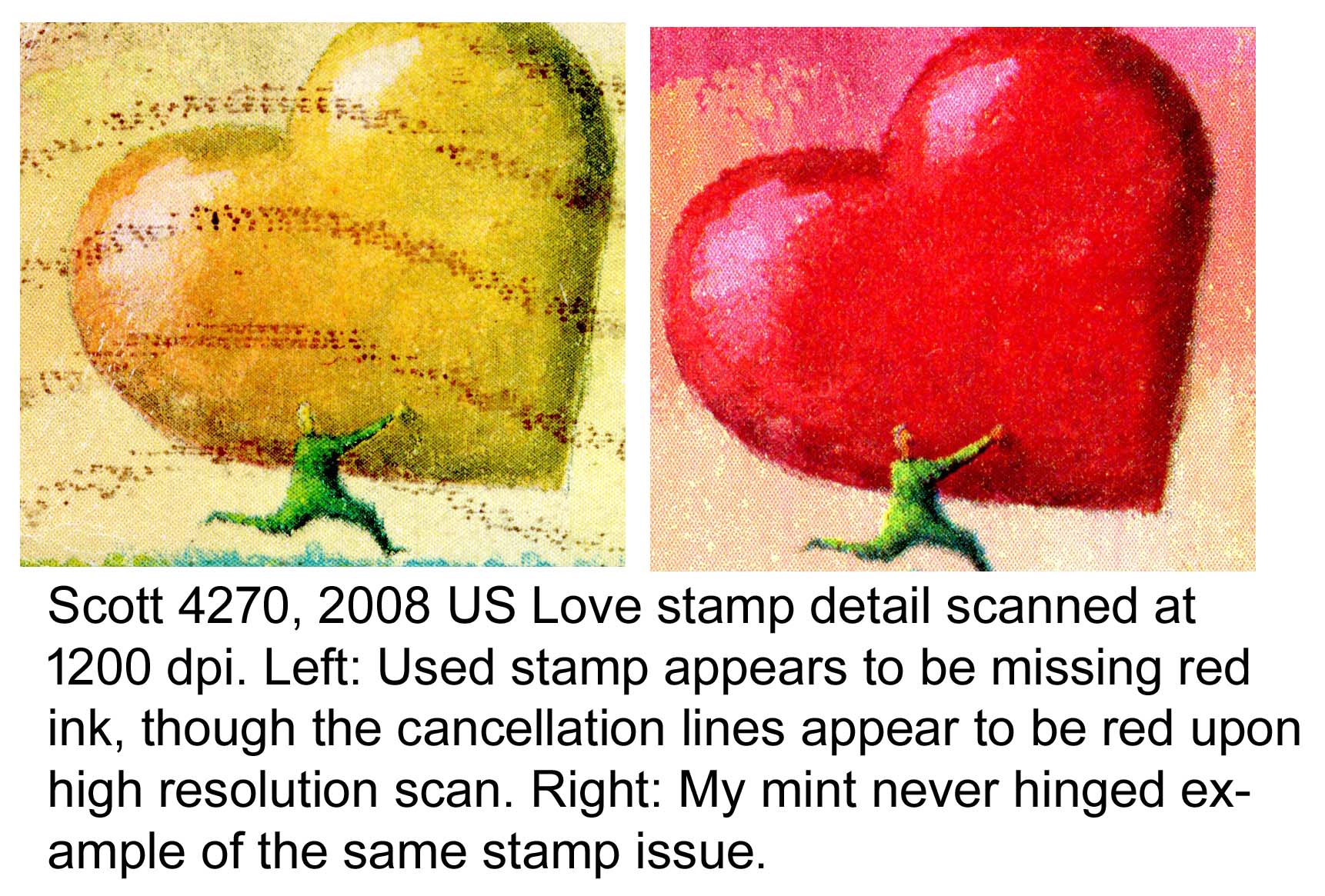
Attached is a composite detail scan at 1200 dpi of the man and heart area of both stamps. Some commenters suggested the missing red ink stamp may have been chemically treated. If so, why are the non red colors still about the same strength as the MNH stamp? Has the stamp collecting community determined their are reagents, i.e, bleaches, that are color selective?
Another interesting artifact is that in the high resolution 1200 dpi composite scan from the Epson scanner the wavy cancellation marks are red in color, while there is no red in any other area on the stamp. Yet, when looked at that stamp with the 10X eye loop or the 40X microscope with a halogen light source the cancellation lines are black with no hint of red.






 Posted 03/19/2024 12:40 pm