We seem to have lost out original poster. I may be wrong, but I get a sense the replies here come mostly from stamp collector standpoint rather than postal history perspective. Let me go out on a limb and to try to describe a continuum from large to small...
Entire: exactly what it says, the whole mailpiece ... whether envelope, postcard, postal stationery, etc.
Reduced: a fairly general term often seen describing a mostly intact cover perhaps with a rough edge trimmed off to square it up. Sometimes it happens naturally in commerce. Consider, in the era of mailing utility bill payments, that much business mail was run through an automatic opener which trimmed a very small strip off the top and sometimes into the stamp.
Back flap absent: a specific example of "reduced" of approximately the same amount of paper loss. Can easily happen with unsealed 3rd class mail run through an opener.
Front: typically the front panel of an envelope. I have seen a lot of these on WWII-era metered mail where the front panel was saved as a collectible and the back side sent to the paper recycling drives for the war effort (as the explanation I have heard for these). Stampless folded letters often have had their contents removed leaving only the outer address panel. This is also about where large pieces of parcel wrappings tend to fall along the continuum.
Clippings: often 3x5 or 2x4 to save the entire cancel with the stamp, or frequently with metered envelopes to save a strip across the entire top of the envelope showing the meter imprint and the return address. These clippings have fallen out of favor with recent postal historians who want entires, although they do provide valuable eary/late date of use information.
On piece: which might include "clippings" above but typically are stamps cut or torn much closer than 2x4, often removing a significant portion of the cancel. Stamps on piece in large enough groups to be treated as a "lot" (or weighed, if you wish), would be called "on paper kiloware". This is also where most neatly-cut postal stationery of embossed envelope "cut squares" would fall, or a "full corner" if the clipping includes the back flap portion of the stationery.
Off-paper: removed from the envelope backing paper. And in bulk would be "off paper kiloware".
And specific individual items may take a more detailed description ... where an iliustration is more valuable than words. Along that tangent, crash mail is one example. I was amused many years ago by an auction catalog description as "among the best Hindenburg crash covers known", yet does one want one burned the most or least? With a certain franking or routing? Etc.
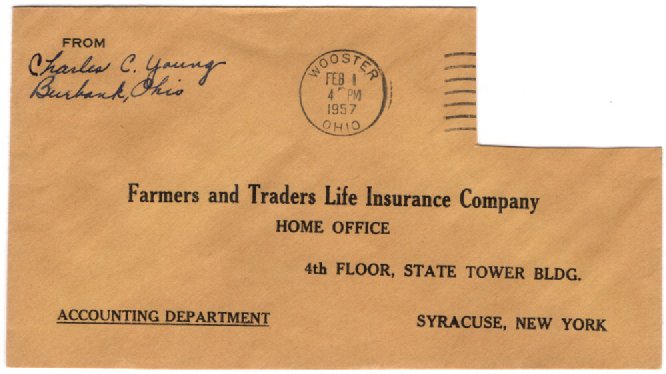
And then how would this be described? No stamp, but still possibly useful to the postal historian to document a date of use of Wooster Ohio's Universal Model-G machine, perhaps early or late use? (And slit open along the bottem!)





 Posted 03/31/2024 8:35 pm


