| Author |
 Replies: 17 / Views: 2,443 Replies: 17 / Views: 2,443 |
|
Valued Member
United States
12 Posts |
|
|
|
I apologize for the long post title.
I am unable to find a proper classification for stamps that have been cut out of whatever they were originally attached to, but were never removed from the backing material they were adhered to during the original mailing process.
The only relevant term in my philately book says "cut-out", but that definition is only for printed and/or embossed stamps on pre-paid mailing material, that have been removed ( cut-out ) from whatever they where part of .
|
|
Send note to Staff
|
|
|
|
|
Pillar Of The Community
Canada
528 Posts |
|
|
Here is a statement that 'PMStamp' provided in another topic today: ( https://goscf.com/t/86571 ) "If you have the complete envelope it is known as an "Entire" and if you only have the corner image it is known as an "Envelope Cut Square". These are the terms you need to know if you go to your library and find the Scott USA Specialized catalog previously mentioned." |
Send note to Staff 
|
| Edited by stamporator - 03/29/2024 5:35 pm |
|
|
Valued Member
United States
192 Posts |
|
|
Quote:
Stamps that have been cut out of whatever they were originally attached to, but were never removed from the backing material they were adhered to during the original mailing process. I think the term you are looking for is "on-paper" |
|
Send note to Staff
|
| Edited by Chesham85 - 03/29/2024 5:56 pm |
|
|
Pillar Of The Community
United Kingdom
8626 Posts |
|
|
Or "on piece", although that may be thought to involve more sophisticated cutting, rather than simply tearing the corner from an envelope. |
|
Send note to Staff
|
|
|
Pillar Of The Community
United States
8956 Posts |
|
|
I think both of the above terms are correct. "On paper" is a general term mostly used to distinguish kiloware, whereas "on piece" is giving the idea of neatly cut with scissors, maybe including the cancel
Peter |
|
Send note to Staff
|
|
|
Pillar Of The Community
Australia
3295 Posts |
|
|
Pillar Of The Community
United States
506 Posts |
|
|
Valued Member
Canada
304 Posts |
|
|
Stamporator, thank you for referencing me, but my terminology was in reference to "embossed stamps on envelopes" not standard affixed stamps that have been cut out from an envelope. The previously mentioned terms of on paper or on piece are appropriate for this poster's question. |
|
Send note to Staff
|
|
|
Pillar Of The Community
Australia
3295 Posts |
|
|
For postal stationery, the term I've seen the most is cut squares, but I can live with mutilated covers  |
|
Send note to Staff
|
|
|
Pillar Of The Community
United States
898 Posts |
|
|
Pillar Of The Community

United States
943 Posts |
|
|
Valued Member
139 Posts |
|
|
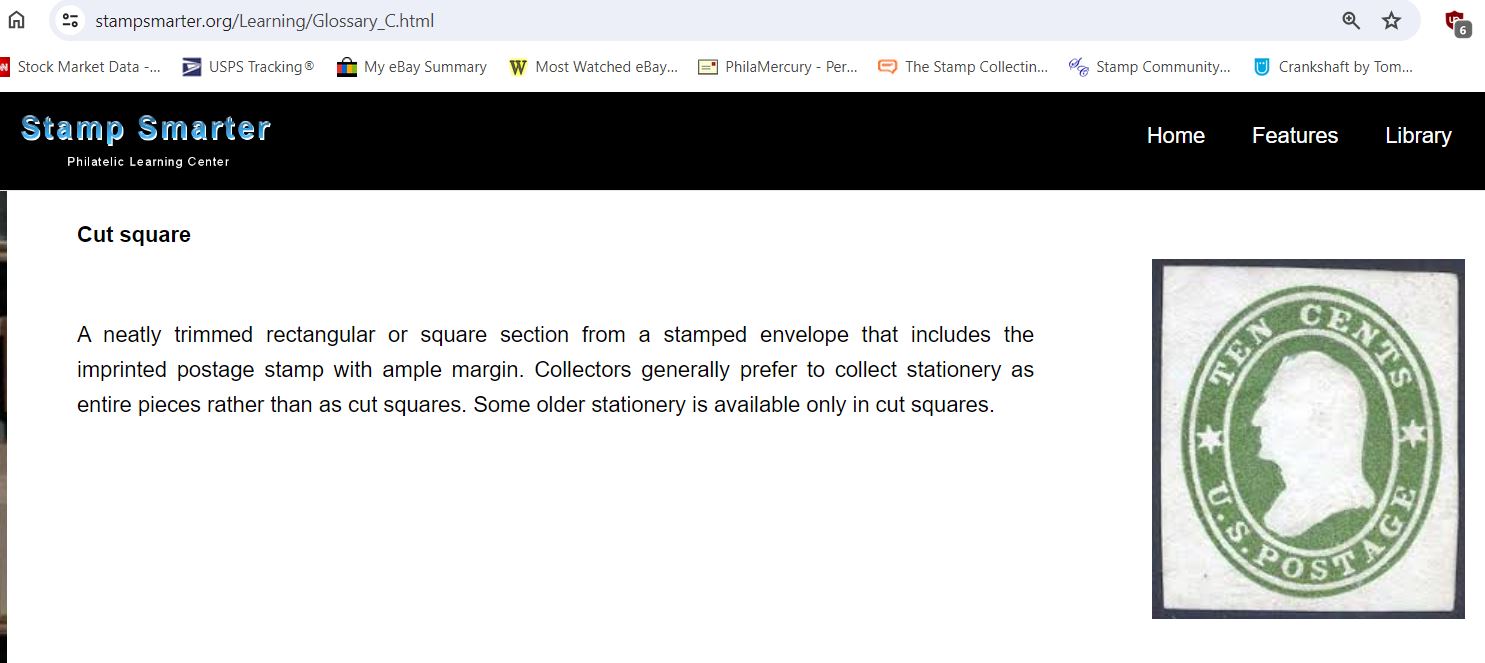
A cut square refers to a cut-out envelope indicium on the front paper of an envelope. A cut square can be cut neatly or be sloppily miscut (butchered) or be cut too close. It can also refer to a cutout wrapper indicium.
A cut corner refers to a cut-out envelope indicium cut so that both the front paper and the back paper are present, as are the top and (usually) right folded edges. The cuts at bottom and (usually) left are made so the indicium is centered, or the corner can be cut even wider. Miscuttings exist.
The modern trend of decades-long standing is for envelopes and wrappers to be collected as entires.
Postal cards today are always collected as entires, but in the past some collectors have cut out the indicia. Nearly all postal card cutouts have minimal or no value today.
|
|
Send note to Staff
|
|
|
Pillar Of The Community
United States
797 Posts |
|
|
just my 2c: embossed envelope or postal stationary would be 'entire' for a complete envelope; 'cut square' for just the postage cut from the envelope. Applied postage : 'on piece' would be an applied stamp to an envelope totally intact, 'on-paper' would be the stamp cut from the envelope (or torn) needing to be soaked or if appropriate cut to retain the cancel to identify origin city & date. (unless the entire envelope is intact, I would classify on-paper as any stamp with remnant envelope). (btw, 2c is not worth as much as when I began collecting) |
|
Send note to Staff
|
|
|
Pillar Of The Community
United Kingdom
8626 Posts |
|
|
eligies: a stamp with totally intact envelope would be "on cover". "On piece", as the words say, means a section of the cover, card etc. |
|
Send note to Staff
|
|
|
Pillar Of The Community
United States
797 Posts |
|
|
oops. I stand humbly corrected. (thank you GeoffHa) yeah, I knew that. My mind was ahead of my fingers (which never catch-up). So now it's my 1c worth. I think I was also somewhat confused (not hard to do these days) by the interchangeable use of the terms on piece & on cover, especially on social media. On cover, WHOLE envelope, on piece, PART (piece) of cover (sum of pieces making whole). I just love this site & interaction. BTW: anyone going to Northeast Show Boxborough MA 4/12-4/14??? I'm planning 4/12 & maybe 4/14. |
|
Send note to Staff
|
|
|
Pillar Of The Community
United States
1126 Posts |
|
|
And halfway between "on piece" and "on cover" is a "front" which is the whole front of the cover but without the back side of the envelope and the backflap. This could be called on-piece but that usually means a smaller cutout including just the stamp and maybe the cancellation or possibly part of the address(es) but not the entire front side of the cover.
From Linn's glossary:
Front: The front of a cover with most or all of the back and side panels torn away or removed. Fronts, while desirable if they bear unusual or uncommon postal markings, are less desirable than an intact cover.
For completeness, you may also see the term "Reduced" when dealing with covers. This means it is a the complete envelope (front and back), but trimmed down on one or more sides, possibly cutting off part of the return address or other markings. Sometimes collectors would do this to cut off unsightly tears, or to fit a larger cover into their smaller album. A small slice off the edge to open the envelope is normal, but if significantly cut down, it should be mentioned.
|
|
Send note to Staff
|
|
|
Replies: 17 / Views: 2,443 |
|




 Posted 03/29/2024 5:27 pm