| Author |
 Replies: 11 / Views: 902 Replies: 11 / Views: 902 |
|
|
Pillar Of The Community
570 Posts |
|
|
|
|
Pillar Of The Community
570 Posts |
|
|
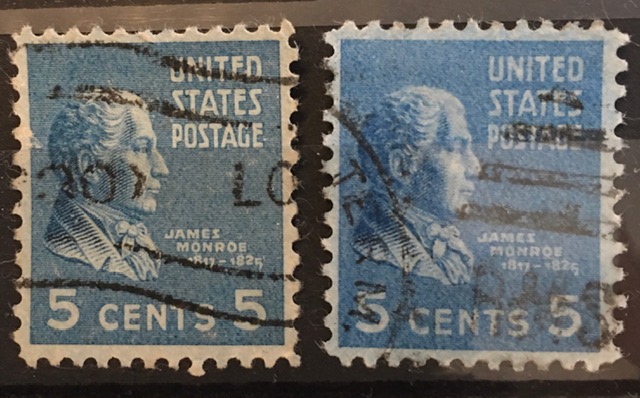
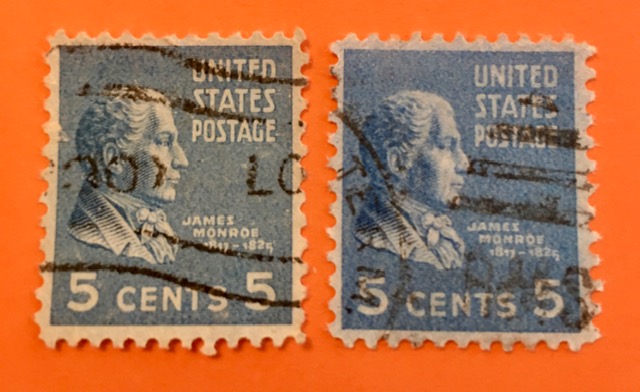
Another visible difference between the two stamps is found in the E of CENTS, clearly different...I don't know if this detail may have any importance. |
Send note to Staff 
|
|
|
Pillar Of The Community
United States
8956 Posts |
|
|
Murasama, two small items here.
Please use a neutral background for these pictures, like black. Orange is only used if you suspect blue paper.
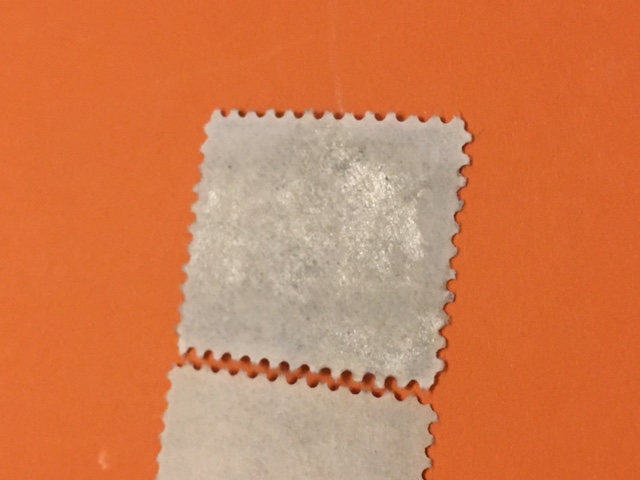
Second, your stamps are damaged. They are used stamps and probably changed color because of environmental influences or maybe from soaking. These are not different colors
Also, I see no difference in the E
Peter |
|
Send note to Staff
|
|
|
Pillar Of The Community
United States
4189 Posts |
|
|
The blue ink in the white areas/margins is just due to poor plate wiping. You will find this a lot on the various Prexie (Presidents) stamps.
typo fixed |
|
Send note to Staff
|
| Edited by eyeonwall - 03/30/2024 09:26 am |
|
|
Pillar Of The Community
6366 Posts |
|
|
Short answer: It appears you may have printings from two different time periods.
Long answer: The Prexie series was the workhorse definitive series for neary 2 decades. Roland Rustad's book "The Prexies" lists a dated progression of up to half a dozen shades for some of the Prexies. For the 5 cent Monroe he lists four shades: grayish blue, bright blue, blue, and light blue. He provides more detail than Scott, which lists only bright blue and light blue. Some of these differences were noticeable at the time. George Sloane specifically notes shade changes of the 1.5 cent in 1939, and 9 cent in 1943 in his "Sloane's Clolumn". The Prexies also see the introduction of electric eye plates and wartime production changes, which included some ink formulations. Plus whatever conditions these two stamps have encountered since being used. |
|
Send note to Staff
|
|
|
Pillar Of The Community
570 Posts |
|
|
I must stop buying stamps and buying catalogs!!....Thank you for providing this valuable knowledge. It sounds interesting and fun to be able to get different colors of the same model but without falling into the Machin UK madness...six shades can even be affordable to distinguish...After reading your response I have reviewed the others and if I have been able to see, not as noticeable as the example in the post, two different greens between the 1 cent Washington and also in the 20 cent Garfield. I'm not going to get into the mess of collecting them, I'll limit myself to indicating it in their corresponding file as they appear, if they appear... |
|
Send note to Staff
|
|
|
Pillar Of The Community
6366 Posts |
|
|
The vast majority of U.S. collectors do not bother with the Prexie shades.
Do not skimp on the literature. Having a Scott Specialized catalog is required reading for U.S. collectors. It will more than pay for itself very quickly. |
|
Send note to Staff
|
|
|
Pillar Of The Community
United States
798 Posts |
|
|
Prexies are (were) the workhorse of that era, It might be a side interest to determine by cancel date, the different shadings which would occur due to the length of the period in use. As for mint, that indeed would be a side task to match-up a mint with a similar shade used. I will leave that to the younger collectors as I think this would be a time needed endeavor. |
|
Send note to Staff
|
|
|
Pillar Of The Community
United States
670 Posts |
|
|
Pillar Of The Community
570 Posts |
|
|
I like the Prexies and I collect them as the last phase of the classic American stamp, but they are not exactly my favorite stamps...I am grateful to know that there are several shades but I would not go crazy to get them, in fact I am missing several models to complete the list (regardless of the color variations) and it is not something that worries me like other series that I would like and seek to have complete, nor from what I see is there a premium, as happens with UK stamps in certain colors, for which deserves to delve deeper into the topic of the different tones.....in the list of Prexis cards from Stampsmarter I have seen that the names of the colors of each type appear... https://stampsmarter.org/1847usa/19...ntifier.html |
|
Send note to Staff
|
|
|
Pillar Of The Community
6366 Posts |
|
|
Quote:
... seek to have complete ... I will snip this small phrase to comment upon. "Completion" is often in the eye of the beholder. To use a tangent area, I am often amused when someone posts here that they have a complete U.S. airmail collection, because it begs the question of what they consider to be "complete". Is it just the 150 main items or does it include booklets, wet/dry printings, tagged/untagged, line/bullseye perforations, large/small holes on coils, special booklet paper, etc. Then the number approaches 200, which is still quite achievable, and (I think) a useful study which applies to other catalog areas As for the Prexies, if I were to start a shade study, I would concentrate on obtaining plate blocks (of known sent-to-press date ranges) and dated covers, starting with a set of the original FDCs followed by a set of the electric eye FDCs. Loose mint and used items would be a last resort, especially when so much dated material is available. |
|
Send note to Staff
|
|
|
Valued Member
United States
158 Posts |
|
|
for Petert4522, regarding "Please use a neutral background for these pictures, like black. Orange is only used if you suspect blue paper."
You might have a good principal but a wrong example here. Please research 5 minutes the subject of complementary colors (in print (inks), not in light (projection / screen / electronic display).
For color shade questions of printed material like small stamps, having NOT a neutral background, but a COMPLEMENTARY color background, is best. Guess which complementary background color is best ("true") to view subjects of the "blue" range of printed colors.
For Murasama, well done on choice of background color. Regrettably, as others have posted, the subject of the two used stamps is rather poor choice to represent the 5c Monroe example.
One day, hopefully soon, you will acquire a "pile" (like approaching 100+ examples) of the "same" stamp like the 5c Monroe that someone accumulated over time, and have the pleasure of sifting through them to find nice, clean looking examples that look fresh. From them, you can then find examples of different shades. This is the better approach to assembling "a collection" of used stamps, although not everyone has the luxury or time to acquire and go through a large quantity like this.
(I guess an analogy is found in the mathematics of statistics, where one needs a suitable sample size to start drawing any conclusions worth posting or asking about.) |
|
Send note to Staff
|
|
| |
Replies: 11 / Views: 902 |
|




 Posted 03/30/2024 08:48 am