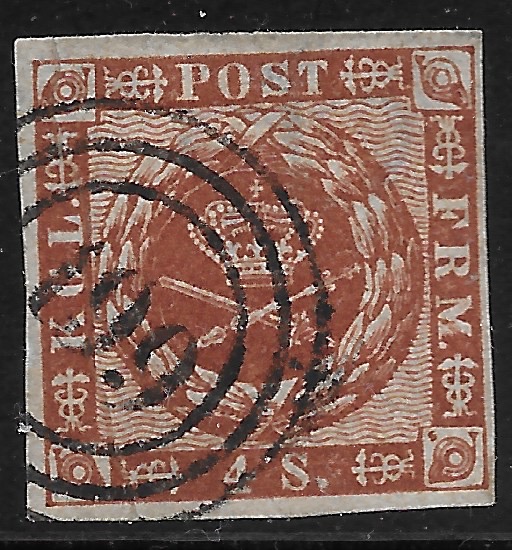
I agree that 3-ring cancellation number 199 is STERUP up through the 1863 stamp issues.
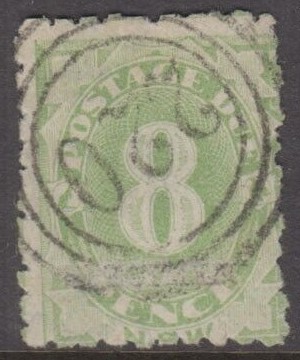
However starting with the 1864 issues used of that number was temporarily discontinued. Eventually, starting with the 1875 stamp issues, 199 was reassigned to RINGE.
The STERUP (199) use is actually somewhat scarce. From a "rarity factor" valuation, perspective, while 1 (København) is a "20" on any stamp, 199 (STERUP)
on this particular stamp -- it varies by stamp and stamp issue -- is rated a "300"! So, congratulations on your scarce postmark.
In terms of financial valuation, the quality of the postmark strike (this is an excellent strike, but not perfect) and the quality of the stamp are paramount. The image of this stamp appears to show a heavy vertical crease near the left side, which would greatly reduce its value in the marketplace, perhaps by 75% or more. (The collectors of these postmarks who are willing to pay for the premiums are quite -- and justifiably -- demanding about quality.)
3-ring numeral cancellation 199 (STERUP) was located in Schleswig-Holstein (see below). Postmarks of Schleswig-Holstein are especially collected as a group, including by some German collectors since this area is now within Germany. The
AFA Specialized Catalog 2016 [the most recent edition that has been published] has a special section which lists and prices all types of the Danish-period Schleswig-Holstein postmarks. I stock this catalog; it is the premier specialized catalog of Danish stamps and postal history.
https://www.jaysmith.com/Literature....html#a_1837Danish numeral cancellations can be collected in several ways, from simplest to most detailed: a) One example each used before vs from 1864; b) One example each on each major stamp issue, including before vs from 1864; c) An example on every different stamp. Option "c" is a great challenge because many (most) of these cancellations experienced very little use on other than the basic letter-rate stamps. People in tiny villages were not as likely to use high-denomination stamps on packages to other countries, etc. At the same time, there are great opportunities of collecting Option "c" and of finding extremely scarce uses that few people would realize are so scarce. There have been two books published (both out of print) that attempt to catalog and assign rarity factors for the uses of all these cancels on all different stamps.
At the moment, to the best of my knowledge, there is
not an
in print complete priced listing of
all, from all periods, the Danish numeral cancellations available that just breaks them out by major stamp issue categories. One of the handiest listings (but out of print and hard to find) that priced the Danish numeral cancellations (and some other types of early cancellations, as well as stamps, postal history, etc.) was the
DAKA Handbook 1999 Classic Denmark [DAKA Håndbog 1999 Klassisk Danmark]. From time to time I have available used examples of that book, as well as other Danish postmark books. When they become available, they are announced in my weekly "Philatelic Enews" email newsletter which is available free to those who request and include their (real) name and their complete postal address... from
js@jaysmith.com The "Philatelic Enews" covers much more than just Scandinavia and includes an informational / opinion column that is often picked up by other philatelic publications.
In case you are interested, the reason for the "1864 dividing line" in numeral assignment of these postmarks is that the "Second Schleswig War" started on February 1, 1864. All the towns / post offices in what had been the Schleswig-Holstein area of Denmark, that were subsequently lost to the Germans, were no longer part of the Danish postal system. Over time, most of those numeral cancellations were reassigned to other Danish towns. The new Danish 1864 stamp design started to appear (different dates for different denominations) in May 1864, thus could not bear what had been a Schlewswig-Holstein area postmark.
Jay Smith





 Posted 04/19/2024 5:08 pm