| Author |
 Replies: 6 / Views: 1,372 Replies: 6 / Views: 1,372 |
|
|
Pillar Of The Community
3865 Posts |
|
|
|
|
Valued Member
United States
74 Posts |
|
|
What do you mean by coil waste and sheet waste? How can a person know to identify them? Were these issued by the government and for sale at post offices? |
Send note to Staff 
|
|
|
Pillar Of The Community
3865 Posts |
|
|
Valued Member
United States
74 Posts |
|
|
Thank you for the link. Lots of very good information to study and understand what the differences are.Thanks again..... |
|
Send note to Staff
|
|
|
Pillar Of The Community
3865 Posts |
|
|
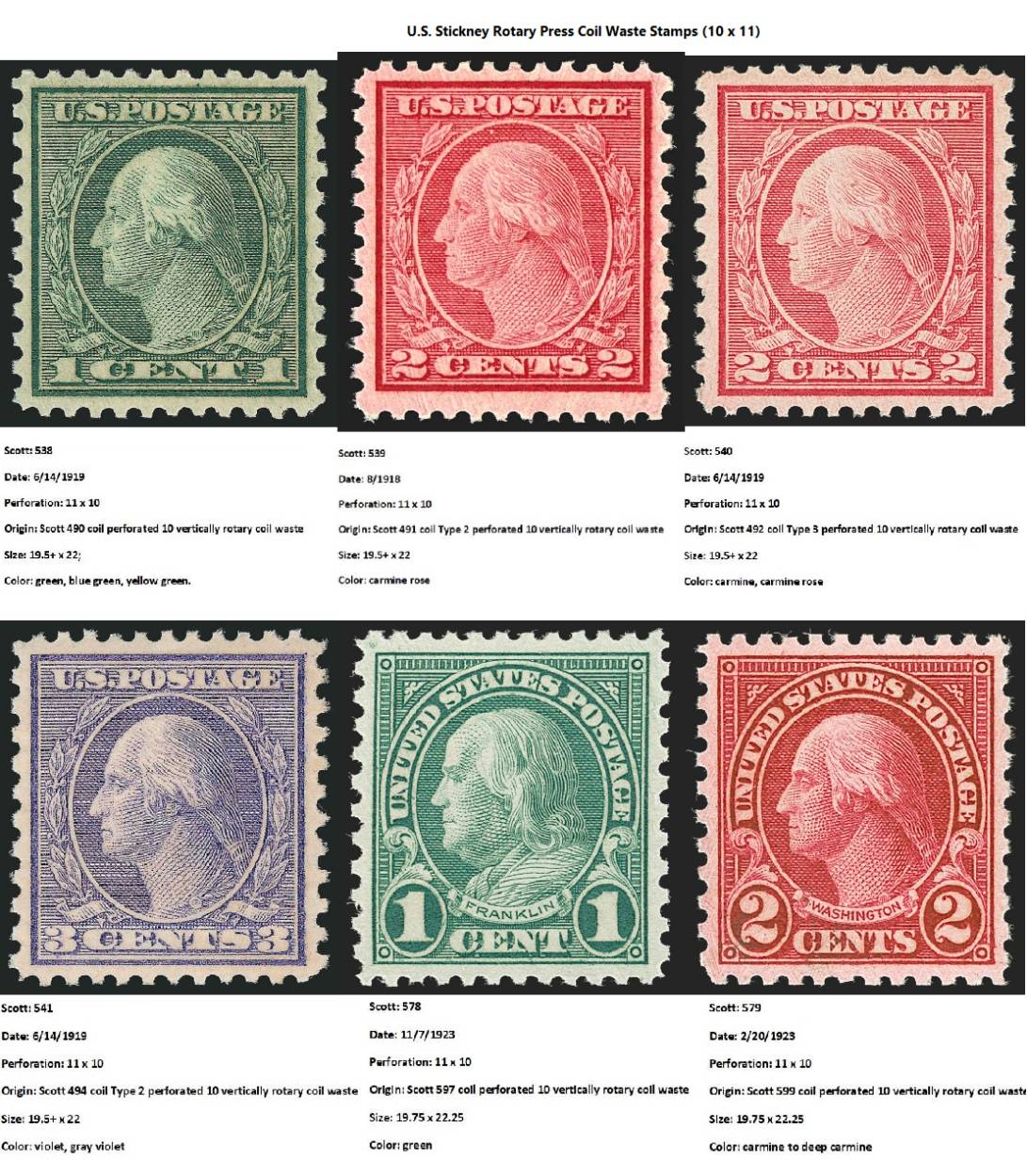
Coil waste stamps were produced on a small Stickney rotary press for making coil stamps.
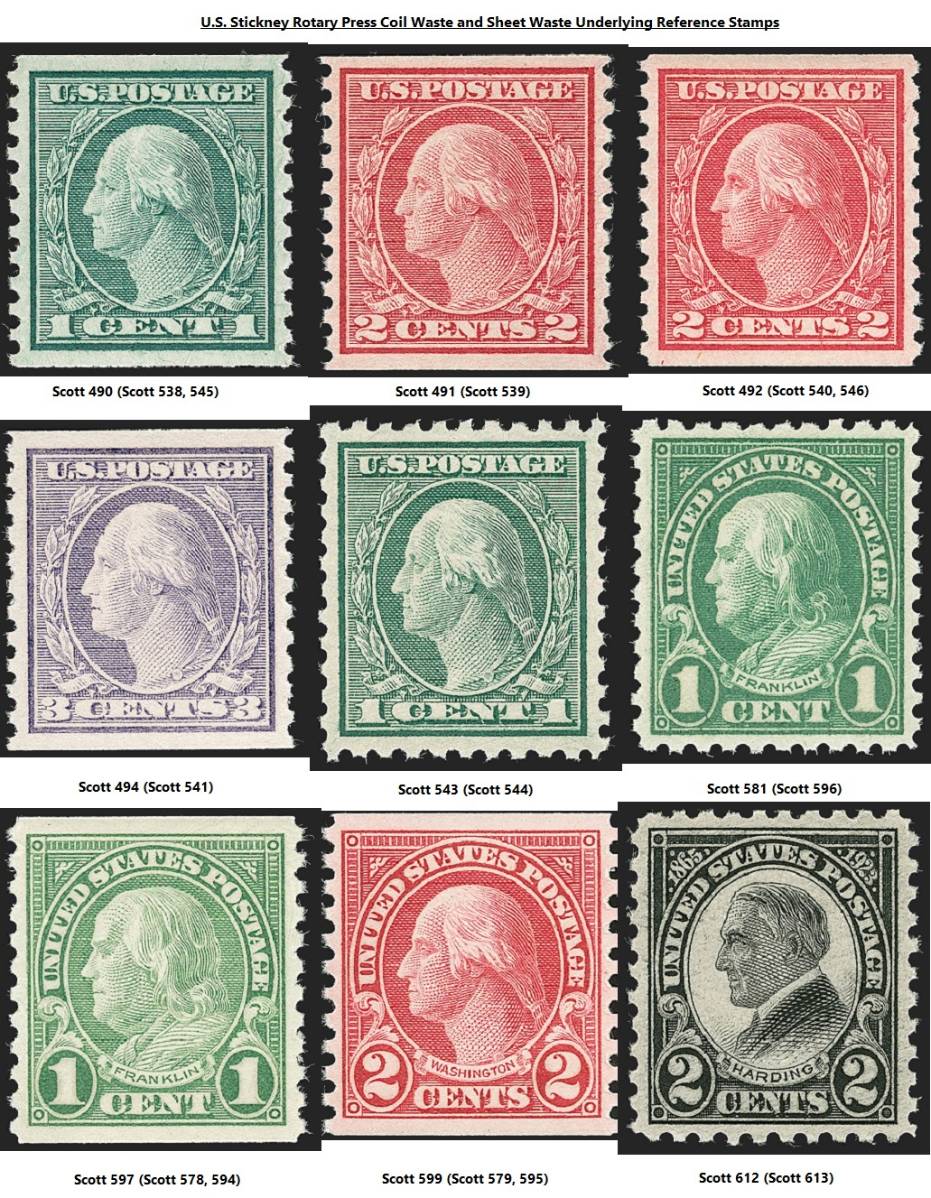
For horizontal coils that are vertically perforated two 170 (17 x 10) subject printing plates were used. The usual method of producing coils involves a web-fed Stickney rotary press that prints and gums web rolls. Then, the web rolls would be perforated gauge 10 vertically on a web-fed coil bar perforator. Scott 490, 491, 492, 494, 597, 599 are examples.
For 11 x 11 coil waste, the web would have been cut into unperforated sheets after printing and gumming and sent to two sheet-fed rotary wheel perforators to be perforated gauge 11 horizontally by gauge 11 vertically such as Scott 545, 546, 594, 595.
For 11 x 10 coil waste, the web roll would have been cut into perforated sheets after printing, gumming and coil bar perforator 10 vertical perforations. These sheets with perforated 10 vertical perforations were then perforated with gauge 11 horizontal perforations on a sheet-fed rotary wheel perforator. Scott 438, 439, 440, 441, 578, 579 are examples.
Coil waste was usually cut out of the printed stamp paper web roll from some of the beginning and end printed parts. |
|
Send note to Staff
|
| Edited by jogil - 06/11/2024 09:29 am |
|
|
Pillar Of The Community
3865 Posts |
|
|
Sheet waste stamps were produced on a large Stickney rotary press for making sheet stamps.
For sheet stamps two 400 (20 x 20) subject printing plates were used. The usual method of producing sheet stamps involves a web-fed Stickney rotary press that prints and gums web rolls. Then, the web rolls would be perforated gauge 10 horizontally by gauge 10 vertically on a web-fed bar and wheel perforator. Scott 543, 581, 612 are examples.
For 11 x 11 sheet waste, the web would have been cut into unperforated sheets after printing and gumming and sent to two sheet-fed rotary wheel perforators to be perforated gauge 11 horizontally by gauge 11 vertically such as Scott 544, 596, 613.
Coil waste was usually cut out of the printed stamp paper web roll from some of the beginning and end printed parts. |
|
Send note to Staff
|
| Edited by jogil - 06/11/2024 09:30 am |
|
|
Pillar Of The Community
3865 Posts |
|
| |
Replies: 6 / Views: 1,372 |
|




 Posted 06/10/2024 10:23 am