Stamp Community Family of Web Sites
Thousands of stamps, consistently graded, competitively priced and hundreds of in-depth blog posts to read


Stamp Community Forum
 
Username:
Password:
Save Password
Forgot your Password?

This page may contain links that result in small commissions to keep this free site up and running.

Welcome Guest! Registering and/or logging in will remove the anchor (bottom) ads. It's Free!

25˘ Prexie Solo - Unusual Usage

 
To participate in the forum you must log in or register.
Author Previous TopicReplies: 12 / Views: 1,106Next Topic  
Pillar Of The Community
United States
802 Posts
Posted 11/24/2024   11:32 pm  Show Profile Bookmark this topic Add Philazilla to your friends list Get a Link to this Message
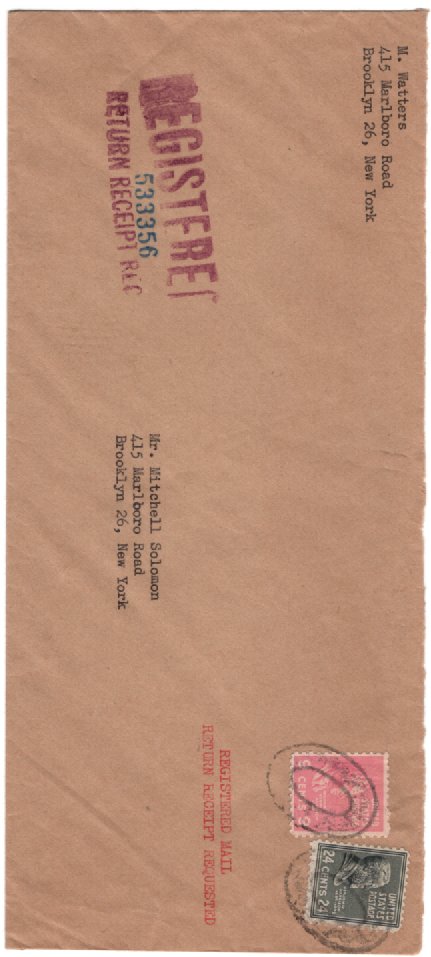
Here is another one.

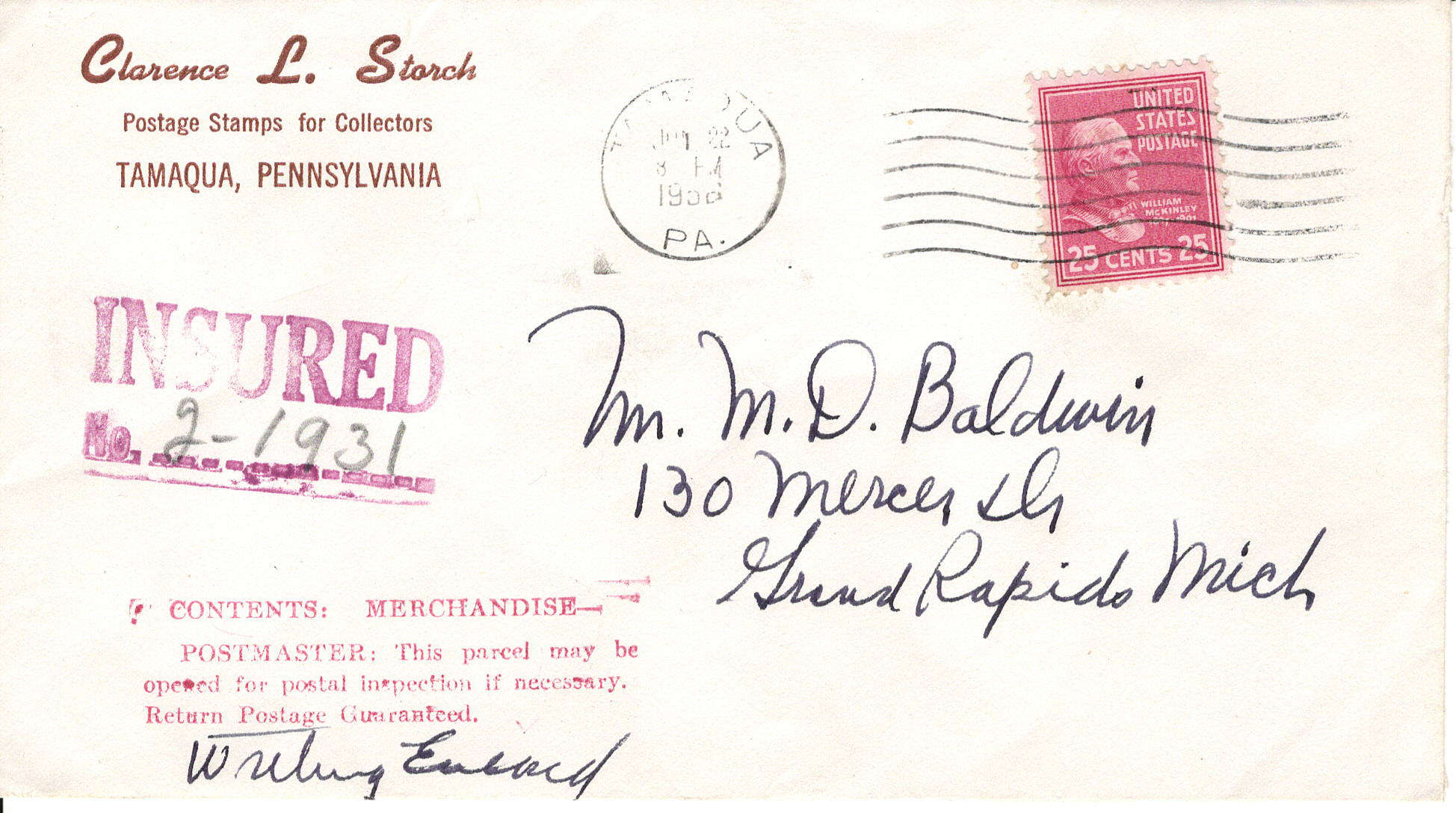
1956 insured domestic cover containing "merchandise" (probably stamps) with a singe 25˘.

What rate is "merchandise" and how much might the insurance have cost? This is a philatelic cover, but I would love to know if the usage is right.


Send note to Staff

Pillar Of The Community
6326 Posts
Posted 11/25/2024   10:35 am  Show Profile Bookmark this reply Add John Becker to your friends list  Get a Link to this Reply
0.20 for insurance coverage for 25.01 -50.00
0.02 for 3rd class rate for merchandise weighing less than 2 ounces
0.03 for the 1st class letter rate postage indicated and required by the "writing enclosed" notation
0.25 total
Send note to Staff  Go to Top of Page
Pillar Of The Community
6326 Posts
Posted 11/25/2024   10:51 am  Show Profile Bookmark this reply Add John Becker to your friends list  Get a Link to this Reply
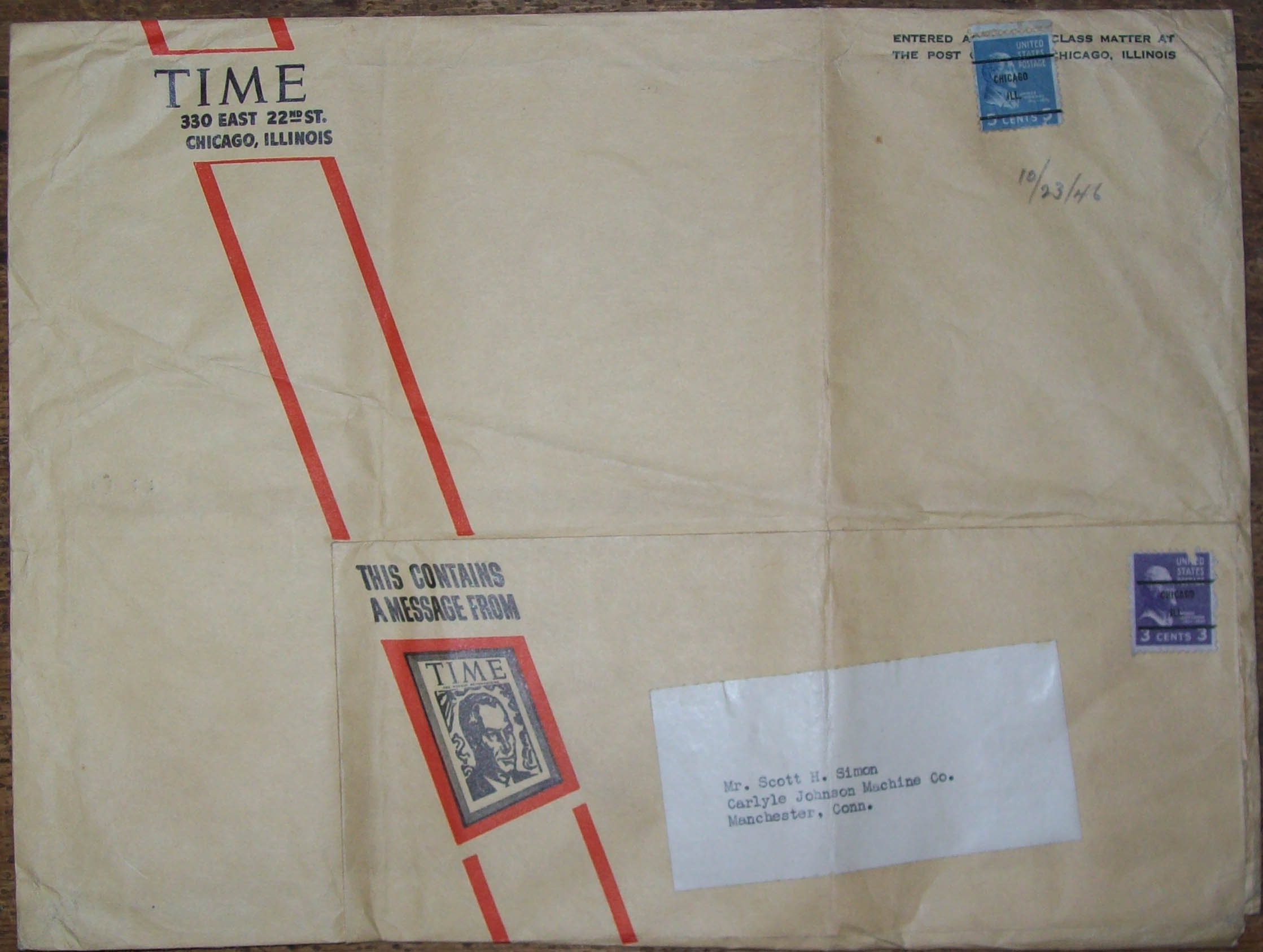
With some similarity, here is a double-envelope from Time, with the smaller 1st class envelope glued to the larger 3rd class envelope. Each with their separate postage paid by a precancelled Prexie. An easy way to send a single magazine with a cover letter. In this case the 2 complete envelopes were glued together, but some of these double-mailers are truly 1-piece patented envelopes. As you may imagine, the survival rate of larger pieces is much less than for letter-sized mail, and this one has been folded.
Send note to Staff  Go to Top of Page
Valued Member
Sweden
127 Posts
Posted 11/25/2024   10:54 am  Show Profile Bookmark this reply Add aolsson to your friends list  Get a Link to this Reply
Was the merchandise fee charged for the total weight or was the weight reduced with 1 oz for the letter weight?
Send note to Staff  Go to Top of Page
Bedrock Of The Community
United States
10594 Posts
Posted 11/25/2024   11:04 am  Show Profile Bookmark this reply Add revcollector to your friends list  Get a Link to this Reply
I would not call the original cover here "philatelic". It was a legitimate commercial usage, probably sending a purchase to a collector.
Send note to Staff  Go to Top of Page
Pillar Of The Community
United States
4284 Posts
Posted 11/25/2024   4:04 pm  Show Profile Bookmark this reply Add Parcelpostguy to your friends list  Get a Link to this Reply

Quote:
or was the weight reduced with 1 oz for the letter weight?


No, the writing (AKA letter) was paid for separately and in addition to the other postage and fees.


Quote:
Was the merchandise fee charged for the total weight


There was no "merchandise fee" as merchandise under a specific weight was considered third class mail and assessed postage at the rate of 2 cents per each 2 ounces or fraction. This compares to first class which would have been six cents for up to two ounces.

However, first class mail matter could not be insured, it could only be registered at a much higher fee. Insurance could only be purchased for Parcel Post (4th class) and for 3rd class qualifying merchandise. Third class merchandise could be insured as third class matter meaning third class postage plus the insurance fee. However third class matter was allowed to be enclosed in first class matter and airmail matter when both the postage costs for the higher classes of mail is paid and when third class enclosed is noted at which time insurance can be purchased for the third class matter.

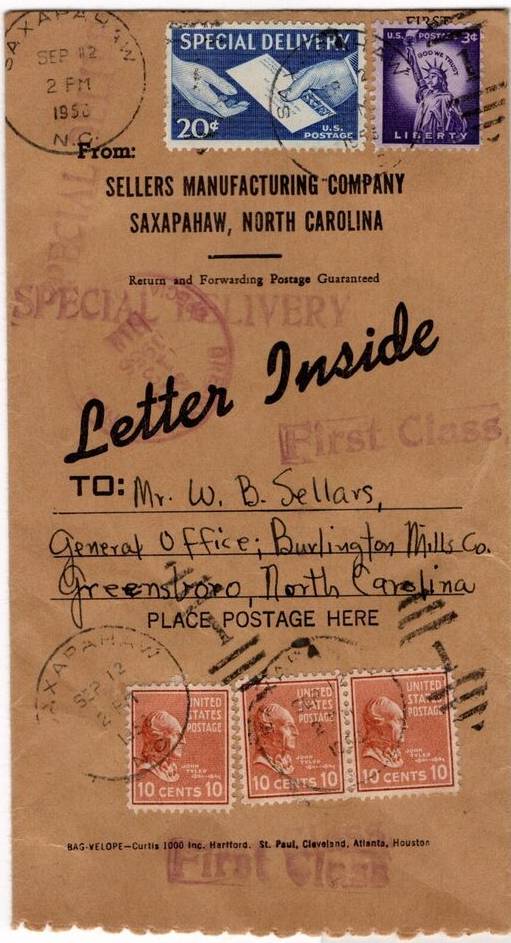
Here is an example of the older types of split envelope where the was one section to affix the 3rd or 4th class postage (and if insured, the fee) and another location to affix the first class postage (as well as the first class related fee for special delivery). Do note the scalloped edge at the bottom. That was caused by the removal of a cloth bag sewn on to the tag for the purpose of holding the third or forth class matter.


This rates as 3 cent for writing (letter) and 20 cents for first class special delivery fee above and below 30 cents for 10 ounces of merchandise..
Send note to Staff  Go to Top of Page
Pillar Of The Community
6326 Posts
Posted 11/25/2024   10:00 pm  Show Profile Bookmark this reply Add John Becker to your friends list  Get a Link to this Reply
Philazilla,
As you can see from this thread and your other one, if you are going to wade into the Prexies, don't limit yourself to the artificial constraint of solo uses.
Send note to Staff  Go to Top of Page
Valued Member
United States
148 Posts
Posted 11/25/2024   11:24 pm  Show Profile Bookmark this reply Add stampsOnMail to your friends list  Get a Link to this Reply
"This rates as 3 cent for writing (letter) and 20 cents for first class special delivery fee above and below 30 cents for 10 ounces of merchandise."
While above might be the reasoning of the sender, I suspect it is not correct rating. Once a sender decides to use first-class service, the contents as long as "mailable" (i.e, not disallowed for hazardous, harmful, perishable etc. matter) are (allowed) sealed against inspection. Hence it does not matter if the content is material "of the nature of first class" (i.e., private correspondence) or matter allowed for 3rd class or a mix. In this example, if the container + actual first-class (private correspondence, invoice, etc.) + 3rd class matter did not exceed 10 ounces, 30c postage would have been sufficient... so a "3c stamp for letter" would be superfluous.
I can see how constant habit of sending true "mixed class" mail with this packaging and applying respective 1st-class and 3rd-class postage, would have led someone to affix the 20c SD & 3c stamp "without thinking" before considering they decided to pay for expedited 1st class for the merchandise too.
("Mixed class" mail was treated at the service level of the lowest class.)
Send note to Staff  Go to Top of Page
Pillar Of The Community
United States
802 Posts
Posted 11/26/2024   12:17 pm  Show Profile Bookmark this reply Add Philazilla to your friends list  Get a Link to this Reply
Thank you! This is all very helpful. I have the Rustad book. I'm getting the Beecher-Wawrukiewicz book. I've generally been picking up interesting covers for a couple years, and I'm now at the point where, at least with the prexies, I have enough to assemble something more coherent. I don't plan to limit myself to solo usages - I have several interesting covers with multiple stamps, including a 2x14˘ + a certified mail stamp. (The usage on that one is crazy: 28˘ pays 7˘ return receipt fee, then seven times the 3˘ first class rate.)
Send note to Staff  Go to Top of Page
Pillar Of The Community
6326 Posts
Posted 11/26/2024   3:34 pm  Show Profile Bookmark this reply Add John Becker to your friends list  Get a Link to this Reply

Quote:
I don't plan to limit myself to solo usages

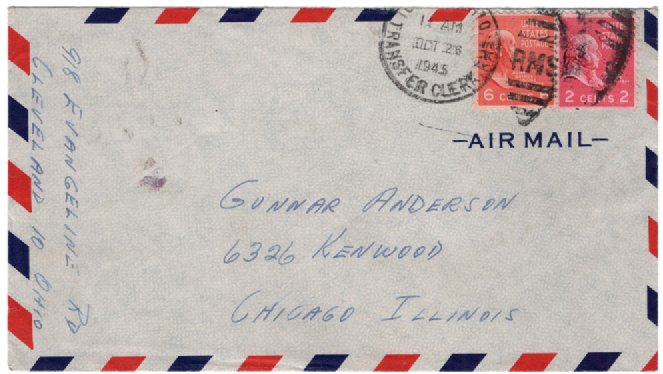
Good choice. The combinations rates and presidents can be great fun. Here are two "family pairs" of the Adams and Harrison's. Not particularly common together, but fun and not too expensive either.

Send note to Staff  Go to Top of Page
Pillar Of The Community
Learn More...
United States
936 Posts
Posted 11/26/2024   4:00 pm  Show Profile Bookmark this reply Add mml1942 to your friends list  Get a Link to this Reply
Some more resources.

[1]
On the Stamp Smarter website, we have the following Exhibit:

The 1938 Presidential Exhibit: A Postal History Look at Rates & Usages,

prepared by Hal Klien.

https://stampsmarter.org/learning/a...ie_home.html

[2]
The United States Stamp Society has a Presidential Era Committee, which published 97 issues of a publication titled The Prexie Era, between 1991 and 2022, when the last editor, Louis Fiset, retired to work on his exhibits. All 97 issues can be found here and can be downloaded as individual files:

https://www.usstamps.org/resources/prexie-era/

Several years ago, I merged all 97 issues into four larger compilation files, which can be downloaded as well or as an alternative. These downloaded files have a left-hand sidebar with the title for most of the articles, which makes it a little more convenient to browse through a number of issues without a lot of PDF file open/close operations.

Either group of files for The Prexie Era are searchable.

Several of the issues from the 1990s have listings of all of the possible rates that could be paid with solo issues of each stamp issue. I suspect these are duplicated, and possible expanded, in the Rustad book, but readers who might not have that reference, this would provide them with a preview of how many rates there might be to look for.

You do not have to be a member of the USSS to view or download these, but if you are really interested in the Prexies, you should join as The Specialist also has many articles about the stamps in the Prexie issue.

[3]
Another interesting resource is maintained by Collector/dealer Rich Pederson, who maintains two census data pages for the Prexies.

One census focuses on the largest number of each issue reported on a cover, the second is more of a selected group of covers with solo uses of most of the Prexie issues showing some of the interested solo rate usages.

These are found here:
https://www.pedersonstamps.com/prexie-census-data

Rich also has many other resources for the Prexie collector.

[4]
Ken Lawrence has written numerous articles on the Presidential Series for Linn's Stamp News. These are available to subscribers.

IN 2013 he had ten articles on the Presidential Series published in his Spotlight column.

He published several articles on solo Prexie covers in the June 15, 2020 issue.

He published an article on the Prexie coil stamps in the Feb 15, 2021 issue.

All of these will give you ideas on how other have collected this interesting series of stamps, and hopefully will lead you into years, if not decades, of collecting fun.

Mike L
Send note to Staff  Go to Top of Page
Edited by mml1942 - 11/26/2024 4:20 pm
Pillar Of The Community
United States
4284 Posts
Posted 11/26/2024   8:03 pm  Show Profile Bookmark this reply Add Parcelpostguy to your friends list  Get a Link to this Reply
Philazilla--
One can also limit oneself to just certain a certain denomination or denominations as well as only domestic or foreign usages. Then there are the overprinted Prexie designs which can be included, excluded on specialize in alone. Currently, I only chase the postal history of the non-Presidential Presidential Series, including those with overprints. I sold off my general Prexies postal history years ago. Non-Presidential Prexies are the one half, one and a half and four and a half cents stamps of which the first two come with Canal Zone overprints as well.

stampsOnMail--

Quote:
"This rates as 3 cent for writing (letter) and 20 cents for first class special delivery fee above and below 30 cents for 10 ounces of merchandise."
While above might be the reasoning of the sender, I suspect it is not correct rating.


In my quickness my
Quote:
This rates as 3 cent for writing (letter) and 20 cents for first class special delivery fee above and below 30 cents for 10 ounces of merchandise.
likely was unintentionally misleading.

I failed to state clearly that the 10 ounces of potential merchandise for 30 cents was NOT at the 3rd class rate but at uprated to 1st Class rate of 30 cents (3 cent x10 ounces). While this is a split 1st and 3rd or 4th class mailing container, it was not sent that way, it was sent as solely 1st class (note the extra first class hand-stamps applied both top and bottom.). This is a 1956 mailing and third class was limited in weight to 8 ounces until the limit was raised in 1958 to 16 ounces. Additionally for the 8 oz maximum weight of 3rd class, the postage was 5 cents only; 2 cents for the first two ounces and 1 cent each for the next three two ounce units..

If Parcel Post, as a zone 1 item which this would be, the rates, by pound, for all 4th class matter over 8 ounces, for zone 1 were 23, 27 and 31 cents for the first through third pounds; thus not correct for the postage applied. Additionally the 20 cent special delivery would be incorrect as non-first class matter required a higher fee for SD service, 35 cents for two pounds or less.

So I clarify the rating description as follows:

What this is was a solely first class item weighting 11 ounces, 10oz of which may have been 3rd or 4th class qualifying matter uprated to 1st class or all simple 1st matter, for 33 cents 1st Class (3 cents x 11 oz) and 20 Special Delivery fee for 1st class matter 2lbs or less.


Quote:
Once a sender decides to use first-class service, the contents as long as "mailable" (i.e, not disallowed for hazardous, harmful, perishable etc. matter) are (allowed) sealed against inspection. Hence it does not matter if the content is material "of the nature of first class" (i.e., private correspondence) or matter allowed for 3rd class or a mix. In this example, if the container + actual first-class (private correspondence, invoice, etc.) + 3rd class matter did not exceed 10 ounces, 30c postage would have been sufficient... so a "3c stamp for letter" would be superfluous.


Let me gently reply to you: "Sort of." First a small issue, "perishable" matter was not precluded from 1st class; perished perishable was.

Any mailable matter can be sent at a higher class (read more expensive rate) of mail including 1st or Airmail. It can then be sealed against inspection, but if any indemnity is desired, registration is the only USPOD option.To receive lower fee insurance, the contents must include 3rd or 4th class matter and be so specified on the envelope, tag, wrapper, box or other container as "3rd [or 4th] class enclosed'. Beginning in 1948 sealed 3rd class matter no longer needed the endorsement that it could be opened for inspection, it was understood it could be inspected. What is misdirecting on the piece I illustrated is that it was designed for a combination of mail classes which the sender intended to modify to only 1st class. The printed statement, "Return and forwarding postage guaranteed" is not needed for first class as those services are free (excluding for a period postal and post cards which were sort of first class, more or less, kinda, but not fully letter first class mail).

The USPOD specifically allowed mailing containers split into two sections one for the first class rate (writing) and another for the 3th or 4th class matter and two containment sections, one for the writing and the other for the merchandise. If the USPOD wanted to be picky, they could examine, including weighing, the non-first class portion of such a sending. I don't have an illustration handy at the moment for what I would like to show. But the rate of 1st postage paid for the writing and the merchandise postage was paid at the 3rd or 4th class rate as appropriate in different areas of the container. Interestingly the rate for the 1st class postage could be paid at the lower "local" 1st class rate if the item qualified at the local first class rate. Those, local paid, are quite difficult to locate. For accuracy I will state do not confuse letter "local" with parcel post "local" as they have different designations for the term, "local."

Two odd circumstances come to mind regarding the handling certain mail matter.

First banks could mail at the 4th Class with an insurance fee paid but the USPOD was required to handle the insured matter as if registered matter. Besides the signatures in transit required for registered matter the package paid at 4th class traveled with 1st class registered matter at the speed of 1st class. At the time only first class could be registered domestically so it was handled with the speed of 1st class with all other registered mail.

The next circumstance is first class matter does not always require first class matter to be paid at the rate of 1st class postage. The USPOD allowed one exception. Regarding penalty mail, where if exceeding the weight limit of the penalty endorsement, and if over 25 Lbs, any class of mail matter or combination contained was rated at the parcel post rates. But that is an article for a publication, not here in a blog.

{Provenance for item I illustrated: Tony Wawrukiewicz, Wade Saade}

Edited, to correct a singe digit changing an eight to a five.
Send note to Staff  Go to Top of Page
Edited by Parcelpostguy - 11/27/2024 12:05 am
Valued Member
Sweden
127 Posts
Posted 11/26/2024   10:00 pm  Show Profile Bookmark this reply Add aolsson to your friends list  Get a Link to this Reply
Some years ago I made a web-site with Prexie uses to Sweden. It can be seen at https://projekt.sspd.se/xie/xiem.htm (items are no longer added to this list)
Send note to Staff  Go to Top of Page
Edited by aolsson - 11/26/2024 10:03 pm
  Previous TopicReplies: 12 / Views: 1,106Next Topic  
 
To participate in the forum you must log in or register.

Go to Top of Page

Disclaimer: While a tremendous amount of effort goes into ensuring the accuracy of the information contained in this site, Stamp Community assumes no liability for errors. Copyright 2005 - 2026 Stamp Community Family - All rights reserved worldwide. Use of any images or content on this website without prior written permission of Stamp Community or the original lender is strictly prohibited.
Privacy Policy / Terms of Use    Advertise Here
Stamp Community Forum © 2007 - 2026 Stamp Community Forums
It took 0.21 seconds to lick this stamp. Powered By: Snitz Forums 2000 Version 3.4.05