| Author |
 Replies: 9 / Views: 1,018 Replies: 9 / Views: 1,018 |
|
|
Valued Member
United States
20 Posts |
|
|
*** Moved by Staff to a more appropriate forum. ***Hello Everyone, I came across this in a lot I recently purchased. I do not collect G.B. stamps and was curious as to why this has a Malta cancellation. Is it rare to have a complete Malta cancellation like this? I can not determine SC. number because of the paper type i.e. blue or not. Any help is much appreciated.  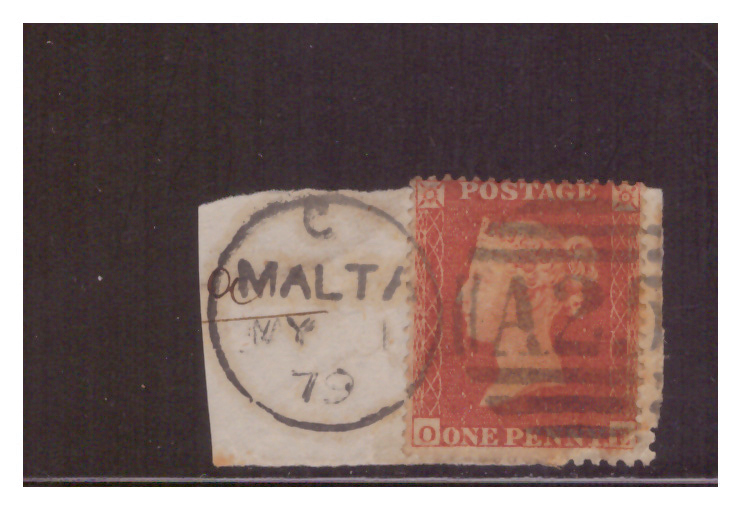
|
|
Send note to Staff
|
|
|
|
|
Pillar Of The Community
France, Metropolitan
3756 Posts |
|
|
Valued Member

United Kingdom
230 Posts |
|
|
GB stamps were valid for use in the colony of Malta until 1884, so your example isn't a rarity.
However, it looks as if your Penny Red is Perf 16, which according to Stanley Gibbons is uncommon in Malta, and known only with Small Crown watermark (SG no. Z25, cancellation type Z5, catalogue price £375).
The Queen's head looks to me like Die I. The corner letters may be Alphabet I or Alphabet II. But the paper of a Die I Perf 16 stamp ought to be blued enough for the blue to be visible even in a scan.
The more I look at it the more it looks "wrong". Perhaps somebody who knows more than I will explain. |
Send note to Staff 
|
|
|
Pillar Of The Community
Australia
3297 Posts |
|
|
It would be a perf. 14 in 1879 surely?
The cancellation appears to be a little watery but who's faking a Malta duplex on a penny red? |
|
Send note to Staff
|
|
|
Valued Member
United Kingdom
230 Posts |
|
|
I've checked against my perf 14 and perf 16 examples, and I'm confident it's perf 16. Count the teeth at the top.
It's a late date for perf 16, but not impossible. What puzzles me is the combination of (what looks like) Die I and (apparently) non-blued paper.
According to SG, perf 16 exists used in Malta only with the Small Crown watermark, so even if the head is Die II the paper ought to be blued.
I said it looks "wrong", because I can't explain it. |
|
Send note to Staff
|
|
|
Pillar Of The Community
Australia
3297 Posts |
|
|
It looks like a plate 158, but the SG QV specialised says this plate doesn't exist perforated. The other candidate that caught my eye is plate 185, which does exist perforated.
The blueing was eliminated in 1857, but could something have happened if the stamp was originally blued but hadn't been used for over 20 years following its supply? |
|
Send note to Staff
|
| Edited by Bobby De La Rue - 02/22/2025 9:03 pm |
|
|
Valued Member
United Kingdom
230 Posts |
|
|
Bobby, I haven't heard of blueing fading, but I'm not an expert. I think there must be some blueing in the paper that isn't visible in the scan. Otherwise we're looking at an impossibility.
thefinfin, if you're reading, I think you can be congratulated on having picked up something that looks commonplace at first glance but is really quite unusual and interesting. |
|
Send note to Staff
|
|
|
Pillar Of The Community
Australia
3297 Posts |
|
|
Plate 185 was put to press in July 1854, so if it was still in use in 1857 maybe that's the answer as to why we're not seeing any blueing? Interesting indeed  |
|
Send note to Staff
|
|
|
Valued Member
United Kingdom
230 Posts |
|
|
But none of the plates made from Die I were printed on white paper! Not even plate 204, the last of them all!
It still looks like Die I to me, but logic suggests that my eyes are deceiving me and it's really Die II. In that case, the watermark must be Large Crown, because otherwise we still have the impossibility of Small Crown + White Paper. But Large Crown + Perf 16 isn't recorded by Stanley Gibbons as used in Malta.
thefinfin, we need a closer scan of the stamp to be sure whether it's Die I or Die II.
If I stare at it uncomprehendingly much longer I'll start to think it's Benjamin Franklin. |
|
Send note to Staff
|
|
|
Pillar Of The Community
Netherlands
6641 Posts |
|
|
Maybe OP could provide a clearer, cropped scan of the stamp. That would help answering the question whether it is a die I or die II stamp.
SG C11 from plate 44 is known used in Malta with an "M" cancellation at Valetta. C10 is known with the A25 duplex.
The lack of a known cover - there are not many known - with C11 and the A25 duplex is not necessarily proof it does not exist.
Also, the stamp could have been applied on maritime (paquebot) mail arriving in Malta.
The "5" in the obliterator needs closer scrutiny. The end of the loop at the bottom appears to end quite far to the left of the lower part of the vertical stroke. |
|
Send note to Staff
|
|
| |
Replies: 9 / Views: 1,018 |
|



 Posted 02/21/2025 11:10 am


