| Author |
 Replies: 35 / Views: 3,746 Replies: 35 / Views: 3,746 |
|
|
|
Bedrock Of The Community
United States
10869 Posts |
|
|
I have a 60x glass, so I have seen fibers often. But I have no idea what fibers they are, except in the general sense. It's paper. |
Send note to Staff 
|
|
|
Valued Member
98 Posts |
|
|
It's of course fascinating to zoom in to discover those fibers, and the characteristics are quite easy to learn, I have books about it, online sources are rare, this may give some idea: https://www.researchgate.net/figure...g1_305153128As said it is not so hard to see those fibers and define them in theory, linen has those nodes, cotton has not but it more curled with rounded sides, wood has dots. But I am not used to it on a daily basis, so I know what I see but I don't know what I don't see :). |
|
Send note to Staff
|
|
|
Valued Member
63 Posts |
|
|
Littbarski,
Your first collage reasonably supports linen identification in the broad sense of bast type fibers. However, the images provided do not clearly show cotton mixed in.
If you can upload one or two full resolution microscope frames ideally the same field captured at two focus planes it will be easier to mark specific diagnostic features.
Alternatively, if you're comfortable with Matlab and have a very high resolution calibrated scanner, I can forward you the dataset related to stamp paper type from the complete specifications stamps set.
|
|
Send note to Staff
|
|
|
Valued Member
98 Posts |
|
|
Hello, well as said I am not the microscope expert and don't have a good equipment, so those images are the best possible, and if I would be asked about them I would see indeed those linen and as well cotton fibers (curled without dots but more grain in the inner area, typical borders) and wood pulp in the W-F. And in the Bank Note paper, if it is not linen/bast, what else should it be than cotton :).
I only wanted to add the images as examples how easy it can be to make the fibers visible, and of course with a better equipment the fibers would be even better detectable.
The connection to the topic here is that the new introduction in Scott just calls for such microscope work :). |
|
Send note to Staff
|
|
|
Valued Member
98 Posts |
|
|
And while it seems manageable to detect the linen fiber which have obvious nodes, of course the cotton fibers are not so easy, but mostly if there is also wood pulp there, like in the W-F. So I have to admit that I am not sure about them. But I attach another one, I guess the last one here, just to show what could be wood pulp (above from W-F) vs cotton (bottom from ABN). So the bottom image is from re-engraved ABN 1c Sc. 206 where I also found linen fibers without any doubt, but is this a linen fiber? I would say cotton perhaps. 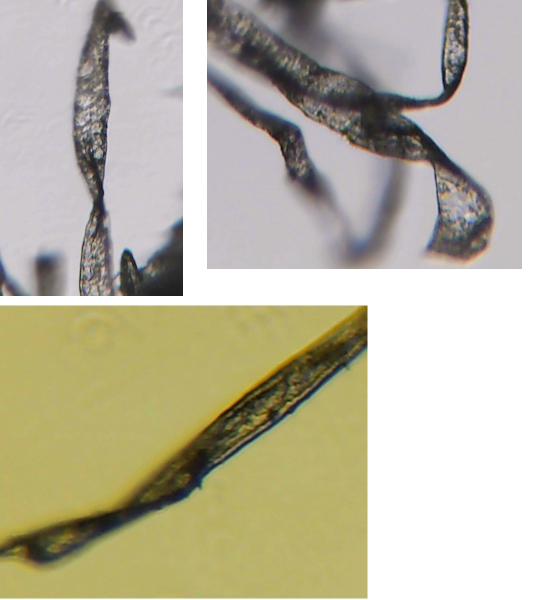 To summarize this little excursion in the microscope area: if in Scott Specialized the plant fiber is a describing or even defining factor for the ABN issue, then it can happen that a collector looks at his stamp under microscope. If he sees perhaps only cotton fibers (mainly if he has a better equipment and better knowledge than me) should he write to Scott or the PF that he has found a special and rare paper variety, because he can not find a single linen fiber? Or if he finds both fiber types, will it be a new paper :) ? Still, it would be interesting if those images, that I only showed for illustration, are good enough to define the fibers, e.g. by somebody who is more trained than me :). |
|
Send note to Staff
|
|
|
Pillar Of The Community
United States
2555 Posts |
|
|
Too bad the descriptor "linen paper" was already being used on some ABN printings, albeit a much smaller subset of stamps, the hard paper printings of the ABNCo. Not sure who originally started calling them linen paper, or why, but knowing those stamps fairly well, I would surmise that it was because of the surface texture of the stamps and not the type of fiber they are made of. |
|
Send note to Staff
|
|
|
Pillar Of The Community
United States
1946 Posts |
|
|
littbarski said:
"The first image shows quite good the linen fibers. I took just some example of a pile of re-engraved 10c ABN Sc. 209."
Given the old understanding of #209, the comparison we especially need to see shown is between linen and wood. Up to now the main distinction has focused upon the sizing agent used in producing a type. Now we need to see how much of the "softness" of a 209 versus an earlier 10c is attributable to a simple starch sizing agent, and how much has to do with paper fiber. Barwis has given us a well tested chronological sequence of sizing agents, and this can inform our attempts to sequence by paper fibers from just prior to early/mid-1878 and later.
|
|
Send note to Staff
|
|
|
Pillar Of The Community
United States
1946 Posts |
|
|
sinclair2010 wrote:
"Not sure who originally started calling them linen paper,..."
Winston, check my post on that earlier in this thread. References given there point an article by Albert Valente in the APC Chronicle. . |
|
Send note to Staff
|
|
|
Valued Member
98 Posts |
|
|
I have not seen any article writing about wood used for the Bank Note issues, from what I suppose the switch to more wood would have been around 1885. So probably in the regular 1887 issue, ABN.
Has there been any research that the ABN re-engraved issue was also made partly from wood? Or do we think that this was more some early experiment in some of the re-engraved stamps only?
In Barwis' indeed the focus is not on the fiber plants, and the fiber photos are not close enough to see anything. He works more with colouring the fibers which of course does not work if the stamps should stay intact.
Working with a microscope can only give a first idea and is not a quantitative method of course. Nevertheless it is interesting to see if one can find some fiber type at all and how often (without statistics, just an experience study).
When I find more time I will perhaps look at more stamps, also for wood, but for now I wanted to show that this is something that an average collector can do :).
|
|
Send note to Staff
|
|
|
Pillar Of The Community
United States
2555 Posts |
|
|
Essayk, thanks. I did see your reference to the Valente article but I was talking specifically about the ABN hard paper stamps with respect to the use of the descriptor "linen paper". Ron Burns used it as early as 2017 in his Chronicle article about the ABN hard paper stamps. In the article he states: "This paper is also known as "linen paper ".". This suggests someone else had already coined the description and I do not believe it ever had anything to do with the fiber used to make the paper but rather an apt description of the paper texture. I don't agree with Burns' conclusion as to the origins of those hard paper stamps but that is another matter for another day. |
|
Send note to Staff
|
|
|
Bedrock Of The Community
12778 Posts |
|
|
Valued Member
98 Posts |
|
|
thank you - I just wanted to add the direct link to the Analytical Philately website, where I downloaded this Barwis article and others, but their website is gone and redirected to some strange .ba domain ? If somebody know a member perhaps let them know. |
|
Send note to Staff
|
|
|
Valued Member
63 Posts |
|
|
The current confusion has far less to do with what philatelists can or cannot see under a microscope and or the core methodological issues raised. The problem is a category mistake created by Scott. By promoting linen into a section header that reads like a fiber furnish assertion, Scott has collapsed what was historically a philatelist facing operational classification (soft/porous as a tactile, handling based descriptor) into a materials determination that implicitly demands laboratory grade specificity. This is not a harmless phrasing adjustment; it shifts the label's logical status from how the paper behaves to what the paper is made of, without supplying the evidentiary steps such a claim requires.
What makes this more concerning is that Scott continues to publish unverified claims not as an isolated lapse, but as a recurring pattern sustained over years without meaningful readjustment or correction. To this day, the consequences are propagating through stamp series and classification decisions. In doing so, Scott predictably amplifies confusion across the entire system: researchers, philatelists, collectors, and even expertizing organizations. The catalogue effectively implies that anyone can validate a furnish level statement through casual microscopy, yet Scott offers no operational definition of linen, no stated thresholds (dominant flax vs. blend vs. trace presence), no scope limits, and no published analytical protocol. The result is a textbook recipe for contradictory discoveries, inconsistent submissions to expertizing bodies, and circular disputes driven by impressionistic observations rather than shared, testable standards.
Moreover, the term linen paper already existed in specialist vocabulary in a narrower, different sense often referring to a linen like surface/formation (ribbing / linen finish) in certain ABN contexts. Scott's repurposing of the same term as a broad section wide descriptor effectively collapses two meanings (finish vs furnish) into one label, guaranteeing that competent specialists will interpret it differently. When a catalogue chooses ambiguous terminology and elevates it to header status, it is not merely reflecting research, it is actively creating interpretive instability.
Modern analytical philately has the tools to characterize paper as a multi variable system, yet the obsolete Scott continues to publish determinative language without presenting the underlying evidence in a form the community can audit. If Scott wishes to assert linen at the header level, the burden is straight forward: publish or cite transparently a quantitative, well scoped furnish study.
Until then, the most responsible editorial posture would be to keep the heading at the operational level soft porous paper and place linen in a qualified note with sourcing and scope not as a blanket label.
|
|
Send note to Staff
|
|
|
Bedrock Of The Community
12778 Posts |
|
|
Remember that Scott is a small publisher with a small staff publishing catalog listings for every Country in the world and even some that no longer exist. Scott primarily focuses on values. Quote:
Scott continues to publish determinative language without presenting the underlying evidence in a form the community can audit. If Scott wishes to assert linen at the header level, the burden is straight forward: publish or cite transparently a quantitative, well scoped furnish study. This will never happen nor should it. Scott is not a technical organization. It looks to the outside for such things. If you want highly specialized technical information you go to other sources. |
|
Send note to Staff
|
|
|
Pillar Of The Community
United States
3532 Posts |
|
|
Quote:
If you want highly specialized technical information you go to other sources. Right; and I think a key issue is how does Scott know if those sources are adequately vetted? Its a challenge. |
|
Send note to Staff
|
|
|
Replies: 35 / Views: 3,746 |
|




 Posted 02/02/2026 07:18 am


