Stamp Community Family of Web Sites
Thousands of stamps, consistently graded, competitively priced and hundreds of in-depth blog posts to read


Stamp Community Forum
 
Username:
Password:
Save Password
Forgot your Password?

This page may contain links that result in small commissions to keep this free site up and running.

Welcome Guest! Registering and/or logging in will remove the anchor (bottom) ads. It's Free!

Australia Perforation Pip Examples - Post Yours

 
To participate in the forum you must log in or register.
Author Previous TopicReplies: 3 / Views: 898Next Topic  
Moderator
Learn More...
United States
5105 Posts
Posted 07/28/2025   3:04 pm  Show Profile Bookmark this topic Add Partime to your friends list Get a Link to this Message
My ACSC (Australia Commonwealth Specialist Catalog) lists an interesting item known as Perforation or Perf Pips. These were placed in the margins of some sheets and were for the purpose of centering of perforations. We've had one or two discussions in the past, but I thought I would start a new thread here with an interesting example.

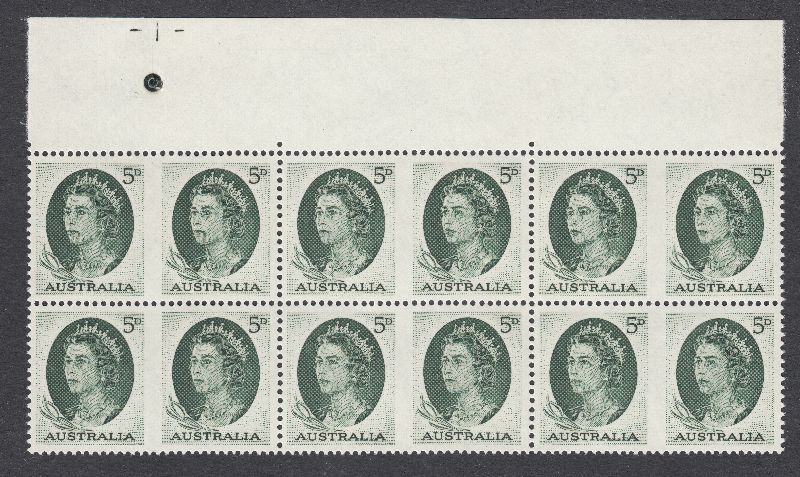
In July, 1964, uncut sheets of 288 stamps were placed on sale to the public. These are the QEII green 5d stamps, Scott 365, ACSC 400. There were 1500 sheets sold, for a total of about 432,000 stamps. But what was interesting is that these were lacking vertical perforation lines in multiple places. The optimum collecting unit is a block of 9 comprising three imperf between pairs and three stamps imperf on one side.

In addition, these were available with a Plate Number Block, either with number 1 or 2. The least common is Plate number 1 without dashes, but mine is Plate number 1 with dashes (ACSC 400za). This isn't the optimum collecting block (based on the definition above), but it nicely shows the imperf between, the Plate Number, and the Perf Pip. The perf pip actually breaks through the paper, though difficult to see the way I scanned.

Entire Front


Plate Number and Perf Pip closeup


Entire Back


Please feel free to comment and post our Perf Pip Examples.
Send note to Staff

Valued Member
Learn More...
United Kingdom
220 Posts
Posted 07/28/2025   4:46 pm  Show Profile Bookmark this reply Add pjr to your friends list  Get a Link to this Reply
Interesting!

GB stamps of the same period have "perforation guide holes" in the margins, but the holes are either not inked or "boxed" with narrow lines.

The Stanley Gibbons "Part 1" catalogue lists the Australian pair "imperf between" as 354b, at a much lower price than the ordinary booklet pane of six. Does this mean that more sheets were remaindered in this way than were made into booklets? SG also says that there were 288 stamps in the sheet, not 284 - and 288 is a multiple of six, so I think it must be right.

Do you know the position of the plate number and "perf pip" in the sheet? The SG illustration of what you call the "optimum block of nine" (with stamp-sized blank at the side) doesn't include them.

Are there any miscut booklets, imperf down the middle?
Send note to Staff  Go to Top of Page
Moderator
Learn More...
United States
5105 Posts
Posted 07/28/2025   6:58 pm  Show Profile Bookmark this reply Add Partime to your friends list  Get a Link to this Reply
All excellent questions.

Quote:
The Stanley Gibbons "Part 1" catalogue lists the Australian pair "imperf between" as 354b, at a much lower price than the ordinary booklet pane of six. Does this mean that more sheets were remaindered in this way than were made into booklets?

The pair, imperf between, is listed in my ACSC 2024 as 400bb with a value of AUS$3, so not particularly valuable. If it was on an envelope, however, the price increases dramatically to about AUS$150.
The ordinary booklet pane of six is ACSC 400c, with a value of AUS$50, so it does appear that the imperf panes were mainly sold to collectors, and were saved, as such, so the value is not really there for the pairs.

Quote:
SG also says that there were 288 stamps in the sheet, not 284 - and 288 is a multiple of six, so I think it must be right.

Oops. You are right. I corrected my original post to reflect your finding. Thanks.

Quote:
Do you know the position of the plate number and "perf pip" in the sheet?

Per ACSC, the Plate number blocks of 6 have plate number 1 (without dashes) at the top center. Plate number 1 and 2 (both with dashes) are also located at the top center. Further information in ACSC is that the Plate number 1 without dashes is the most scarce and is on the left Sheet. The others are on the right sheets.

Quote:
Are there any miscut booklets, imperf down the middle?

Very likely. There were 166,583,520 stamps issued to the Post Office in booklets. Per ACSC, these are identified as B67 and B68 which include 2 panes of 6, advertisements, sometimes wax interleaves, usually stitched on left side, but a few stapled remakes, all from AUS$100 to AUS$275 in my 2003 catalog. There isn't any mention of miscuts, but I'm positive they are out there somewhere.
Send note to Staff  Go to Top of Page
Moderator
Learn More...
United States
5105 Posts
Posted 07/28/2025   7:48 pm  Show Profile Bookmark this reply Add Partime to your friends list  Get a Link to this Reply

Quote:
The optimum collecting unit is a block of 9 comprising three imperf between pairs and three stamps imperf on one side.

Here is an example of this collecting unit (ACSC 400bc). This does not have the Perf Pip or the Plate number.
Send note to Staff  Go to Top of Page
  Previous TopicReplies: 3 / Views: 898Next Topic  
 
To participate in the forum you must log in or register.

Go to Top of Page

Disclaimer: While a tremendous amount of effort goes into ensuring the accuracy of the information contained in this site, Stamp Community assumes no liability for errors. Copyright 2005 - 2026 Stamp Community Family - All rights reserved worldwide. Use of any images or content on this website without prior written permission of Stamp Community or the original lender is strictly prohibited.
Privacy Policy / Terms of Use    Advertise Here
Stamp Community Forum © 2007 - 2026 Stamp Community Forums
It took 0.16 seconds to lick this stamp. Powered By: Snitz Forums 2000 Version 3.4.05