| Author |
 Replies: 13 / Views: 2,498 Replies: 13 / Views: 2,498 |
|
|
Pillar Of The Community
United States
811 Posts |
|
|
I recently bought this cover and thought it was interesting. I did some research and attempted a write-up. What to the experts here think? Franked with a 3¢ Jefferson (Prexie) and cancelled Philadelphia, Pa., Dec 19, 1946, this cover to Tehran was underpaid by 2¢ against the 5¢ UPU surface rate per ½ oz. The deficiency was first noted in the U.S. with a boxed "Postage Due … 2 Cents." At the New York exchange office, purple encircled "T N.Y." and "CENTIMES 20 F" markings were applied, representing the UPU conversion of the 2¢ postage due. Additional black encircled "T" and "20" markings—likely applied in France—reaffirmed the charge ("T" = Taxe, or postage due). In Tehran, clerks added magenta and blue notations including "Please pay us 2.50," converting the 20 centimes to 2.50 rials, and confirmed collection with a purple Farsi handstamp. Backstamped Tehran, early 1947. Addressed to the Community School, Tehran, an American-founded institution that operated from the early 1900s until its closure in 1979, serving expatriate and Iranian students. 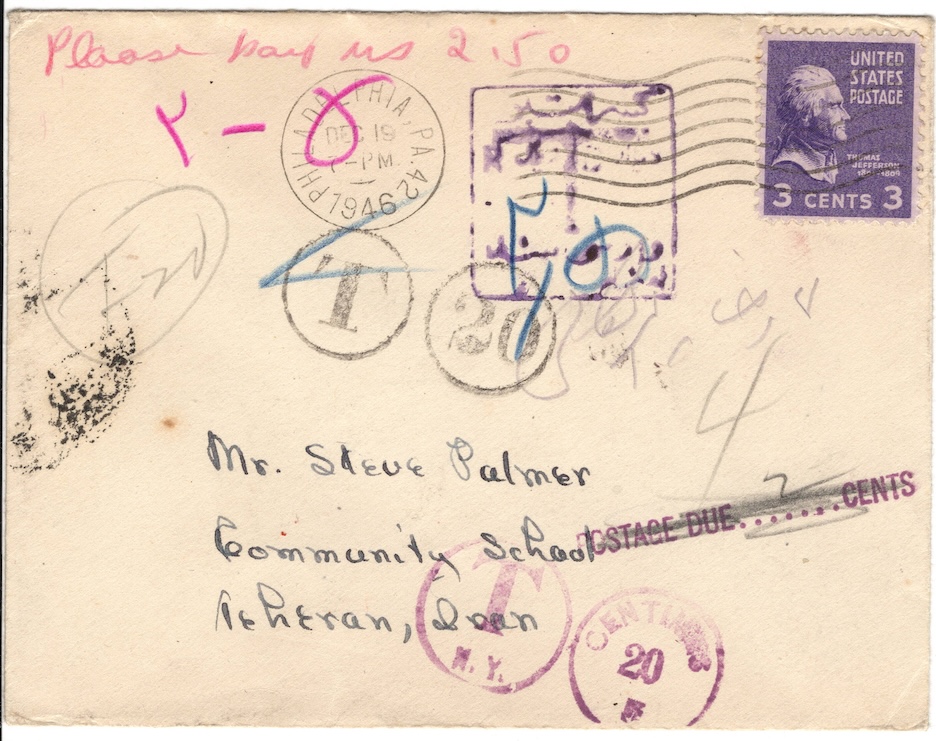 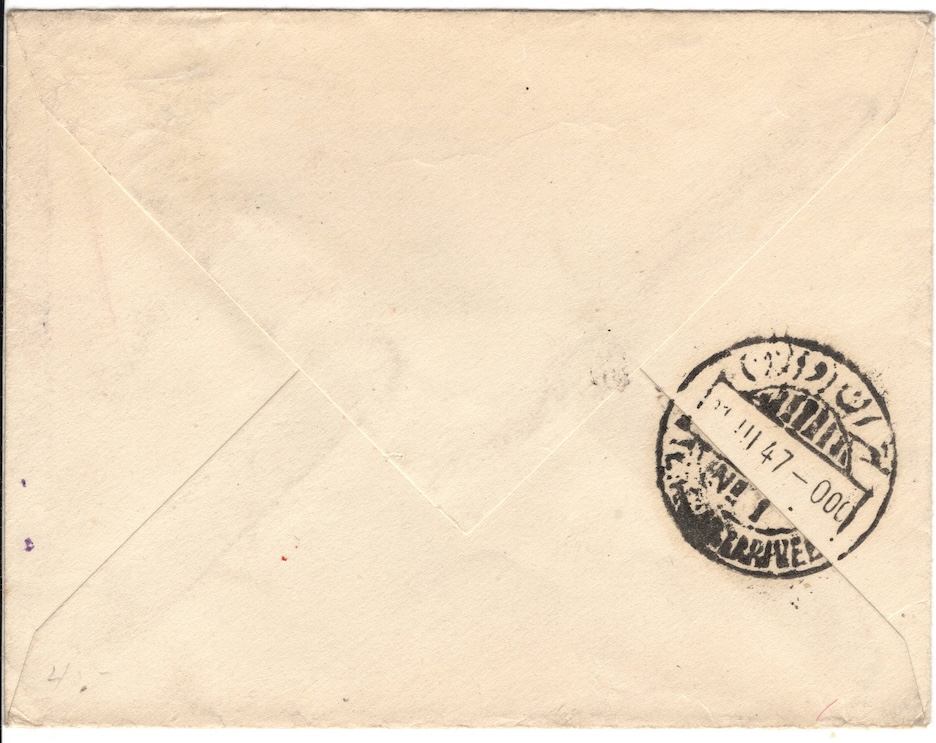 |
|
Send note to Staff
|
|
|
|
|
Pillar Of The Community

United States
1167 Posts |
|
|
Indeed an interesting cover. I like busy covers like that. I'm no expert but if you're looking for a critique, here's my 20 centimes ...
I agree with the write up yet I still have questions. "In Tehran, clerks added magenta and blue notations" -- there are also pencil notations, is that another T-20 at the left, and is that Farsi on the right? Can you read what that says above the big "4" ? Was it likely the same clerk who scratched out the "postage due 2 cents" who also wrote the "4" etc and the pencil T-20? One may never know, and best not to speculate, just wondering if you tried to interpret that part of the cover.
[boxed "Postage Due … 2 Cents."] - is there a box surrounding this marking?
"confirmed [postage due] collection with a purple Farsi handstamp" - - since I do not read Farsi and I am not familiar with this marking, it would be nice for the detailed writeup to include a literal translation of this marking for future reference. Is it simply "postage paid" or ??
"Backstamped Tehran, early 1947" - I would prefer to see a more specific date in the description. I am reading the month as Roman numeral III (March?). Is that a correct interpretation of an Iranian cancel from 1947? Is any calendar conversion needed from that time period?
My point being, in a detailed writeup of a cover, don't just describe the obvious things, also explain the things that someone looking at the cover might not know. I collect Prexie covers in general, but I do not have a deep understanding of receiver markings from other parts of the world, so if I saw this cover for sale, it would be helpful for the description to decipher those sorts of details. My first interest was, how long did surface mail take from USA to Iran in 1947, and "early 1947" did not give me that answer.
Not criticizing your write up at all, just responding to your inquiry about what others think. |
Send note to Staff 
|
|
|
Pillar Of The Community
United States
811 Posts |
|
|
Thanks for the critique. A few points: The "postage due. . ." marking is not boxed - thanks for catching that. The 2 was definitely crossed out. . .i ignored that, but perhaps I shouldn't. It does look like it was replaced with a "4" - not sure why that would be - maybe a penalty? It does look like another "T-20" in pencil. I do not know what the magenta or blue markings say - I assume they were applied in Iran and maybe in Farsi? I cannot read the pencil notation above the "4" - again, maybe Farsi. The backstamp does not appear clear enough to read other than the year. It is also my guess as to where the circled markings were applied. AI translated the purple farsi handstamp as "2 rials," but there is obviously more written than that. |
|
Send note to Staff
|
|
|
Pillar Of The Community
United States
811 Posts |
|
|
Well, it looks like the AI came through on the farsi translation on the purple handstamp: "2 rials should be collected" (The forum will not accept non-Latin characters, so I cannot show the actual Farsi letters or the latinized version which has accented characters). |
|
Send note to Staff
|
| Edited by Philazilla - 08/19/2025 9:30 pm |
|
|
Pillar Of The Community
United States
811 Posts |
|
|
Ok - I think I have clarified some things. . .still not 100% sure on all of it. . .especially my interpretation of the various local currency notations. . .Wawrukiewicz confirms the rates and rules, AI did the Farsi translation, but I could be interpreting something wrong.
Franked with a 3¢ Jefferson and canceled Philadelphia, Dec 19, 1946, this cover to Tehran was underpaid by 2¢ against the 5¢ UPU surface rate per ½ oz. U.S. clerks marked "Postage Due … 2 Cents," then crossed it out and penciled "4," applying the UPU rule of double deficiency. A faint pencil notation, possibly in Farsi, appears above, with "T 20" at left.
At New York, purple encircled "T N.Y." and "CENTIMES 20 F" indicated the minimum UPU surcharge; black "T" and "20" handstamps, likely from France, reaffirmed the charge ("T" = taxe, or postage due).
In Tehran, the due was variously converted: a purple handstamp reads "2 rials should be collected," a blue manuscript "4 rials," and a magenta notation "2–3 rials." A final magenta instruction fixed the charge at 2.5 rials ("Please pay us 2.50").
Backstamped Tehran; only the year "47" is legible, the month and day unclear. Addressed to the Community School, an American-founded institution that operated in Tehran until 1979. |
|
Send note to Staff
|
|
|
Pillar Of The Community
6366 Posts |
|
|
I suspect the "Postage due 2 cents" was applied at Philadelphia.
Lacking a return address to collect the 2 cents from for remailing, it was sent on to NY where the 2 was crossed out and the international due calculations applied, etc. |
|
Send note to Staff
|
|
|
Valued Member
United States
213 Posts |
|
|
Thank you Philazilla for this post and write up along with ZebraMan and John Beckers responses, I learned A helluva LOT by reading this.
I love collecting covers and FDC's and have been doing so for a while now but I am just starting to learn how to decipher them as well,...ugh...I struggle because I am not that great at the research part unfortunately.
Eventually one day if I ever get a scanner and computer that works I'll be able to show them here. |
|
Send note to Staff
|
|
|
Pillar Of The Community
United States
811 Posts |
|
|
For those following, I did some checking on the farsi numerals and determined that the "backwards 7" in both pink and blue is a "2" and the "topless 8" is a "5" the pink note reads "2-5" and the blue reads "2,5" (comma being the decimal separator in that language.) And th "<" is probably just a check mark. So all the Iranian markings indicate 2.5 rials due except for the purple handstamp which I can't independently read or decipher, but the AI bot is confident that it says "2 rials should be collected" - and not 2.5. So I have now updated my description:
1946 Underpaid UPU Surface Letter to Iran
Franked with a 3¢ Jefferson and canceled Philadelphia, Pa., Dec 19, 1946, this cover to Tehran was underpaid by 2¢ against the 5¢ UPU surface rate per ½ oz. Philadelphia clerks marked "Postage Due … 2 Cents." Lacking a return address, the New York exchange office forwarded the letter with postage due, crossing out "2" and penciling "4," per the UPU rule of double deficiency. A faint pencil notation, possibly in Farsi, appears above, with "T 20" at left.
At New York, purple encircled "T N.Y." and "CENTIMES 20 F" showed the minimum UPU surcharge; black "T" and "20" handstamps, likely from France, reaffirmed the fee ("T" = taxe, or postage due).
In Tehran, the due was recorded four ways: a purple handstamp "2 rials should be collected"; a blue manuscript "#1778;,#1781;" (2.5); a magenta manuscript "#1778;-#1781;" (2.5); and a final magenta instruction fixing the charge at 2.5 rials ("Please pay us 2.50").
Backstamped Tehran with a boxed arrival mark; only the year "47" is legible, the month and day unclear. Addressed to the Community School, an American-founded institution that operated in Tehran until 1979.
[I left in the farsi characters which will be rendered here as unicode numbers] |
|
Send note to Staff
|
|
|
Valued Member
Sweden
138 Posts |
|
|
Pillar Of The Community
6366 Posts |
|
|
Quote:
the month and day unclear. The month on the backstamp appears to be "III", thus March. |
|
Send note to Staff
|
| Edited by John Becker - 08/24/2025 08:23 am |
|
|
Valued Member
United States
213 Posts |
|
|
Wow,...way above my education level - you guys are incredible with your investigative and researching skills...I'm just amazed. |
|
Send note to Staff
|
|
|
Valued Member
United States
158 Posts |
|
|
Well, I'm flabbergasted... never thought I could be considered a postal rates "expert" yet here I am, haha!
... Two separate posts now have repeated "1/2 ounce" ... nonsense since 6th UPU Congress of 1906, conventions effective Oct. 1, 1907. (Table 1, page 4 Wawrukiewicz and Beecher, int'l rates 1872-1996.)
... Just wanted to look up to confirm, since I've handled hundreds of int'l surface covers and dare say only a handful had "tissue" envelopes (e.g., as used for AIRMAIL since many air rates well into 20th century were based on 1/2 oz weight steps). |
|
Send note to Staff
|
|
|
Pillar Of The Community
United States
811 Posts |
|
|
Thanks for noting the mistake. I will update the rate to "per ounce" rather than "per 1/2 oz." |
|
Send note to Staff
|
|
|
Pillar Of The Community
United States
4474 Posts |
|
|
Philazilla, I was late to this party and all the good comments were made. I have Defense (899-901) covers to Iran about any way you can find them including short paid. What I see as the nicest touch with this cover is that it is NOT addressed to an oil company. Being personal mail for here I find is more difficult than commercial (business) mail.
To add to UPU SURFACE rate, first unit is a nickel, after that 3 cents per unit. We call that unit an ounce, but the UPU used "grams" in the same way, but it was 20 grams. |
|
Send note to Staff
|
|
| |
Replies: 13 / Views: 2,498 |
|




 Posted 08/19/2025 6:28 pm


