| Author |
 Replies: 137 / Views: 11,230 Replies: 137 / Views: 11,230 |
|
|
|
Bedrock Of The Community
12781 Posts |
|
|
Quote:
And that they care about reputational conversations. Readers in the organization usually tip off nonprofit hobby organization leadership about forum threads like this within a few days, so one would think that they know. I have had it happen many times as a hobby organization leader. And setting automated alerts for open posts that use your organization's name is standard practice among those customer-focused organizations that have a CR officer or use an outside PR-CR firm. Alas, the organization has to care.
Quote:
I doubt that the PF has anything or anyone even remotely interested in doing this. From a tech or tech-adoption perspective, the PF is firmly entrenched in the 1980s, in my experience. I say that not as an insult, but an observation. Given the nature of the ideological comments frequently made here by one member who purports to be a part of the PF organization I highly doubt they monitor this forum either. If they did any ties with that person would have been severed long ago. Insulting at best fully one half of your customer base is not a smart thing to do. Maybe they should know. |
Send note to Staff 
|
|
|
Valued Member
98 Posts |
|
|
As this is about the PF mostly, I would like to add that exactly the same is also true for the other one, the PSE. There it is exactly the same, no name given who was expertizing, and also no real answer from the PSE about the expertizing when asking. But PSE even does not have any certificate archive (had to be made privately if I remember), so here the PF offers even more transparency.
Interesting that in the US, the expertizing landscape this has developed this way, while in Europe, I have sent so many stamps to expertizers always signing with their name, giving detailed answers when asking before or after expertizing.
(It should be normal for a large US expertizing company to offer an archive with scans of high quality from both stamp sides at least for above 1000-5000 USD catalogue value, this would be not a matter of time.)
|
|
Send note to Staff
|
|
|
Valued Member
98 Posts |
|
|
to keep it factual and objective again:
has there never been any article or discussion or letter to the editor in any printed or online philatelic publication about those questions?
(how the expertizing is organised in the US, if it would not be better to name the experts rather than hiding them, why there is no standardized way to get questions answered by the experts, why there is no archive at the PSE and the archive at the PF not always showing the best scans, why there is in general not more information about how some rare stamps have beedn identified, always a bit a mystery) |
|
Send note to Staff
|
|
|
Pillar Of The Community
Netherlands
6647 Posts |
|
|
As to the colour scans: Unless I am mistaken, the entry in the PF database implies that this certificate and that of nr. 563441 are of the same stamp. 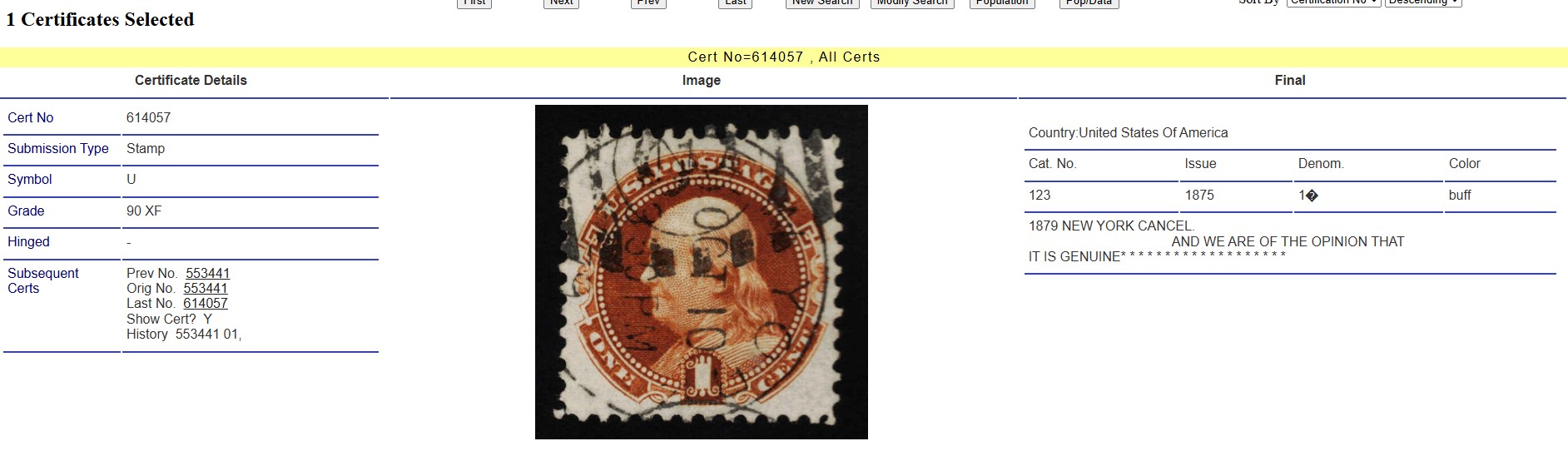 That other one, also, is in the database: 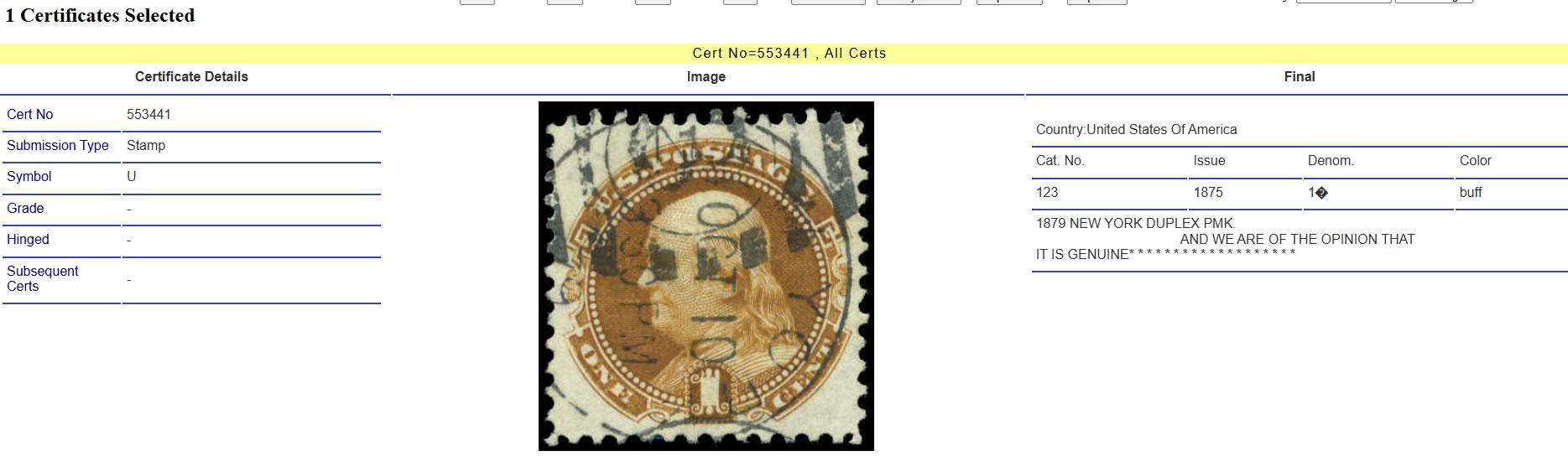 |
|
Send note to Staff
|
| Edited by NSK - 12/21/2025 1:07 pm |
|
|
Bedrock Of The Community
United States
10870 Posts |
|
|
Clearly taken at very different times many years apart on different equipment. The top scan is much closer to the actual shade, although it is a bit dark. |
|
Send note to Staff
|
|
|
Pillar Of The Community
Netherlands
6647 Posts |
|
|
Quote:
Clearly taken at very different times many years apart on different equipment. That was what I thought. I did not see issue dates for the certificates. Did I miss those? It, nicely, illustrates how useless online images are for identifying colours and, also, how much variation might be due to devices or the wear of those devices. Quote:
The top scan is much closer to the actual shade, although it is a bit dark. That surprises me, as other images in the database appear a little closer to the bottom image. This, too, should not be a surprise. I have seen plenty scans that distort colours almost every time you scan them. |
|
Send note to Staff
|
|
|
Pillar Of The Community
Netherlands
6647 Posts |
|
|
There, also, is quite a difference in the colour of the paper inthose two scans. |
|
Send note to Staff
|
|
|
Bedrock Of The Community
United States
10870 Posts |
|
|
There is a difference in the cancellation too. This is why scans have limited applications. |
|
Send note to Staff
|
|
|
Bedrock Of The Community
United States
10870 Posts |
|
|
Because the 133 was issued on soft paper, it's by nature less consistent. Soft paper always produced a less quality product, with greater variation. |
|
Send note to Staff
|
|
|
Valued Member
United States
233 Posts |
|
|
Valued Member
United States
470 Posts |
|
|
Vagaries of the particular stamp that is (or was) in question aside - I find this thread interesting as it does bring to mind some key questions around transparency (or a lack thereof): 1) Why won't some organizations that rely on multiple experts divulge who examined a particular patient, and 2) Why is it often not possible to receive detailed notes? As Rog said way back at the beginning of this thread, "It has long been argued that the notes should be included with all opinions since you paid for the work". Why is this not standard? Individual experts obviously don't deal with 1); I'm not sure to what extent they release their notes, either proactively or when asked. Is it just to avoid whining and complaints from customers who don't like the verdict they received? Is it to keep their methods somewhat secret to protect business? For most people, the point of getting a cert for something is to increase its market value by both 1) establishing identity and 2) establishing trust in the determination of identity. revcollector said, Quote:
I have also explained why it is better not to know exactly who is actually looking at these items, unless they choose to say so I've read through this thread and unless I missed something, I don't see this explanation. I'd love to know, and from the messages here quite a few others would, too. Please explicitly tell us why it's best to keep the expert's identity a secret. |
|
Send note to Staff
|
|
|
Bedrock Of The Community
United States
10870 Posts |
|
|
Quote:
I've read through this thread and unless I missed something, I don't see this explanation. I'd love to know, and from the messages here quite a few others would, too. Please explicitly tell us why it's best to keep the expert's identity a secret. Because it opens them up to angry collectors who disagree with their opinions, and it opens them up to the possibility of friendly bribery to give a desired opinion. These are just facts of life, not anything against anyone who does expertising or who submits items. Back in the day, most expertising was done by dealers who had a financial interest in people knowing who they were. The item that started this thread was originally done by two dealers. And I am not sure what one actually expects to find out from the notes. In my experience, 98% of them are very basic, even for stamps such as this that are found to be different from what was submitted. The perfs were wrong, or the watermark was wrong, or the shade was wrong, or the type was wrong, etc. Most of the few examples that are of real interest are postal history items, where more detailed reasons might be given for why something is not what it seems to be. |
|
Send note to Staff
|
|
|
Pillar Of The Community
Netherlands
6647 Posts |
|
|
-Wouldn't the notes give some clue on the characteristics that you should look for?
Also, I suspect there always be people who get angry when their expectations are not met, You, only, have to search for threads about certain extremely expensive stamps that poppoed up from time to time. I doubt these people get angry because a name is mentioned.
Littbarski mentioned European expertising practices. It is quite common for a certificate to be issued by a single expertiser who is recognised as an authority in the field. Often that person, also, is a dealer. (Francesc Graus for Spain, Roy Hamilton-Bowen for Ireland, and Henk Vleeming for the Netherlands come to mind; the former two being dealers.) However, I have never seen any notes and certificates tend to confirm that a stamp is genuine, even if altered, not that it is an outright forgery.
|
|
Send note to Staff
|
|
|
Bedrock Of The Community
United States
10870 Posts |
|
|
Quote:
Wouldn't the notes give some clue on the characteristics that you should look for? Very possibly, but those should be found simply by comparing what it was submitted as to what it came back as. So if someone submits a stamp as US 596, and it comes back as US 632, they should be able to see that the perforations are the difference, 11x10.5 instead of 11x11. |
|
Send note to Staff
|
|
|
Valued Member
98 Posts |
|
|
well, for me it would not be so necessary to receive any other document / notes, but only the certificate. The main difference is just, in Europe you get a certificate from an expert, in the USA you get it by... ? This difference means that the person giving me the certificate is just that, a person :). So it can answer question before and after, and actually I had it never happened that I did not receive an answer. In my case, all experts were only experts and not dealers which I never saw actually.
I don't think that the history of expertizing in the US area can be changed so easily, so there will be probably PSE and PF in the future. But naming the experts would mean a huge improvement in transparency and mainly communication for all collectors. The experts would not need to give their personal data or contact information, this could of course be managed by the organisation. |
|
Send note to Staff
|
|
|
Replies: 137 / Views: 11,230 |
|




 Posted 12/21/2025 10:15 am


