The victory of Warren Harding in the 1920 Presidential election ushered in a new Republican administration. Among Harding's appointments in the Post Office Department was W. Irving Glover, the Third Assistant Postmaster General.
Among Glover's early efforts was the revamping of the nation's postage stamps. It was announced on June 30, 1922 that a new series of ordinary postage stamps would replace the Washington-Franklin series that had been in use sinch 1908. The new series, now known as the Fourth Bureau Issue, would include portraits of past Presidents as well as scenes of national monuments.
It was decided that our nineteenth president, Rutherford B. Hayes, a Republican, would appear on an eleven-cent stamp in the series. A Mathew Brady portrait in the Library of Congress was selected for the subject image of the stamp.
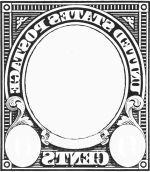
It had also been determined that the low value stamps of the new series through the 14-cent value would share a common stamp frame and lettering. Die 706 was designed to provide this service for each of them. Note that die 706's engraving design below has a mirror image of the frame and lettering.
A steel block for the Hayes die proof was selected and assigned the identity of die 695.
Transfer role 1178 was made from die 706. It was used to transfer the frame and lettering on die 706 to the 695 steel block.
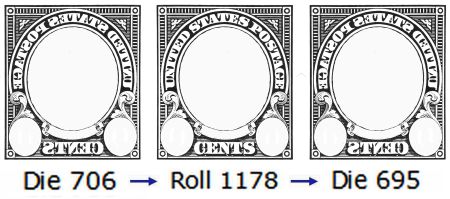
Once the transfer roll had applied the detail from die 706 to the 695 steel block, engraver John Eissler added the Hayes picture to the design and E.M. Hall and H.I. Earle added the remaining elements of the design. The master die was now complete.
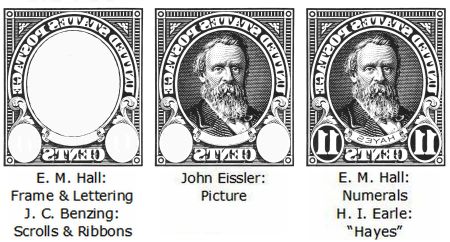
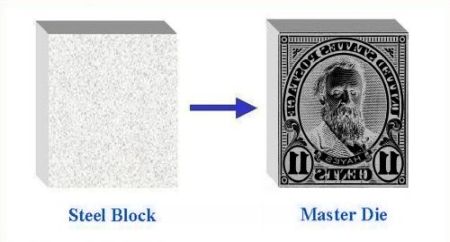
A new transfer roll, one derived from the Hayes master die, was next needed.
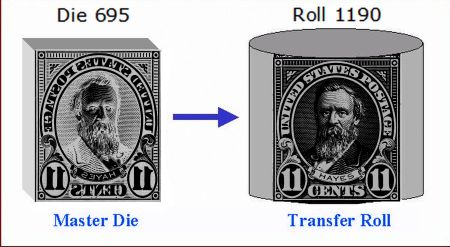
The transfer roll would be used to transfer 400 images of the master die design to a steel plate.
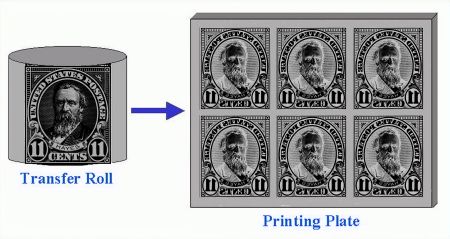
The first Hayes plate, 14058, was completed and certified on Saturday, September 30. It then went to press by itself and printed 600 sheets. Three other plates, 14059 - 61, that would have also been used, would not be available for use until October 6.
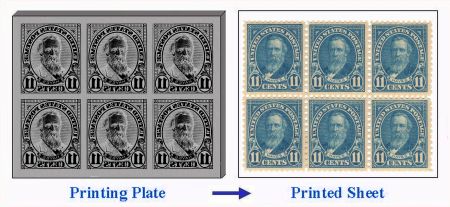
The printed sheets of 400 stamps were each converted into four panes of 100 stamps which were then made available for the first day of stamp release on October 4 at Fremont, Ohio and Washington, DC. post offices.
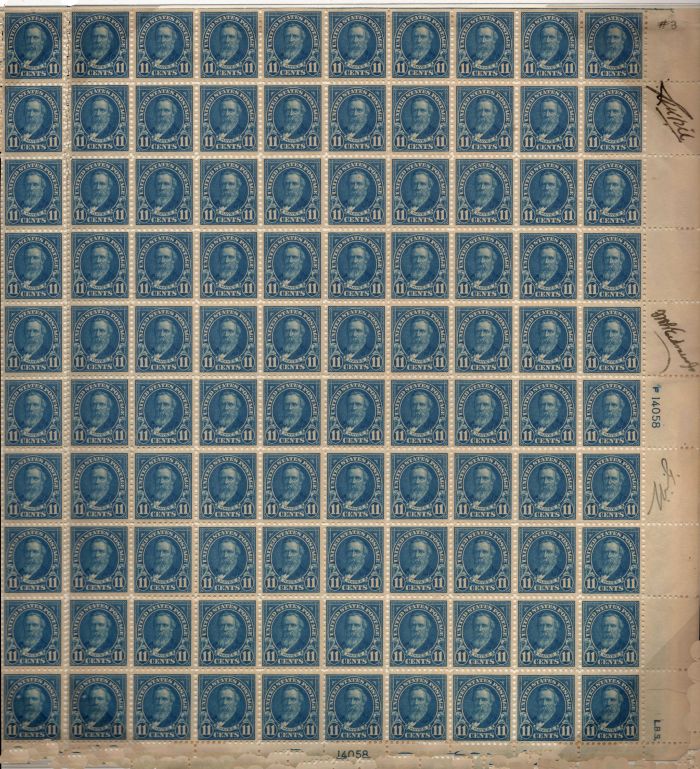
The following pane is from the first printing because it has a marginal "F" marking by the side plate number. That is true of some panes from the first printing. Also, it is one of 32 panes that were signed by officials before the first day of issue to commemorate the new issue. See side selvage.





 Posted 12/06/2025 4:58 pm