Background to a ProblemThe U. S. Special Delivery Service was started on October 1, 1885. This was the result of a proposal that a special (delivery) 10-cent stamp be provided, which when affixed to a first class letter in addition to the ordinary postage, should cause the receiving post office of the addressee to provide immediate delivery of the letter. Policies and procedures were put into operation and the new service became an instant success. Within a year the service had been extended to all domestic post offices and to all classes of mail, regardless of weight or distance.
The Special Delivery postage requirement was modified on July 1, 1907 when it became permissible to use ten cents of ordinary stamps in lieu of the Special Delivery stamp. This required that the phase "Special Delivery" be prominently displayed on the mailable item.
Other countries followed suit. Canada created its own Special Delivery Service and Special Delivery stamp in 1898. However, the problem of securing expedition of mail that crossed country borders began to attract attention in the U.S. and Canada. Any incoming foreign mail with the U.S. Special Delivery stamp would receive special delivery service in the U.S. This service was not provided if the Special Delivery stamp was that of the sending country. The item would be treated as ordinary mail. The same situation was true for U.S. requested special delivery service in Canada. A Canadian Special Delivery stamp was required.
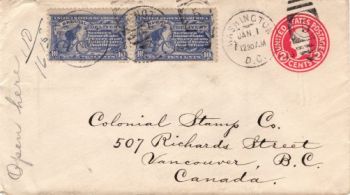
Solving the ProblemA new reciprocity agreement between the U.S. and Canada finally simplified the special delivery process by allowing for the use of the sending country's Special Delivery stamp or equivalent stamps on mail requiring special delivery service within the receiving country. The agreement went into effect on January 1, 1923. Since Canada had increased its domestic Special Delivery fee to 20 cents in 1922, the Special Delivery fee for the reciprocity service was set at 20 cents.
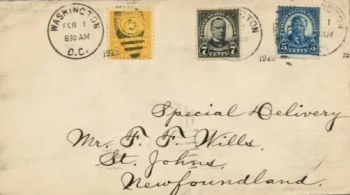
The reciprocity agreement was extended to Newfoundland in early 1926. A separate treaty was made with Newfoundland because it was governed independently of Canada at the time.
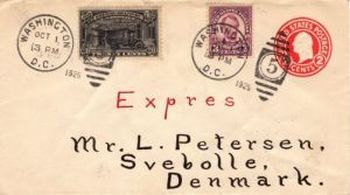
The Special Delivery reciprocity was made effective between the U.S. and six European countries on October 1, 1926; Denmark, Belgium, France, The Netherlands, Norway, and Sweden. Special Delivery covers were now required to have affixed to them an "
Expres" Special Delivery label or the equivalent boldly marked in red ink. The 20-cent fee remained unchanged.
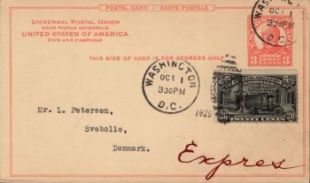
Treaty rate reciprocities were enacted by the United States with more than 40 countries by the end of 1935.
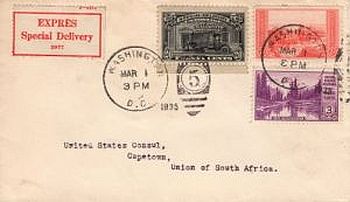
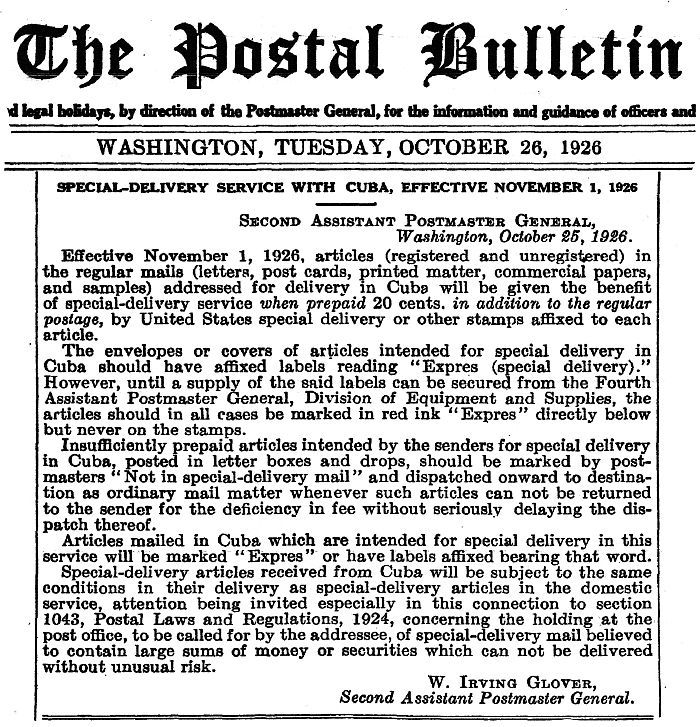
Henry Hammelman, the noted first day cover servicer, worked for the Post Office Department in Washington, DC. He had access to the Postal Bulletin, the daily publication of the Post Office Department that discussed new service policies and procedures. It enabled him to know when the special delivery reciprocities with other countries would first take effect. He would then mail, on a country's respective effectivity day, a small number of U.S. covers requiring special delivery in that country. A Postal Bulletin example is found below at the end of this delivery.
51 different Hammelman First Day of Service reciprocity special delivery covers are known addressed to 28 countries. In some cases, both covers and postal cards were sent to the same address. All are easily identified by Henry's return address on their back sides. The covers and postal card shown in this delivery are all Hammelman serviced items. Have you seen others? You can find out more about the 51 Hammelman covers on the web at treatyrates.wordpress.com.
The Postal Bulletin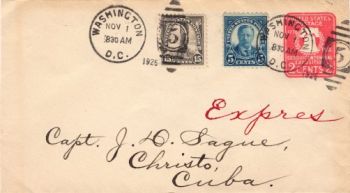





 Posted 12/23/2025 5:39 pm


