Quote:
My question is why would they bother making such a small change if it is a change at all. The overall print quality is obviously not as crisp on one block vs the other and that points to variations in a mass produced low value utilitarian item.
Well this is where we get into real unknowns and maybes. Maybe BANB looked at the original stamp and, in a moment of pride, said "We can do better than this - and at essentially no cost for subsequent printings". Maybe
Canada Post "That looks terrible. Fix it!" and, as you know, the customer is always right. Maybe someone like me with poor eyesight (from too much flyspecking?) said "I have trouble reading the denomination. Can you fix it?" and the request trickled through the system and was fixed.
Quote:
Ah, so you did see the difference so it complies with the catalogue listing, but is anyone going to buy it at a CV of $100, or $10, or even $1. I think the problem here is that the catalogues should have said something like "Major kiss print". But then people like you and myself are going to argue over what "major" means.
Unitrade lists varieties with minuscule differences so why not include this one. The 741iv I posted below is described as a kiss print but you need an electron microscope to see the difference.
Here's a question? Why does Unitrade list 714iv as "Black inscription and ©1977 doubled, kiss print" then list prices for everything but inscription blocks". Here are two images of the similar kiss print on 743i from posts in January 2055:
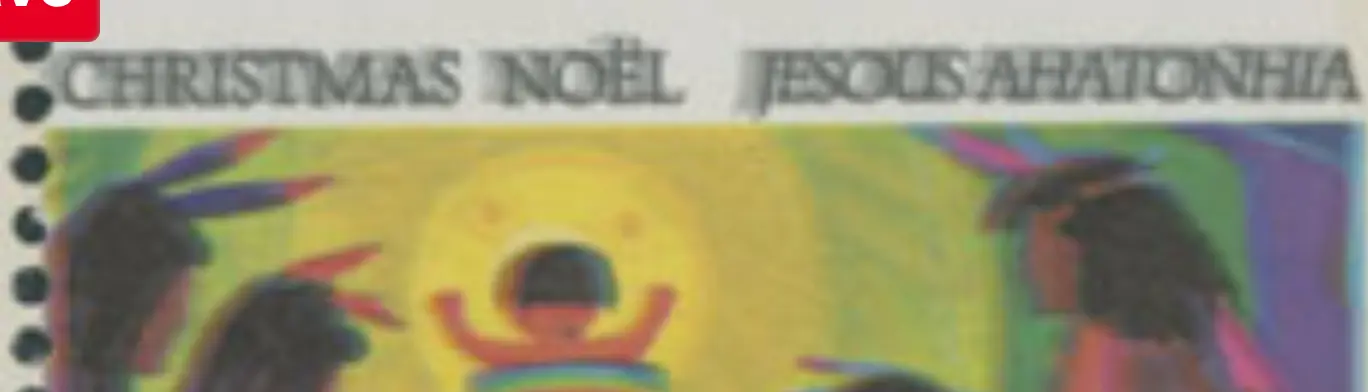
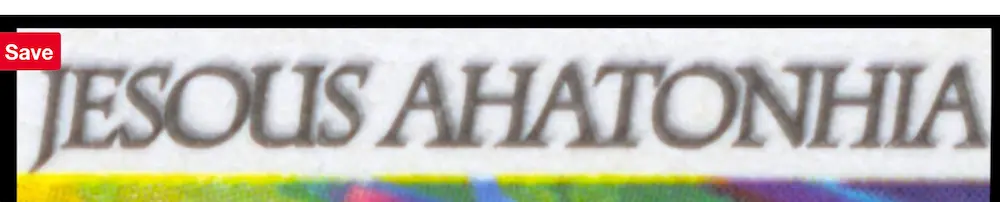
The first comes from an auction catalogue and presumably the auctioneer knew what he was doing. Re the second one, you said that you didn't think that it qualified as a 743i. It would be interesting to know why you thought this. Like the first, it is complete enough, given the italicised letters, to see that the kiss print includes all of the black, so what more could be needed for it to qualify? To my mind, the two prime requirements are completeness and the shade (there's that nasty word again) of black.
A final word about the Christmas 1977 stamps: I have a number of plate blocks of all denominations. Probably 80% of them exhibit, albeit minimally, the kiss print.
And to close off, a word about reselling ones collection. I am currently in this stage as I am getting too close to my sell-by date and have no-one who would appreciate my after I'm gone. I could, of course, sell it to a dealer for pennies. I don't think dealers are really ripping people off as I know they need to devote a lot of time to verifying exactly what they are getting. I am getting a huge kick out of doing this. It's just like collecting , but after you research a stamp bring money in, instead of paying out. As an investment, low value stamps are probably the best investment. Selling single stamps is a mugs game but PBs, sheets and pre-cancelled can give a good return. Looking for lowest prices on Hipstamp, I can get $US0.75 for a 1#8373; 705, a profit of around 1000% over the 4#8373; Canadian cost. For pre-cancelled (those days are now long gone) the profit on the doubles. Then there are the different flourescences. All of my 713 seem to be
DF/MF (713iii). I picked 30 or 593b PBs in 1976 and they should yield around 400%. Meanwhile, I can't get rid of my 1976 $1 and $2 PBs at a 25% profit.
I started using Hipstamp seriously last year and, , To date, with only 350 stamps listed so far, I have probably made more than a Dealer would pay for my entire collection. Again, largely with the help of Australian low denomination stamps. And I have done this, generally, by looking at existing prices on Hipstamp and shaving a bit of the lowest.
Well, that's enough for this round.





 Posted 02/07/2026 2:09 pm


