Stamp Community Family of Web Sites
Thousands of stamps, consistently graded, competitively priced and hundreds of in-depth blog posts to read


Stamp Community Forum
 
Username:
Password:
Save Password
Forgot your Password?

This page may contain links that result in small commissions to keep this free site up and running.

Welcome Guest! Registering and/or logging in will remove the anchor (bottom) ads. It's Free!

Scott 552 Frame Height Variance?

Previous Page | Next Page    
 
To participate in the forum you must log in or register.
Author Previous TopicReplies: 34 / Views: 1,894Next Topic
Page: of 3
Bedrock Of The Community
United States
10588 Posts
Posted 03/03/2026   4:27 pm  Show Profile Bookmark this reply Add revcollector to your friends list  Get a Link to this Reply
Am Teck
Yawn. After 69 years in the hobby, I will continue to utilize logic over a flyspecker looking for attention.
Send note to Staff  Go to Top of Page
Valued Member
United States
10 Posts
Posted 03/04/2026   3:03 pm  Show Profile Bookmark this reply Add clarkphilatelics to your friends list  Get a Link to this Reply
Start with direct observation and simple known facts. Do not start with theories like "the sun revolves around the earth". Most flat plate stamps have flecks of ink on the back from stacking sheets after printing. Rotary press print impressions are slightly sharper with narrower lines and paper is slightly harder (and stronger). Flat plate stamps shrink after printing across the paper grain. Low denomination Bureau flat plate stamps were printed on 400-subject plates. Variable shrinkage in the horizontal direction should be expected. Flat plate booklet pane singles were printed on "special paper" with horizontal grain to minimize errors when cutting sheets into booklet panes. Except for AEF booklet pane stamps, all booklet pane stamps have one side or one side and the bottom imperforate. Booklet pane singles are noticeably wider or shorter than sheet stamps. Comparison with a reference stamp is faster and more effective than attempting to measure in millimeters. Early 20th Century United States stamps were printed and perforated by equipment built to English measurements.

Most First Bureau, Second Bureau, and some Washington-Franklin stamps have watermarks with letters aligned with the paper grain. Higher denomination stamps printed on 200-subject plates were generally printed on horizontal grain paper. Like anything from that era, exceptions occur. The most notable is use of "special paper" to print higher denomination Fourth Bureau (1922 issue) flat plate stamps after booklet pane production transitioned to rotary presses. The stamps, if the design is vertical, are shorter or wider. If gummed, the paper will curl in different directions. Keep in mind that perforator setup was sensitive to paper grain direction. Some sheets had one corner clipped diagonally to help insure proper orientation.
Send note to Staff  Go to Top of Page
Valued Member
United States
25 Posts
Posted 03/04/2026   8:33 pm  Show Profile Bookmark this reply Add TaylorHealey to your friends list  Get a Link to this Reply
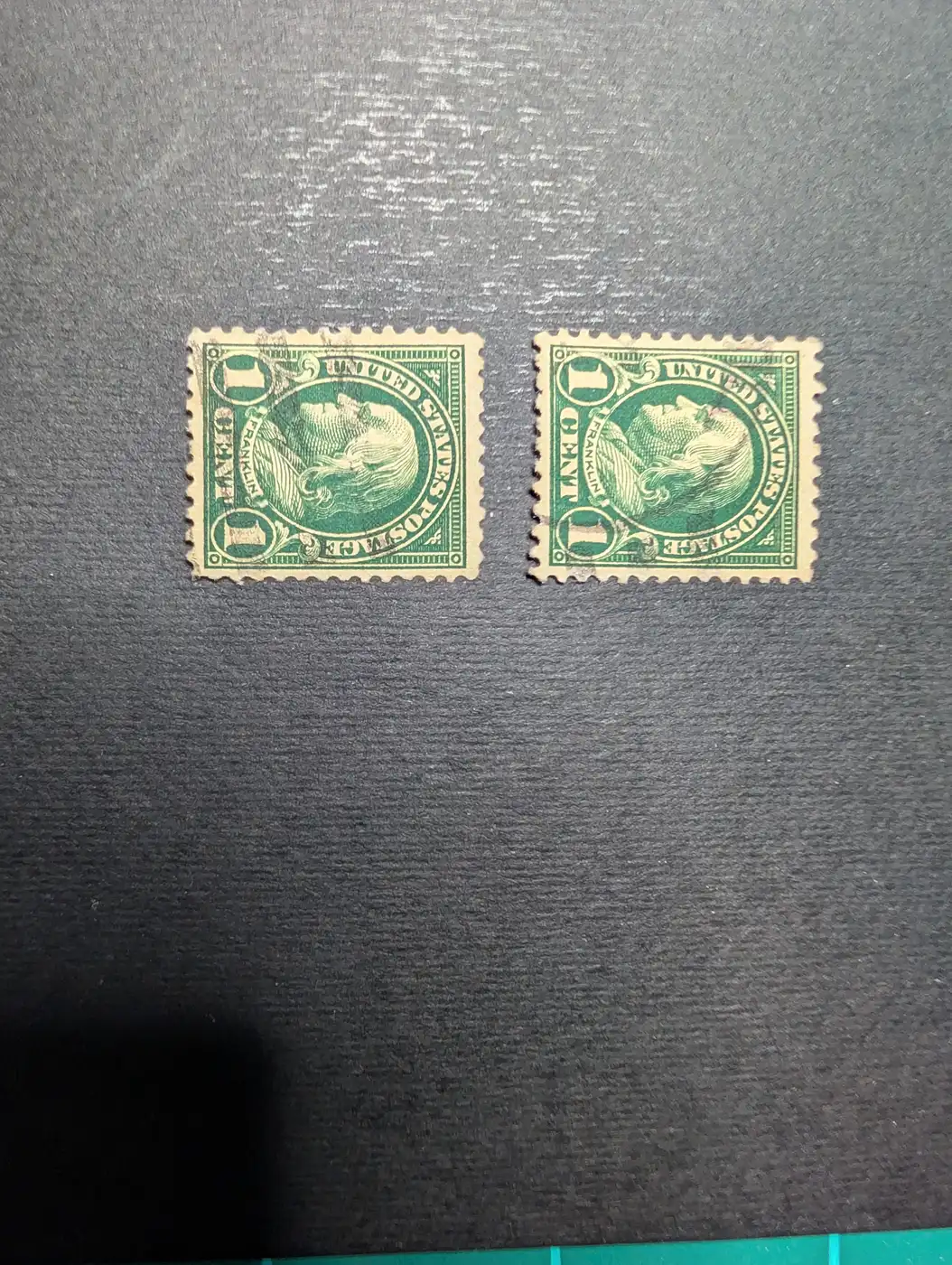
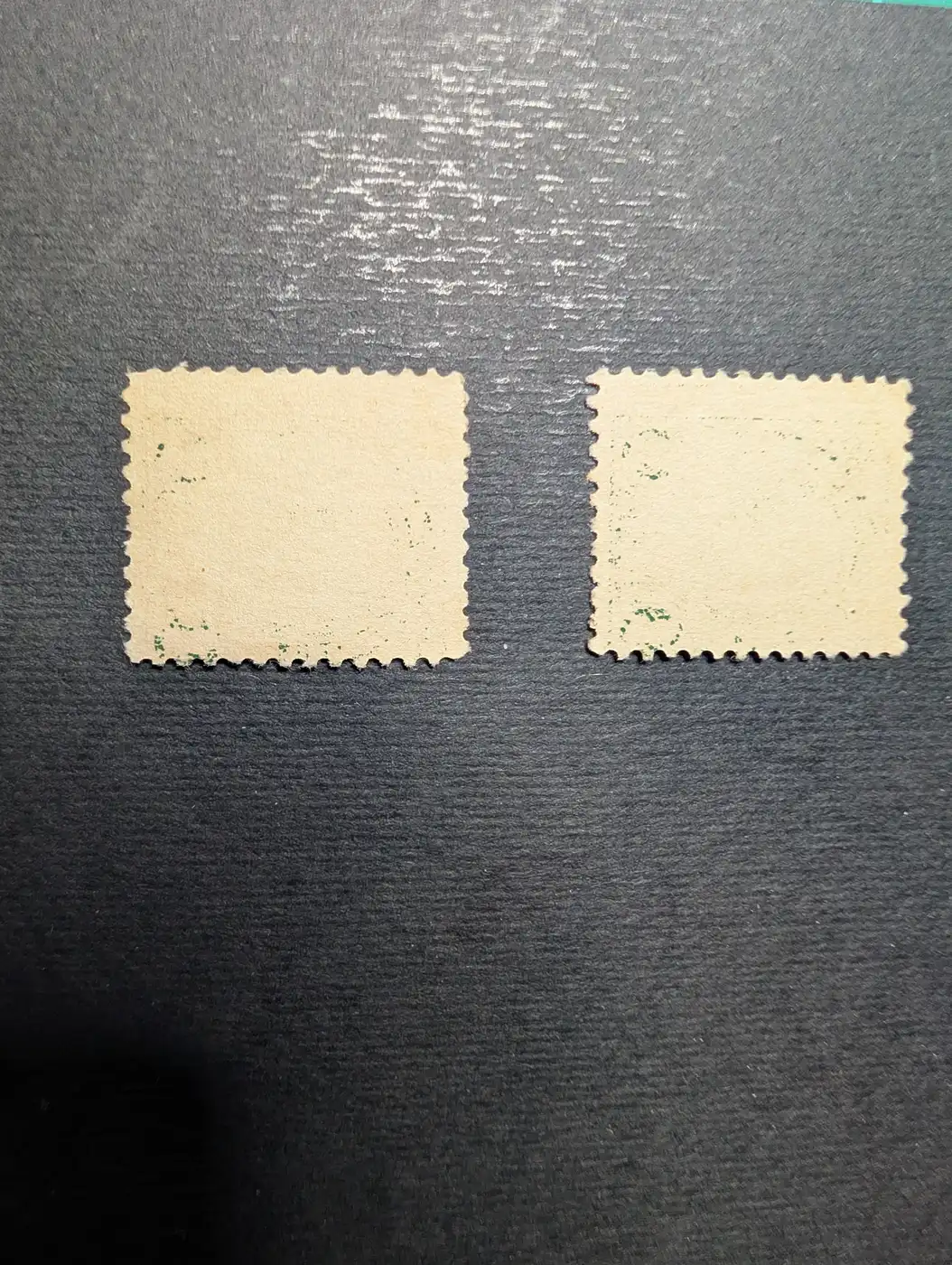
I tried using my scanner. It only does 600 DPI and outputs PDF files which cause quality loss when converting to JPG. These are pictures from my Google pixel 50MP camera which gives a resolution of 8000 some odd by 6000 some odd.

If that's not good enough just go ahead and lock the thread.

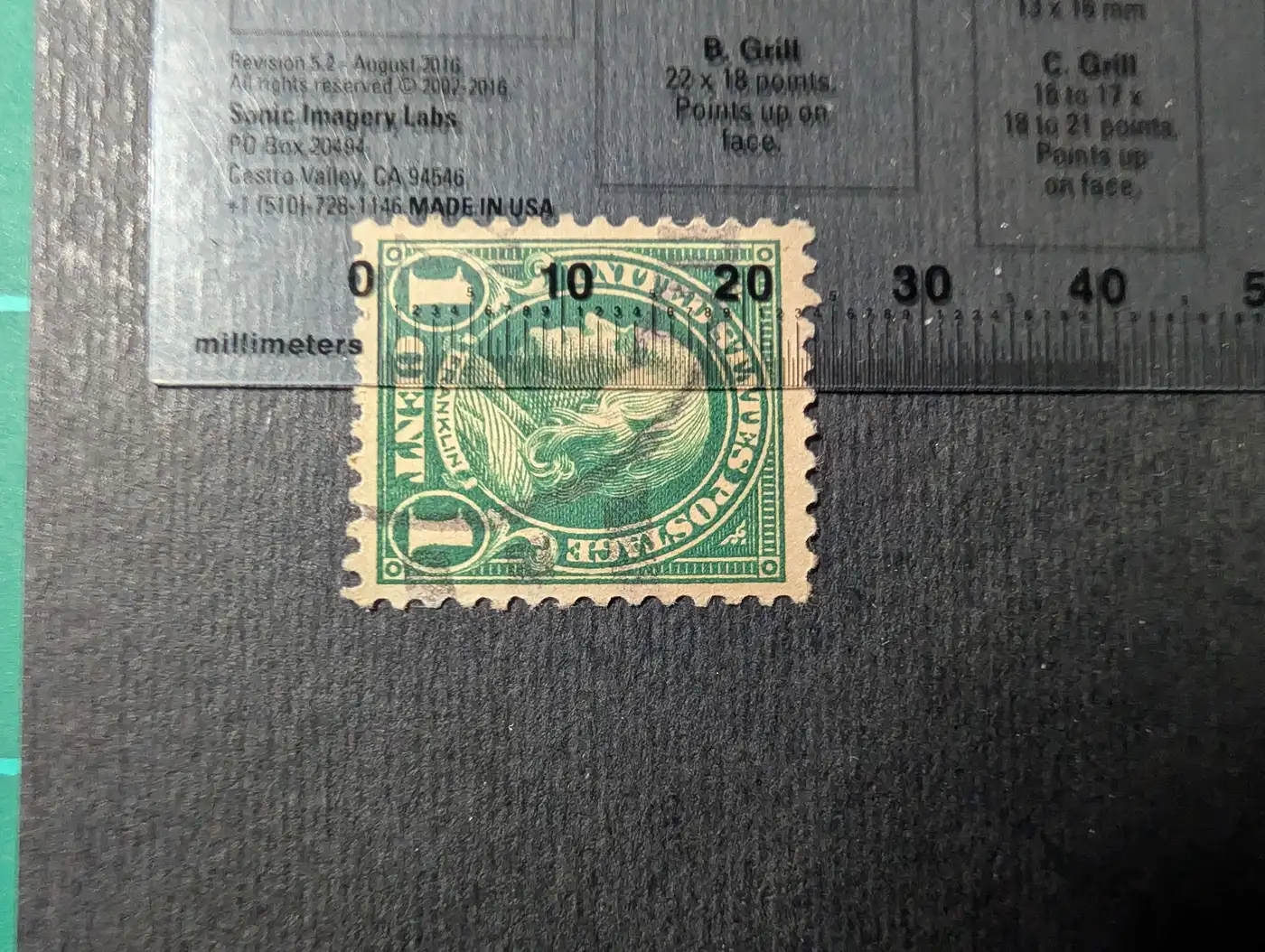
Clearly 552s. And it is clearly longer than 22mm. As stated.


Send note to Staff  Go to Top of Page
Valued Member
United States
10 Posts
Posted 03/04/2026   9:46 pm  Show Profile Bookmark this reply Add clarkphilatelics to your friends list  Get a Link to this Reply
Here is a quote from the Scott United States Specialized Catalog of Stamps and Covers:

"For a limited period of time in 1928 the Bureau of Engraving and Printing produced eleven stamps on "special" booklet paper, being sheets of paper specif­ically ordered and purchased for booklet pane pro­duction. A significant inventory of this paper remained when the BEP stopped printing booklets on the flat plate press and began printing all booklets on rotary presses. The "special" booklet paper had the grain running horizontally rather than the vertical grain paper normally used for sheet stamps. After being produced on moistened paper, stamps shrank four times more across the grain than with the grain. Thus, the stamps printed on "special" booklet paper shrank differently when dried than stamps printed on normal stamp paper, and the differences in design dimensions are readily identifiable.
The eleven stamps involved, with their minor-let­tered numbers, are Nos. 563b, 564b, 566a, 567b, 568a, 569a, C11 b, E13a, QE1, QE2 and QE3. All of the first printings of Nos. QE1, QE2 and QE3 were printed on "special" booklet paper.
Nos. 563b, 564b and 566a are slightly wider and shorter than the varieties printed on normal paper; Nos. 567b, 568a and 569a are slightly narrower and taller than their counterparts; and Nos. C11 b, E13a, QE1, QE2 and QE3 are slightly shorter and noticeably wider than their counterparts."

Please note the following:


  • The 22 mm height given for flat plate stamps is an approximate dimension that can vary somewhat. Rotary press sheet stamps were expected to be about a half millimeter taller and rotary press horizontal coils about half a millimeter wider.

  • The Bureau of Engraving and Printing tried multiple times without success to control uneven shrinkage of flat plate stamps. The amount of shrinkage after printing was related to how damp the stamps were when printed.

  • "Flat Plate Stamps were expected to shrink four times more across the grain than with the grain. Size differences due to grain direction are noticeably less than rotary press-flat plate differences."

  • I cannot over emphasize who futile it is to "measure" stamps to determine if they are flat plate or rotary. Normally paper, color, and printing differences should be sufficient. Comparison with another stamp is the best option.

  • A 10x Peak loupe with a reticule is helpful for measuring to the nearest tenth of a millimeter, but the width of field is too narrow to easily measure across a stamp.


It may be possible to rescue the scanner with vuescan, a program that supports many scanners, some long abandoned by their manufacturers. Stamps should be scanned as tiff files and exported to jpg images for the web. jpg files cannot be modified without loss of resolution after each successive edit. Free image editing programs are available as alternatives to Photoshop and the recently renamed Photoshop Elements program.

Finally, and perhaps the most important. Please join the United States Stamp Society (USSS). Members can download articles from the Bureau Specialist that cover every aspect of United States Bureau stamp production and resulting varieties found by collectors. The society also publishes the Durland Standard Plate Number catalog with comprehensive descriptions of plate layouts and other useful information beyond what is in the Scott specialized.

Please mention my name and the Stamp Community Forum as recommending you for membership. I hope that others will also join rather than being frustrated by finding incomplete or inconsistent observations in this and other forums. New information is available every month in the Bureau Specialist, the most useful periodical about older and current United States postage stamps.

Some of the expertizing course material developed by Irv Miller, Bill Weiss, and I may also be available online from the American Philatelic Society Education Department. Some material exists on Stamp
Smarter.

If you are in planning to visit the Boston 2026 show in May, please stop by to chat.

Clark Frazier
Send note to Staff  Go to Top of Page
Moderator
Learn More...
United States
5094 Posts
Posted 03/04/2026   9:52 pm  Show Profile Bookmark this reply Add Partime to your friends list  Get a Link to this Reply
Those pictures were good. You just need to crop them just around the edges of the stamps before converting for upload next time. (We don't need to see all that empty space.). Thanks for getting back to us with the front and back pictures.
Send note to Staff  Go to Top of Page
Valued Member
United States
25 Posts
Posted 03/05/2026   12:37 am  Show Profile Bookmark this reply Add TaylorHealey to your friends list  Get a Link to this Reply
Clark thank you for that information. That is exactly what I was looking for.

Got it Partime
Send note to Staff  Go to Top of Page
Valued Member
Switzerland
480 Posts
Posted 03/05/2026   12:53 am  Show Profile Bookmark this reply Add drkohler to your friends list  Get a Link to this Reply
.. jpg files cannot be modified without loss of resolution after each successive edit

I wonder where that myth came from.
Most (all?) programs can set the compression factor. IrfanView, for example, has a 0..100 "quality" slider. 100 means zero compression loss.
Lossless jpg compression can yield huge image file size reductions, particularly with single color stamps. With single color stamps, you'd have problems seeing any difference even when the quality slider is set to 25 (which might give you a compression ratio of upto 100:1.
Send note to Staff  Go to Top of Page
Edited by drkohler - 03/05/2026 12:54 am
Valued Member
62 Posts
Posted 03/05/2026   11:18 am  Show Profile Bookmark this reply Add Am Teck to your friends list  Get a Link to this Reply
Clark, it has been a long while….. how quickly it flies. I hope you have been well!

It would be beneficial for this thread as well for Jayce's ones to include some further clarifications from your 2015 remarks. I quote:

{A rotary press stamp must be taller or wider than the original 3/4 x 7/8 inch size of the die. A flat plate stamp will not extend beyond the 3/4 by 7/8 inch. Variations in shrinkage due to the paper mesh or grain can be expected. If the stamp is smaller than the die, it must be a flat plate stamp. If it is larger than the die, then it is a rotary press stamp. By "larger", I mean about 1/2 a frame line or maybe 1/2 mm}.
Send note to Staff  Go to Top of Page
Pillar Of The Community
Netherlands
6526 Posts
Posted 03/05/2026   11:30 am  Show Profile Bookmark this reply Add NSK to your friends list  Get a Link to this Reply
Let's utterly ignore the strong offsets on the back shown in OP's images.
Send note to Staff  Go to Top of Page
Bedrock Of The Community
12552 Posts
Posted 03/05/2026   12:28 pm  Show Profile Bookmark this reply Add rogdcam to your friends list  Get a Link to this Reply

Quote:
Let's utterly ignore the strong offsets on the back shown in OP's images.


I was waiting for that one.
Send note to Staff  Go to Top of Page
Bedrock Of The Community
United States
10588 Posts
Posted 03/05/2026   2:27 pm  Show Profile Bookmark this reply Add revcollector to your friends list  Get a Link to this Reply
As a point of information-it is possible for a 594 or 596 to have offset on the back, because the waste stamps were simply tossed into a bin when printed, and would not be taken to be perforated until there were enough stamps to make it worthwhile. Since they were still wet, offset was possible, and I have seen at least one genuine example that did have offset on it.
Send note to Staff  Go to Top of Page
Valued Member
17 Posts
Posted 03/06/2026   09:56 am  Show Profile Bookmark this reply Add Jayce to your friends list  Get a Link to this Reply
Salute All, Clarkphilatelics,

I did read your explanations, yes, other factors are also important, I am asking for sizes for now, and I have some questions, parts of your explanations:

Flat plate stamps shrink after printing across the paper grain. Low denomination Bureau flat plate stamps were printed on 400-subject plates. Variable shrinkage in the horizontal direction should be expected. Flat plate booklet pane singles were printed on "special paper" with horizontal grain to minimize errors when cutting sheets into booklet panes. Except for AEF booklet pane stamps, all booklet pane stamps have one side or one side and the bottom imperforate. Booklet pane singles are noticeably wider or shorter than sheet stamps. Comparison with a reference stamp is faster and more effective than attempting to measure in millimeters.
The most notable is use of "special paper" to print higher denomination Fourth Bureau (1922 issue) flat plate stamps after booklet pane production transitioned to rotary presses.
For a limited period of time in 1928 the Bureau of Engraving and Printing produced eleven stamps on "special" booklet paper, being sheets of paper specifically ordered and purchased for booklet pane production. A significant inventory of this paper remained when the BEP stopped printing booklets on the flat plate press and began printing all booklets on rotary presses. The "special" booklet paper had the grain running horizontally rather than the vertical grain paper normally used for sheet stamps. After being produced on moistened paper, stamps shrank four times more across the grain than with the grain.

1- In earlier posts I did show a single booklet pane 1c Franklin which measure 22.06V and 19.57H which I did measure digitally. I followed your instructions and compare them to examples I have 552 and rotary ones. Like you said it is noticeably wider but the list you mentioned of the 11 stamps printed on special paper does not include the 1c Franklin, is it from the exceptions that was occurring that some 1c Franklin booklet was rotary printed on the remaining special paper stock or not, or something else, and why it wasn't denominated differently.

2- I have also a 1c franklin which measure 22.36V and 19.30H which also I did measure digitally and did compare with 552 and rotary ones. It is like shorter half line vertically than the rotary ones and bigger half line from the 552. Horizontally it is wider kind of a line than the 552 and kind of similar match to the rotary. Also, what is the explanation of that, is it like TaylorHealey mentioned from coil issues.


Send note to Staff  Go to Top of Page
Edited by Jayce - 03/06/2026 10:05 am
Bedrock Of The Community
12552 Posts
Posted 03/06/2026   11:55 am  Show Profile Bookmark this reply Add rogdcam to your friends list  Get a Link to this Reply

Quote:
which measure 22.06V and 19.57H which I did measure digitally.

which measure 22.36V and 19.30H which also I did measure digitally


We are officially in redundant absurd territory.

Thank you for your attention to this matter.

Occupation: Professional Philatelist
Send note to Staff  Go to Top of Page
Pillar Of The Community
United States
4276 Posts
Posted 03/06/2026   12:59 pm  Show Profile Bookmark this reply Add Parcelpostguy to your friends list  Get a Link to this Reply

Quote:
"For a limited period of time in 1928 the Bureau of Engraving and Printing produced eleven stamps on "special" booklet paper, being sheets of paper specif­ically ordered and purchased for booklet pane pro­duction. A significant inventory of this paper remained when the BEP stopped printing booklets on the flat plate press and began printing all booklets on rotary presses. The "special" booklet paper had the grain running horizontally rather than the vertical grain paper normally used for sheet stamps. After being produced on moistened paper, stamps shrank four times more across the grain than with the grain. Thus, the stamps printed on "special" booklet paper shrank differently when dried than stamps printed on normal stamp paper, and the differences in design dimensions are readily identifiable.
The eleven stamps involved, with their minor-let­tered numbers, are Nos. 563b, 564b, 566a, 567b, 568a, 569a, C11 b, E13a, QE1, QE2 and QE3. All of the first printings of Nos. QE1, QE2 and QE3 were printed on "special" booklet paper.
Nos. 563b, 564b and 566a are slightly wider and shorter than the varieties printed on normal paper; Nos. 567b, 568a and 569a are slightly narrower and taller than their counterparts; and Nos. C11 b, E13a, QE1, QE2 and QE3 are slightly shorter and noticeably wider than their counterparts."


I was wondering when this information would be pointed out. My friend Bob Rufe did the work on this and got the information into Scott. But what is the point of reading and digesting the catalog information which is work when you can just toss a question out there. Papers from one production run to another run are not the same, nor then is the handling of the paper during the printing process. There will always be inherent production variations. Thus all stamps will not be the same even from the same final press sheet.

The OP's stamps fall within the accepted and normal variation of normal production whether one measures with a yard stick or a nanometer scale.
Send note to Staff  Go to Top of Page
Bedrock Of The Community
12552 Posts
Posted 03/06/2026   1:47 pm  Show Profile Bookmark this reply Add rogdcam to your friends list  Get a Link to this Reply
A calibrated yardstick?
Send note to Staff  Go to Top of Page
Page: of 3 Previous TopicReplies: 34 / Views: 1,894Next Topic  
Previous Page | Next Page
 
To participate in the forum you must log in or register.

Go to Top of Page

Disclaimer: While a tremendous amount of effort goes into ensuring the accuracy of the information contained in this site, Stamp Community assumes no liability for errors. Copyright 2005 - 2026 Stamp Community Family - All rights reserved worldwide. Use of any images or content on this website without prior written permission of Stamp Community or the original lender is strictly prohibited.
Privacy Policy / Terms of Use    Advertise Here
Stamp Community Forum © 2007 - 2026 Stamp Community Forums
It took 0.2 seconds to lick this stamp. Powered By: Snitz Forums 2000 Version 3.4.05