| Author |
 Replies: 15 / Views: 2,248 Replies: 15 / Views: 2,248 |
|
|
Valued Member
Thailand
375 Posts |
|
|
I have seen many like this type with coat of arms in Scott, but this one I can't seem to locate. Any ideas on Scott number for this one? Any help would be much appreciated. Thanks. Marc  |
|
Send note to Staff
|
|
|
|
|
Pillar Of The Community
United States
6756 Posts |
|
|
Design type A1. You have the 1/2 real stamp, so it is Ecuador #2 (or some minor variety thereof). |
Send note to Staff 
|
|
|
Valued Member
Thailand
375 Posts |
|
|
Wow, did not realize it is that old. So it may be worth $10-$15, depending. Thanks. The Scott photo of the A1 type in yellow is barely even recognizable. Thanks. |
|
Send note to Staff
|
|
|
Pillar Of The Community
United States
6756 Posts |
|
|
Quote:
The Scott photo of the A1 type in yellow is barely even recognizable. Agreed. It's hard to see the older yellow stamps in detail in the Scott color catalogs. I usually have to crank up the magnification to 200%-400% for that color stamp to see the stamp clearly. |
|
Send note to Staff
|
|
|
Valued Member
Thailand
375 Posts |
|
|
The problem is the with the digital Scott catalogs when you start enlarging the picture degrades more and more since they are such low-res to begin with that if there is just a bit of detail variation between types and issues then when you enlarge on the screen you can't see the subtle differences anymore in those low quality Scott pics. Most of the time it is OK. It is just when you start getting those subtle differences when it becomes trickier. :) |
|
Send note to Staff
|
|
|
Pillar Of The Community
United States
6756 Posts |
|
|
Again, agreed. The trick is to look for specific features. In this case, it would be the matching set of rectangular squiggles at the sides. Or alternatively, whether the background lines are horizontal or vertical.
I wasn't sure if the bottom panel would always be colored or would sometimes be white, so I didn't rely on that. |
|
Send note to Staff
|
|
|
Valued Member
Thailand
375 Posts |
|
|
It would be fun to try and figure out exactly which variety this stamp is. My father just told me that it is the "most valuable" stamp he bought as a child when he was about 11-12 years old, which was 60+ years ago. So this one in particular has been our family for quite some time. It cost him 75 cents at the stamp dealer who had his shop across the street from his father's fountain shop at the time. If I do a better scan maybe we can figure out which variety it is? |
|
Send note to Staff
|
|
|
Valued Member
Thailand
375 Posts |
|
|
Rest in Peace
Canada
5701 Posts |
|
|
Beautiful classic stamp Marc, with a nice cancel! Now is that a boat below the sun in the center? |
|
Send note to Staff
|
|
|
|
Valued Member
Thailand
375 Posts |
|
|
Thank you Bee See. Funny you mention the cancellation. My father had actually mentioned this about the cancel: "I also like the cancellation, it is so beautifully sharp, as if done with a fine steel die cancellation instrument (hand canceler or machine canceler, I don't know)." As for the image, I am not actually sure what the coat of arms is. This is what Scott shows for this stamp. 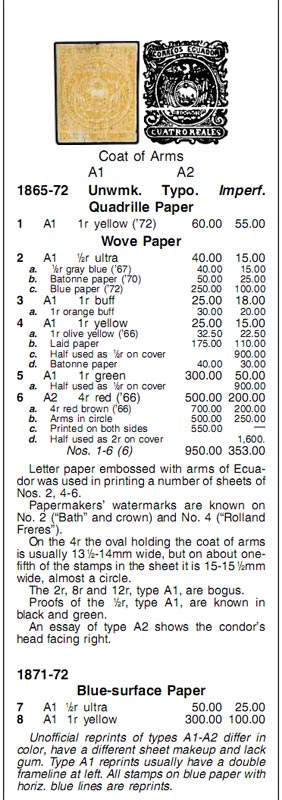 |
|
Send note to Staff
|
|
|
Valued Member
Thailand
375 Posts |
|
|
Pillar Of The Community
United States
6756 Posts |
|
|
It's a beautiful clean cancel!
Since the cancel is 1867, and the color is clearly not gray blue, then according to Scott it can only be #2 and none of the minor varieties. However, Scott has occasionally been wrong about these things in the past.
It's hard to tell from the scan, but I'm wondering if the paper might be Batonne paper? Although according to Scott, the Batonne paper wasn't used until 1870.
Hold the stamp up to a light and look through the stamp from the backside. If the paper is wove, you should be able to see an array of fine white dots (thin spots). If Batonne, you should be able to clearly see some parallel lines going all the way across the paper. Since the background in the stamp consists of vertical blue lines, you may have to focus on the white margins so you don't get confused by the blue ink lines. |
|
Send note to Staff
|
| Edited by khj - 08/13/2010 4:26 pm |
|
|
Valued Member
Thailand
375 Posts |
|
|
Thanks for that Kim. I'll have a closer look in the morning. Many thanks. |
|
Send note to Staff
|
|
|
Valued Member
Thailand
375 Posts |
|
|
Kim - I had a close look at the back, but I could not make out any kind of distinct line or pattern. Probably my eye is not trained enough for that. So lets just assume it is a regular #2 as you said. Thanks again. |
|
Send note to Staff
|
|
|
Valued Member
Ecuador
12 Posts |
|
|
Yes, Scott #2. Too many shades exist beacuse different inks were used. Also many kinds of paper. Postmark is from LATACUNGA city. |
|
Send note to Staff
|
|
|
Valued Member
Russian Federation
7 Posts |
|
|
Marc, you have a classic first stamp issued form Ecuador, our king, our start, the number 1 in more than 24 catalogs (in Scott the #1 is the 1 real yellow from 1872, huge mistake), your stamp is #2 if you use Scott, ultramarine, wove paper,cancelled March 28, 1867 in the south town of LATACUNGA. Before E-bay 20 years ago price $ 20, now with E-bay around here $ 8. |
|
Send note to Staff
|
|
| |
Replies: 15 / Views: 2,248 |
|



 Posted 08/13/2010 02:24 am


