| Author |
 Replies: 11 / Views: 1,295 Replies: 11 / Views: 1,295 |
|
|
Valued Member
Thailand
375 Posts |
|
|
It seems this one is the A11 variety. If it is regular green it might be worth something, but if it is light green it doesn't seem to be worth anything. To me it kind of looks light green, but it is not very light. I would say not dark and not light. Any easy way of figuring out which variety it is? The real stamp looks a bit brighter and less dull than the scan, but the darkness of the color of the scan is at least more or less consistent with the real thing. Cheers. Marc  |
|
Send note to Staff
|
|
|
|
|
Pillar Of The Community
United States
6756 Posts |
|
|
You're a photographer, you know how tricky it is to do color matching on a computer screen that hasn't been color calibrated. Here's a pic of both of them side by side. Let you decide. 70 (light green) on left, 70a (dark green) on right 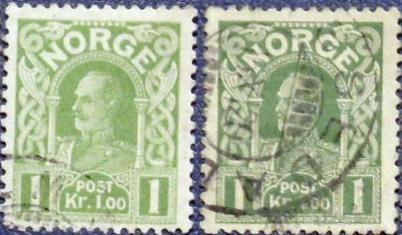 |
Send note to Staff 
|
|
|
Valued Member
Thailand
375 Posts |
|
|
You are right about the screen color issue. Mine doesn't look like either, and I am using an Apple Cinema Display which is quite color accurate. But mine isn't that light to be the #70. I would say more likely 70a. |
|
Send note to Staff
|
|
|
Valued Member
Thailand
375 Posts |
|
|
Isn't it also possibly #67, just regular green? In which case it would also be worth about $110 according to Scott. |
|
Send note to Staff
|
|
|
Pillar Of The Community
Finland
753 Posts |
|
|
Facit catalogue (which is specialized in Scandinavian stamps) states the following:
Haakon VII "profile I" stamps (1907, these equal to Die A in Scott) - horizontally lined background in centre field, 11 small "pearls" in lower arabesque.
Haakon VII "profile II" stamps (1909-10,these equal to Die B in Scott) - horizontally lined background in centre field, 5 large "pearls" in lower arabesque.
Haakon VII "profile III" stamps (1910-18, these equal to Die C in Scott) - filled (no lines) background in centre field, no "pearls" in the lower arabesque.
Updated... Based on the image You have Die C stamp,Scott 70... Will check color details soon... |
|
Send note to Staff
|
|
| Edited by scb - 08/13/2010 03:12 am |
|
|
Valued Member
Thailand
375 Posts |
|
|
Thanks so much scb. Much appreciated. But you are saying then I have the light green variety? It doesn't really look like green to me. It just looks more like grass green. Not light and not dark. |
|
Send note to Staff
|
|
|
Pillar Of The Community
Finland
753 Posts |
|
|
And about the "expensive color variety"... Facit states that there are 3 colors:
The expensive one is bluish green on yellowish paper.
Then comes bluish green on white paper (about 1/10th of value of the yellowish paper).
And finally there's the common light yellow-green to green stamp with minimal catalog value (with 15 different prints)
update... fixed typo. |
|
Send note to Staff
|
|
| Edited by scb - 08/13/2010 03:19 am |
|
|
Pillar Of The Community
Finland
753 Posts |
|
|
Quote:
But you are saying then I have the light green variety? It doesn't really look like green to me. It just looks more like grass green. Not light and not dark. I'm not a specialist with these, but based on image (on my uncalibrated screen) I'd say you have a specimen from one of the 15 prints of the most common type. The colors can vary a lot with these, and key is the paper color. |
|
Send note to Staff
|
|
| Edited by scb - 08/13/2010 03:32 am |
|
|
Pillar Of The Community
United States
6756 Posts |
|
|
I came to the same conclusion as scb -- you definitely have Die C.
When I first saw your pic, my initial reaction was "light green". But my monitor is not an Apple Cinema. It's more like a lava lamp.
I also agree with scb, that FACIT is the better reference. That is also what I use. I knew you used Scott, so I didn't want to confuse you, and I certainly was way too lazy to type out the nice list that scb posted!
The FACIT is a bit better descriptor. What Scott calls dark green is really better described by the bluish green. Given that, your pic would does not appear bluish green, hence -- light green. But remember, I've got a lava lamp. |
|
Send note to Staff
|
|
|
Pillar Of The Community
United States
6756 Posts |
|
|
Quote:
and key is the paper color. Good point. Of course, if your stamp is toned or has foxing... |
|
Send note to Staff
|
|
|
Valued Member
Thailand
375 Posts |
|
|
Thanks all. Great stuff. I would say you are right. Mine is not of the rarer paper variety, so the buck stops there. The paper is a bit yellowed, but after 100 years that is to be expected. So that is just aging I think. It certainly is not on some special type of yellow paper. Just the usual stamp type paper of that era I would say. So case closed. So Scott 70 I think as Kim said from the start. Thanks again. |
|
Send note to Staff
|
|
|
Pillar Of The Community
United States
6756 Posts |
|
|
Quote:
So Scott 70 I think as Kim said from the start. Actually, scb posted that. I was too chicken to make pick! |
|
Send note to Staff
|
|
| |
Replies: 11 / Views: 1,295 |
|



 Posted 08/13/2010 02:29 am


