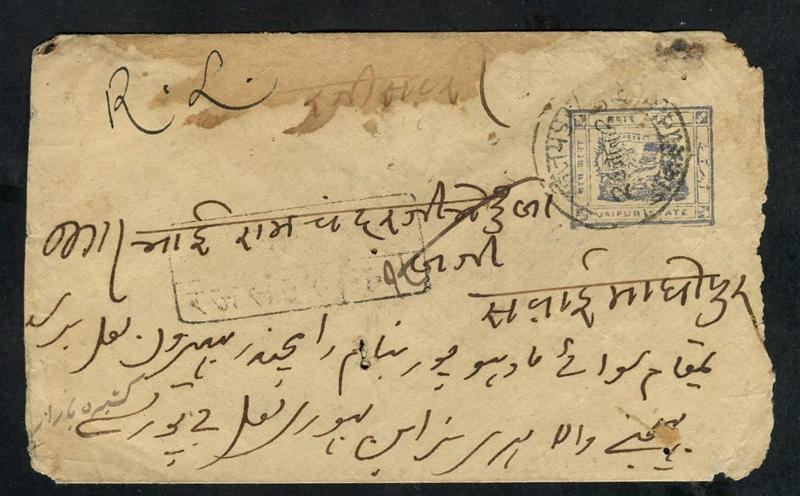
Rod, this is a Jaipur ½ Anna postal stationery envelope.
As you guessed, it's registered; the oblong cachet on the front is for registration, with the number in manuscript at bottom right, probably '98'. Jaipur used simple generic 'Jaipur' registration cachets, so there's no indication of where the letter was posted.
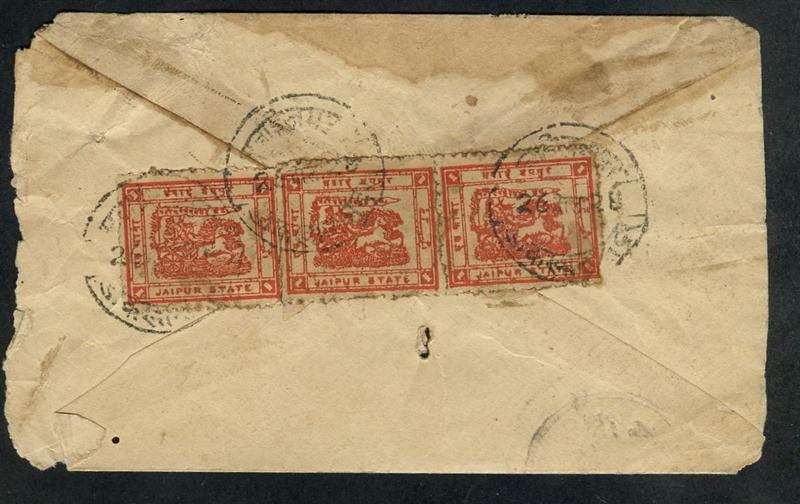
The cancellations are a bit too blurred to read for certain, but they look like 'Sawai Jaipur' - Jaipur Town. The date is also a bit unclear, but seems to be the 27 [month?] 1924.
The stamps are three copies of the 1 Anna, SG 28 (of 1922), paying the registration fee.
The address is interesting in two ways.
First, it's written in both Hindi and Persian/Urdu. Jaipur was overwhelmingly Hindu, and Urdu, these days at least, is associated with Islam, because of its Persian and ultimately Arabic roots. (Pakistani stamps are inscribed in Urdu and English.) However, a hundred years ago, any educated gentleman (and perhaps lady) in Northwestern India would naturally have written in Urdu. Hindi was considered a bit vulgar and unrefined. You had to be able to read and write Urdu in order to get a job in the Jaipur public service, for example.
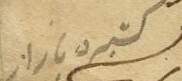
The second point of interest in the cover is the '74' written after the address. As I quoted about this in another thread,
From Frits Staal's The Stamps of Jammu & Kashmir, pp124-125:
'Envelopes even more than single stamps are often marked with scribbles, lines, dots, or other symbols that are supposed to prevent them from being taken away or opened by unauthorized outsiders. A similar practice adopted by Hindus in Jammu and Kashmir, Indore, Jaipur, and so on is to write: //74// at the beginning of the address to insure safe delivery of the letter. ... Professor Bruce Pray has drawn my attention to a story translated from the Hindi in Linguistic Survey of India, vol. VI, pp48-49 about the miraculous powers of song. The singer Tan-sen sang with such force that all the lamps at the court of Emperor Akbar lit themselves, and Tan-sen himself burst into flames and fell down dead. Earlier, he had warned that if such a thing would happen, he could be brought to life only by Queen Kamla of Chittaur. The Emperor therefore attacked Chittaur and a terrible battle ensued. Seventy-four and a half maunds (one maund being equal to approximately 80 lbs.) of sacred threads were collected from the corpses of the slain. Queen Kamla was taken prisoner, and when ordered to sing, she sang with such force that her soul burst its way through her skull and went to heaven, leaving the audience with their mouths open in astonishment. The number 74½ is still written on letters as the strongest of seals, for "the sin of the slaughter of Chittaur" is thereby incurred by all who violate the letter.'
Not really a particularly distinguished cover, but it does show how much interest there can be in even fairly mundane Indian States material. |





 Posted 11/24/2010 07:22 am