| Author |
 Replies: 10 / Views: 2,123 Replies: 10 / Views: 2,123 |
|
|
Pillar Of The Community
Canada
1227 Posts |
|
|
|
|
Rest in Peace
Canada
5701 Posts |
|
|
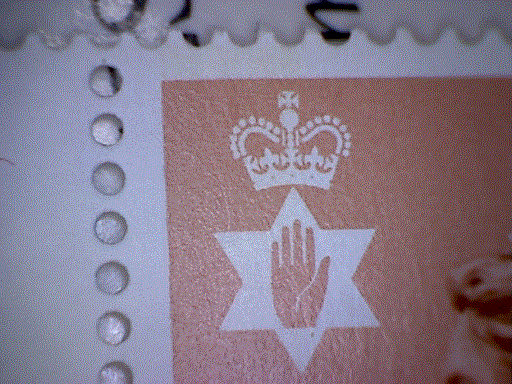
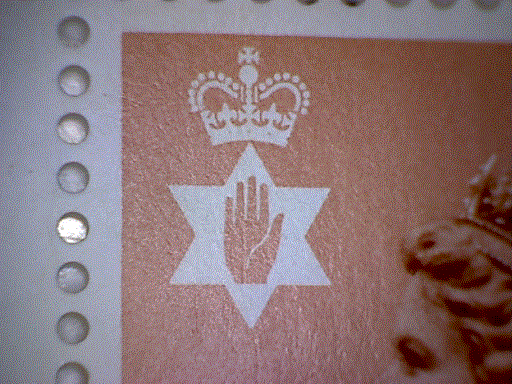
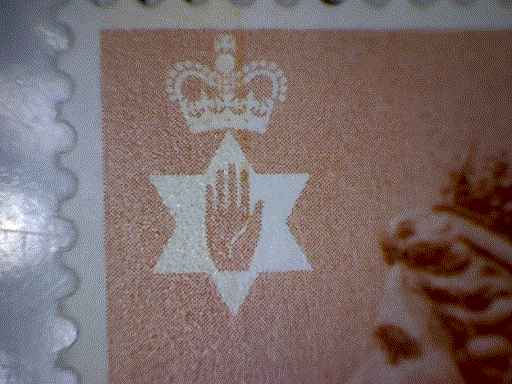
I would say the first two are photogravure, and the last lithography, as it has the normal do patterns that photgravure does not. ...but I am no machin expert... |
Send note to Staff 
|
|
|
|
Pillar Of The Community
Canada
1227 Posts |
|
|
BeeSee, thanks for your response. I've only been collecting for a few years and haven't had the opportunity to pick the brains of knowledgeable collectors before joining this website. I thought the first two were litho based upon what I read in the Scott's catalogue at the start of the list of Northern Ireland Machins. After your response, I looked further into this and found in the Adminware.ca website the following which still leads me to think the first two are litho. 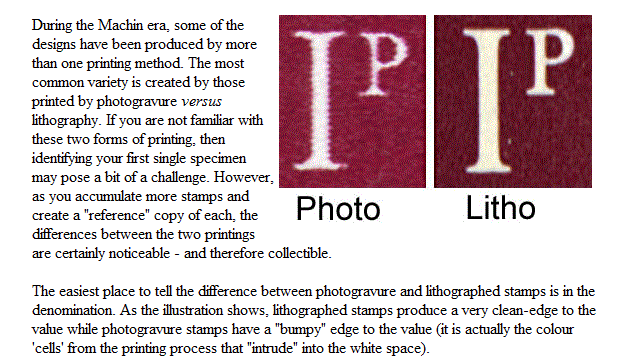 |
|
Send note to Staff
|
|
|
Pillar Of The Community
United Kingdom
1361 Posts |
|
|
Hi, I wouldn't use Scott as a reference for Machins at this level personally. Usually Type I/II refers to the symbol type when referring to regional Machins - http://www.adminware.ca/machin/m_type.htmThe adminware site list 3 types for this regional value which are all litho and printed by Questa with differences in phosphor bands and symbol types - http://www.adminware.ca/machin/m013b.htmThe first two are symbol type IIb and the bottom one IIa The machin 'bible' Deegams may yield further varieties though. |
|
Send note to Staff
|
| Edited by AnthonyUK - 02/12/2011 03:55 am |
|
|
Pillar Of The Community
Israel
6191 Posts |
|
|
mhc99,
I don't know if it is by luck or chance, but the Types you gave to your examples are correct. [Unless Scott and Gibbons actually agree on something].
Type II is most easily recognized by the 3 joined pearls on the left side of the crown.
In addition, Type I has screened background as against a solid background for Type II.
All three are printed by Questa in Lithography [sorry BeeSee!] and have one Phosphor Band left. Your bottom example appears to have a wider band than normal.
Short Phosphor bands and missing phosphor have also been recorded, the former from a later printing.
All are from Sheets.
Londonbus1 |
|
Send note to Staff
|
|
|
Pillar Of The Community
Canada
1227 Posts |
|
|
Londonbus1 and AnthonyUK, thanks for your insight.
AnthonyUK, I agree that Scott's lacks detail on the subject of Machins however Scott's does in reference to the 13p stamp acknowledge that it exists in both Type I and II and among other details differentiating between them, it talks about screened vs solid background. That is why I concluded the first two are litho and the third uploaded image is photo. AnthonyUK, in the first link to Adminware.ca, reference is only made to the orb, line and curvature of the hand as features to distinguish between the types. Furthermore it states that the types only exist in 17p, 20p and 31p. No reference is made to my 13p value example. The second Adminware link shows lots of detail on 13p value Machins but under the Northern Ireland heading, it doesn't seem to acknowledge that Photo types exist for the 13p value. So there lines the root of my continued confusing. Regards Mike |
|
Send note to Staff
|
|
|
Rest in Peace
Canada
5701 Posts |
|
|
Sorry if I confused anyone   . I was basing my comment on some litho Canadian stamps I happened to be examining while reading the post, and they have obvious dot patterns. I obviously don't know Machins   Lithography However, the dots are caused by a screen, which I guess can be used on either printing process. |
|
Send note to Staff
|
|
|
|
Pillar Of The Community
United Kingdom
1361 Posts |
|
|
Hi Mike,
I can see why it is confusing but this is in part to different nomenclatures between the catalogues.
It is mentioned in the first link that there are in fact two sub-types for type 2 - 2a and 2b which is also mentioned in the 2nd link for the 13p NI.
It doesn't mention anywhere on the adminware site that a type 1 exist for this item so I stand by my earlier answer that the first two are symbol type 2b and the bottom one 2a.
In summary -
Type 1:
* the left side of the hand is curved throughout.
* the white line of the hand is thin and faint.
* the bottom pearl underneath the orb is detached from the central cross.
Type 2:
* the left side of the hand is straight but curves in sharply at the wrist.
* the white line on the hand is thick.
* the bottom pearl underneath the orb is joined to the central cross.
There are two subtypes of Type 2. In Type 2a (Scott type I), the pearls along the crown are all separate from each other.
In Type 2b (Scott type II), the second pearl on the left is joined to the crown, and the last three on the left are joined to each other. |
|
Send note to Staff
|
|
|
Pillar Of The Community
Israel
6191 Posts |
|
|
This NI 13p stamp was first issued in 1984. There were 2 further printings. All were in Litho by Questa.
In fact, all Northern Ireland stamps between 1981-1996 were printed the same way. |
|
Send note to Staff
|
|
|
Pillar Of The Community
United Kingdom
1361 Posts |
|
|
Pillar Of The Community
Canada
1227 Posts |
|
|
Gentlemen, thanks for taking the time to help educate me and clear up some of the confusion. While I like having access to more detail in Adminware.ca and connoisseurcatalogue.net/catalogue.htm (I learned about these sites from other threads), it creates problems for me when I am relying on the Scott numbering system to catalogue my collection and their classification system is different. |
|
Send note to Staff
|
|
| |
Replies: 10 / Views: 2,123 |
|




 Posted 02/11/2011 9:04 pm