| Author |
 Replies: 14 / Views: 3,351 Replies: 14 / Views: 3,351 |
|
|
Pillar Of The Community
United States
2480 Posts |
|
|
This stamp was sold as Scott 150 (10c brown issue of 1870-71 on white wove paper). 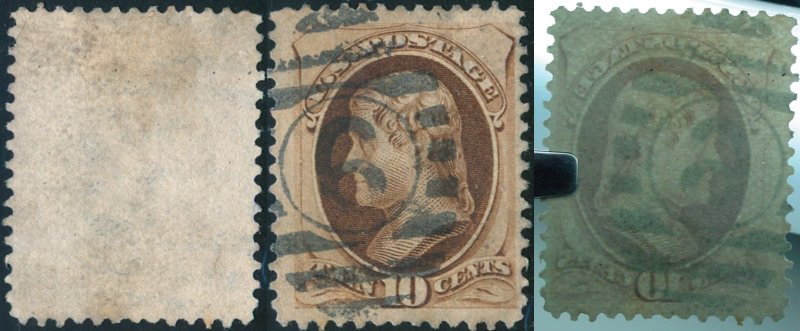 I've ruled out Scott 209 (it isn't re-engraved) and think the stamp is really Scott 187 (10c brown (without secret mark) issue of 1897 on soft porous paper). Given that I constantly wrestle with paper types, I'd really like to hear your thoughts. A higher quality image is available at http://img717.imageshack.us/img717/...omposite.jpgThanks, in advance! |
|
Send note to Staff
|
|
|
|
|
Valued Member
United States
199 Posts |
|
|
Looks pretty 187ish to me, the light check is my favorite indicator. Here's a 150, left and a 188 (same as 187 but w/ mark) 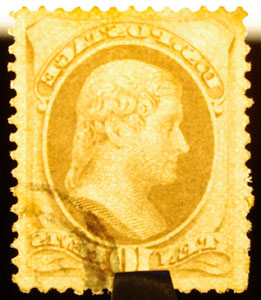 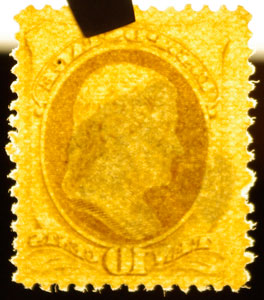 |
Send note to Staff 
|
|
|
Valued Member
United States
338 Posts |
|
|
tomiseksj
This one was to easy. It is a #187, and you don't even need the back lit scans to know. Whom here can tell me why? |
|
Send note to Staff
|
|
|
Pillar Of The Community
United States
2480 Posts |
|
|
Otto and Ron, thanks for the confirmation.
I can't wait for someone to answer Ron's question so I can find out what makes this ID a no-brainer! |
|
Send note to Staff
|
|
|
Valued Member
United States
338 Posts |
|
|
tomiseksj
I will give you a hint. Look at the entire stamp not just the paper or secret mark.
Ron |
|
Send note to Staff
|
|
|
Pillar Of The Community
United States
1947 Posts |
|
|
Pillar Of The Community
United States
2480 Posts |
|
|
Ron, I really hope you're not going to tell me it has something to do with the color because I have even more problems with color than with paper types!
Does it have something to do with the quality of the printed image?
(This would be alot easier if I had a 150 to compare it with!!) |
|
Send note to Staff
|
|
|
Valued Member
United States
338 Posts |
|
|
Well I guess I have kept you in limbo long enough. Please look at the cancel, it is a supplementary type F which is found on the Sc# 187 and not found on the Sc#150. The supplementary cancel found on the Sc# 150 would be a type A or D. As a side note it is very well struck, but only has a small premium of a few bucks. About the back lit light test. This is a good idea to use for the 1850-75 bank notes for two reasons. The first is comparing paper. The second, while doing the light test slightly fold the stamp. If you see darker lines appear parallel to the direction of the fold you have a good chance that the stamp is a double paper verity. If so you have a stamp that is worth a couple hundred dollars more than the listed Scv.  |
|
Send note to Staff
|
|
|
Pillar Of The Community
United States
2480 Posts |
|
|
Ron, thanks for sharing your insight. Where can I (we) find more information on these supplementary type cancels and their dates of usage? Steve |
|
Send note to Staff
|
|
|
Pillar Of The Community
United States
1947 Posts |
|
|
Valued Member
United States
338 Posts |
|
|
The first place to start looking is your Scott specialized guide. This will give you a general overview. Then you look up the Sc# you are wanting to check and whall-laa there it is. But after a short while you will find that as your knowledge increases you will want more info. APS has a wonderful selection of books and articles that will take you further down the road. |
|
Send note to Staff
|
|
|
Pillar Of The Community
United States
2480 Posts |
|
|
Quote:
The first place to start looking is your Scott specialized guide...Then you look up the Sc# you are wanting to check and whall-laa there it is. Ron, If it were only that easy. The example of the Type F Combination Handstamp shown in my Scott Specialized (2011, p. 36A) depicts the numeral "2" within a circle that is inside a much more rounded oval than that on my copy of the #187 and with vertical, vice horizontal, bars. There are also two amplifying notes: a) "(Also comes with numeral "1" )" and ""Stamps with numeral cancel alone do not qualify for Supplementary Mail cancel premiums.)." The numeral in the killer on my #187 appears to be a "6." Based on the preceding, I wouldn't identify the cancel as a Supplementary Type F (but I have a lot more learning to do before I'd put any money on that  ). I'll be the first to admit that I need to hit the books...but I'm grateful for brain trust that is SCF and its ability to help focus that effort!! Steve |
|
Send note to Staff
|
|
|
Pillar Of The Community
United States
4106 Posts |
|
|
for what it is worth..
I bought a 187 mint no gum on bidstart, it was being sold as a 150. What gave it away was the paper fibers on the tips of all the perfs, it, like yours, indicated it is soft porous paper.
This stamp is actually my only 4 digit stamp... (and yes, I got it certified) |
|
Send note to Staff
|
|
|
Valued Member
Russian Federation
10 Posts |
|
|
Pillar Of The Community
United States
1946 Posts |
|
|
The cancel on this stamp is not a Supplementary type F. The bars run the wrong way, and the numeral is outside the range of the supplementary cancels. The cancel is a typical elliptical numbered killer from the era. These however were devised by John Goldsborough and were not introduced until 1875. That is getting to be on the late side for the 10c from the National Bank Note Company (#150). So the suggestion that the cancel may assist in identifying the stamp has merit, even if the cancel is not a Supplementary type F.
The pic showing transillumination is not bright enough for me to tell if the mesh is consistent with soft paper, and there do not appear to be many stray fibers sticking out of the perforations, which the 187 normally does show.
Without seeing the stamp this mix of evidence leaves it uncertain whether this stamp is on hard or soft paper, but the cancel makes me lean toward it being on soft paper. A better shot of the mesh on transillumination might nail it down. |
|
Send note to Staff
|
|
| |
Replies: 14 / Views: 3,351 |
|




 Posted 05/03/2011 5:32 pm


