| Author |
 Replies: 13 / Views: 1,847 Replies: 13 / Views: 1,847 |
|
|
Pillar Of The Community
United States
1357 Posts |
|
|
Hi-- received this yesterday in the mail-- it definitely has inner and outer frame lines, so I think that makes it a Type II, and it doesn't look red at all. I'm not a 3c expert- and from everything I've read, the only real way to identify a 10 vs 11 is from the plating, and that's above my head (at least for now). Any experts out there who can verify this is a 10A? I didn't spend much for it-- if it ended up being an 11A, it would be OK, but it was sold as a 10A. Many thanks-- Ray 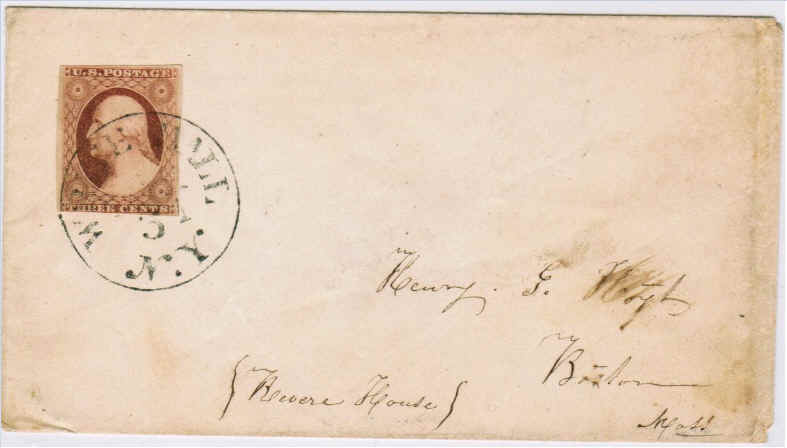 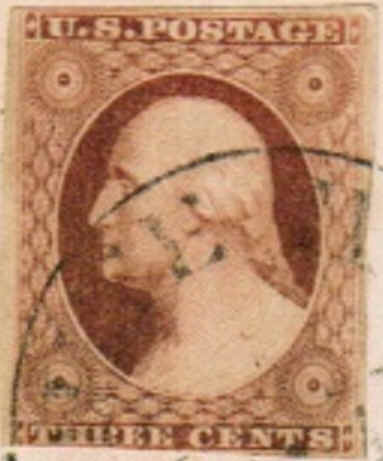 |
|
Send note to Staff
|
|
|
|
|
Valued Member
United States
199 Posts |
|
|
I think it's an 11A. The canonical red for 11s is "dull red" (there are a hundred other shades as well, exaggerating only slightly). The 10s are mostly "orange brown" which, once you see it, you say, "oh, orange brown." And while plating is indeed the only definitive way, you can start to tell when you've seen enough. And this forum, and this topic especially, is a great place to see enough. The tells for me is the fuzzy impression, lack of definition in the hair and collar, and the weak triangles in the corners. And while a larger clearer scan would be better, I think we'd still see the fuzziness. The upper left right diamond in the banner appears gouged, which is sure-fire tell for an 11. Sinclaire or Russ are the resident 1851s men and one or the other will certainly be along to give you a second opinion.
Edit: upper right, meant to say upper right. |
Send note to Staff 
|
| Edited by otto - 05/22/2011 10:11 pm |
|
|
Pillar Of The Community
United States
2555 Posts |
|
|
The stamp is definitely an 11A, the color and impression are way off. With that said, some of the 10/10A's from plate 1E/1i have weak and worn impressions, particularly in the top label block and upper right diamond block.
I forgot to mention that I think the CDS is pretty nifty with the fancy N.Y.. |
|
Send note to Staff
|
| Edited by sinclair2010 - 05/22/2011 7:25 pm |
|
|
Pillar Of The Community
United States
1357 Posts |
|
|
Otto and Sinclair-- thanks guys, I appreciate the help. I've just sprung for the 1st Edition of Brookman's 19th Century reference, the 2 Volume set. Will the information that you're speaking about be found in this reference? I realize that the 3 volume set has more information, but I found the 2 volume set on Amazon for the ridiculous price of around $25, so I jumped on it. At least its a start. I would really like to become a student of the classics. I feel that I know the Wash/Frank's pretty well, and most of my studying up to now has been there. I do realize that the 10/11's are tough, and appreciate the heads up. Thanks again, Ray |
|
Send note to Staff
|
|
|
Pillar Of The Community
United States
3568 Posts |
|
|
I sure am glad to have you guys around. I sure can't id like that. Thank you all for your expertise, even if it isn't my stamp! |
|
Send note to Staff
|
|
|
Pillar Of The Community
United States
2555 Posts |
|
|
Ray, I also have the two volume set of the Brookman books and they don't even really scratch the surface when it comes to differentiating between 10's and 11's. In fact, I breezed through real quick and found no mention of how to do it. It is really all about color but sometimes you can tell by plate characteristics or date of usage. It is very uncommon to find one of the orange browns used after early to mid 1852.
|
|
Send note to Staff
|
|
|
Valued Member
United States
278 Posts |
|
|
with a 10 its alot more "brown" its really hard to tell the 2 apart it seems there are more 11s than 10s out there. |
|
Send note to Staff
|
USAF Retired 1983-2003 |
|
|
Pillar Of The Community
United States
1357 Posts |
|
|
Sinclair, I see what you mean on the Brookman book....
So, I guess if I want to understand the 3c 1851's, I'll need additional references-- I see that there are 3 editions of Chase's study. I don't plan to work on plating, but would like to be able to understand color, and to be able to recognize the recutting and characteristics of #10 vs. #11. Will I need the 3rd edition of Chase's study, or would I be able to learn what I'm looking for from the 1st or 2nd editions?
I don't know if you have the answers on this, but if you can help, I'd appreciate the heads up (or from anyone else who can help here!).
Thanks much! Ray |
|
Send note to Staff
|
|
|
Pillar Of The Community
United States
1947 Posts |
|
|
I posted a cover with a 10 on it a while back. My cover was one of the folded type and I was able to get a date. If I remember correctly, the stamp was issued July 1 1851. The dull red shade did not make its appearance until, I think, October. My cover was an August date, so it was the orange brown shade.
I just got the three volume reprint of the Brookman books and will look and see if there is more info.
Was there an enclosure which would allow you to get the year and date?
Just found my original post. It was August 5 2010. If you search for Scott 10 on covers in the time period last year, you will see it.
I was correct in that the dull red did not appear until October 1851 as per the reply by idhaber in which he referenced the Micarelli work.
|
|
Send note to Staff
|
| Edited by rohumpy - 06/08/2011 06:15 am |
|
|
Pillar Of The Community
United States
2555 Posts |
|
|
Ray, I have the first edition of the Chase book. The third edition is a reprint of the 1940's 2nd edition and was done by Quarterman Publications in the 1970's. I know a person who has the Quarterman reprint and he complained about the images, so I wonder if the images from the 2nd edition were not reproduced that well. I would go for the 2nd edition first, then the 3rd and the 1st edition as my last choice. With that said any three is probably more than adequate unless you plan to specialize in the 3c 1851 or 1857 stamps. The 2nd edition has some corrections and I believe contain a little more information on the 1857 perforated issue. You should not expect to learn much about differentiating the colors however, that is best learned buy aquiring reference examples, IMO. One of the most significant aids in understanding colors is knowing the date of use of the stamp which is typically very close to the date is was printed, the dates of usage of the various colors are known facts. Sorry for the long post and have fun! Winston You will find these sites are invaluable resources http://home.comcast.net/~3cent1851/index.htmhttp://www.stamps4collectors.com/in...cphotos.htmlhttp://www.uspcs.org/ |
|
Send note to Staff
|
|
|
Pillar Of The Community
United States
1947 Posts |
|
|
I checked into the Brookman book. He addresses color by saying that he can't really address color since colors con't reproduce well and the book is in black and white anyway. He does list colors and the years associated with those colors. Nothing to help with the differentiation of orange brown and dull red though. |
|
Send note to Staff
|
|
|
Pillar Of The Community
United States
2555 Posts |
|
|
Pillar Of The Community
United States
1357 Posts |
|
|
Winston- I think I read on VSC (I probably need to join, BTW), that you were submitting an 1851 as a plum-- is that the stamp? Or, am I thinking of someone else?
Good luck on your cert, if it was you...it is a beautiful stamp and color!
Ray |
|
Send note to Staff
|
|
|
Pillar Of The Community
United States
2555 Posts |
|
|
Ray, you should join the VSC, and yes, that was my stamp over there. I have not submitted it but sought the advice of the leading expert on colors of the 1851 3c stamps. I got a very cryptic response that did not say it was a plum shade but suggested it was a brown shade and that plate 4 produced more of the "browns" than any other plate. The shade, IMHO, is several orders of magnitude scarcer than the basic #10/10A orange-browns. |
|
Send note to Staff
|
|
| |
Replies: 13 / Views: 1,847 |
|




 Posted 05/21/2011 11:11 pm


