| Author |
 Replies: 43 / Views: 9,275 Replies: 43 / Views: 9,275 |
|
|
|
Pillar Of The Community
United States
1160 Posts |
|
|
ratio411: To reinforce previous comments, there are Perfins societies in both the UK and the US, as in other countries. The UK Perfins Society specializes in UK/UK colonies and the US Perfins CLub is pretty much open to the US and world perfin chatter. There are catalogs on the US material, expensive, None on line as of yet, The UK catalog is BIG bucks. Changes are being made all the time on ID's (and values) of US material. As mentioned, there are a number of unknown users of the early (as well as even the late) perfin patterns.
They should be kept as a unit I suppose. List them by pattern number. The revenues are in a different Catalog (4 volumes so far I think), and can be listed the same way.
An interesting concept is that the same pattern on and regular issue US stamp could be a "A" (highest value), but on the revenue it may be just a "E" (very common). This can also go the other way, with usage of a "E" on normal stamps and when used on a revenue it can jump to an "A" value.
The rating of any perfin is based on the completeness of the pattern. If incomplete, the value goes down.
The more common patterns range in $0.05 to $0.20 cents each, going thru the scale upwards to "A" which range from $20 to $1xx's) depending on the greedyness of the seller. Be leary of the higher end pricing, it may not always work in the sellers favor.
I would say if you are selling, get access to a catalog and price the patterns you have, and price them to sell, not to retire off the proceeds.
Hope this helps somewhat. I can go into much more detail on this, but fingers are tired of typing. |
Send note to Staff 
|
|
|
Pillar Of The Community
United States
1946 Posts |
|
|
Do the catalogs you mention discuss perfins on U.S. stamps of the 19th century? I'm trying to get info on some items I think may have been experimental among the Banknote issues. |
|
Send note to Staff
|
|
|
Pillar Of The Community
United States
1160 Posts |
|
|
essayk: Not specifically by issue. Most all of the Perfins Catalogs (anywhere) just deal with the pattern information. There are a few sublists that are now listing period of usage (first known usage), but that is also usually mentioned in the normal catalogs. I have been a member of the Perfins Club for 30-40 years now, and cannot specifically remember any lists that may have been done on the "By issue" method. The exception are those that collect one pattern and attempt to get one issue of all that were issued of it.
What patterns are you specifically asking about?
|
|
Send note to Staff
|
| Edited by PoStat4evR - 12/30/2013 11:31 am |
|
|
Pillar Of The Community
United States
1946 Posts |
|
|
This one: 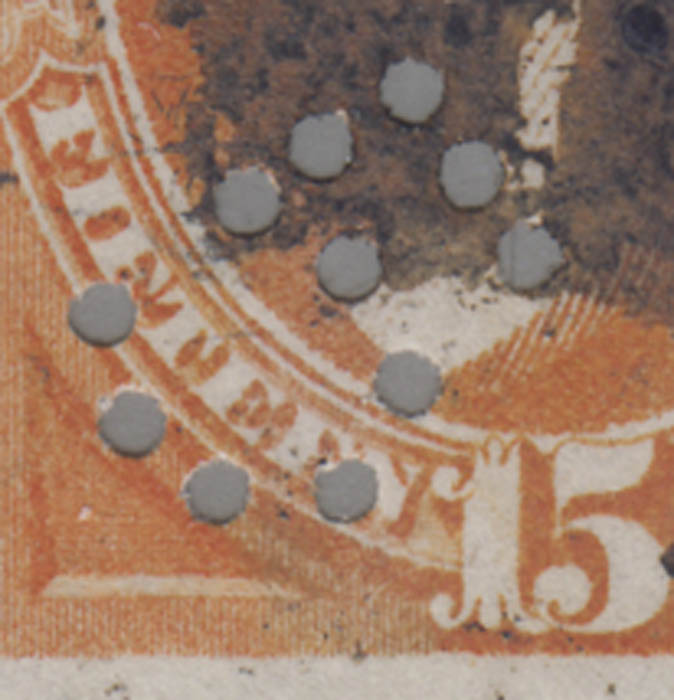 A perfin numeral "5" has been found on a few denominations of the Continental Bank Note Company issues, usually accompanied by a testing cancel which appears to have been brush applied. 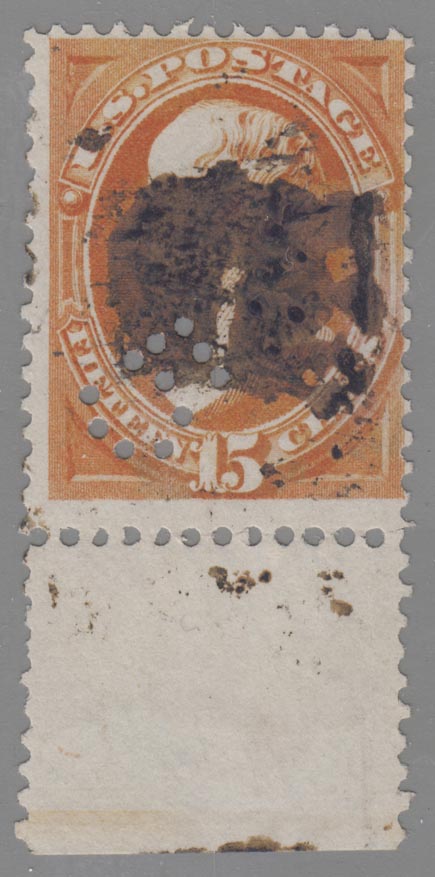 The six cent stamp is known in a few examples, all of them without cancel: 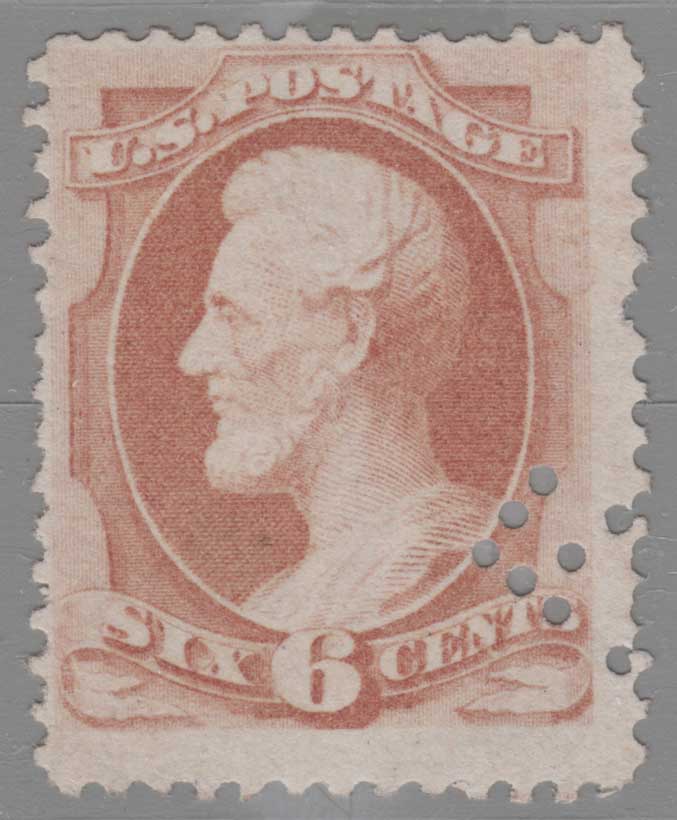 Here are all the denominations so far known: 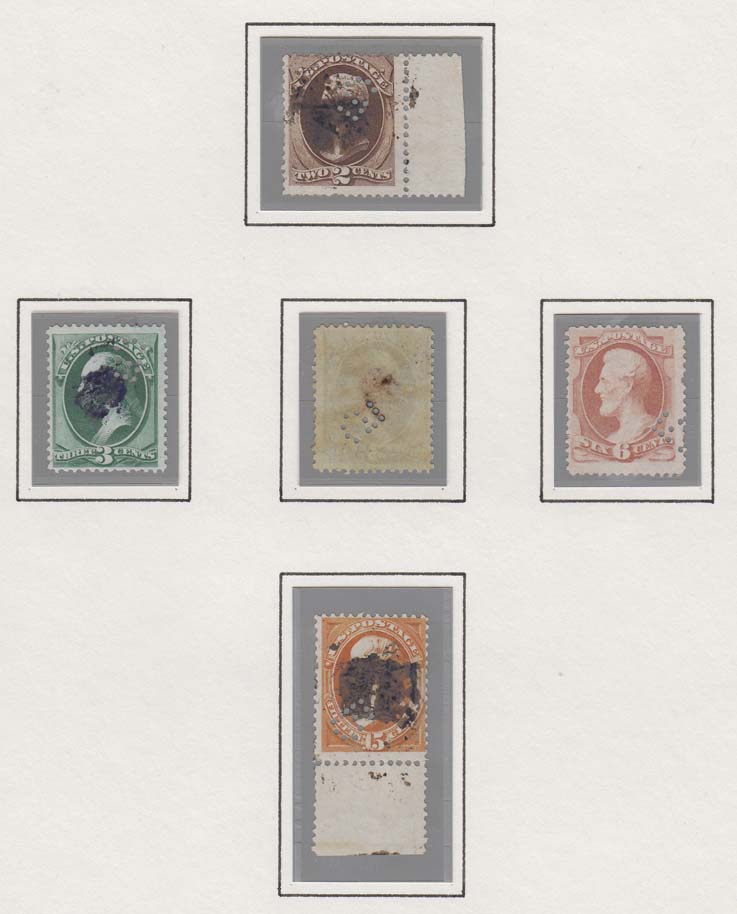 So far I have found nothing written about these stamps, which I regard as experimentals of an unusual type, but of unknown purpose or origin. Do you have anything on these? |
|
Send note to Staff
|
|
|
Pillar Of The Community
Canada
4648 Posts |
|
|
A friend of mine from the Barrie Club was mentioning to me that the British perfins catalogue is quite expensive, as mentioned earlier. With Britain and Germany leading the line of perfin pattern users, with 'roughly' about 20,000 patterns apiece, is quite a job to tabulate to say the least.
I asked if there were rarity factors given for these perfins as well and was told, 'heck no, it's quite a job to get them all listed as it is'. Still though, I would love to get a hold on some perfin publications.
Chimo
Bujutsu |
|
Send note to Staff
|
|
|
Pillar Of The Community
United States
2963 Posts |
|
|
Fascinating, Essayk! I never knew such a thing existed. Are these your copies or from a reference collection?
Brian |
|
Send note to Staff
|
|
|
Pillar Of The Community
United States
1946 Posts |
|
|
Moderator

United States
5106 Posts |
|
|
I find it interesting that the perfin "5" has hole sizes almost exactly equal to the standard stamp perforation sizes. I wonder if that is the norm for perfins ...
It is also interesting to note that the location of the perfin "5" is in the same general area and orientation on each stamp (x and y distance from a corner). Interesting. |
|
Send note to Staff
|
| Edited by Partime - 12/30/2013 2:46 pm |
|
|
Pillar Of The Community
United States
1160 Posts |
|
|
essayk: Interesting. These stamps were released in 1870 (ish). The first known Perfin usage was when they were authorized by the PO in 1908. To answer Partime, the perfin holes were required to not exceed 1/32nd of an inch in diameter.
I can only assume these may have been cancelled by a bank perforator for some reason. I will check further when I get home. |
|
Send note to Staff
|
|
|
Pillar Of The Community
United States
1946 Posts |
|
|
I appreciate whatever you can find that is based on good evidence. The time frame for these was sometime from 1873-79. I have not done the kind of study of them (paper and color) required to narrow it down tighter than that. However, during part of this period, various approaches to the testing of cancellation ink were being conducted, presumably as part of the search for an ink that was difficult or impossible to remove without harming the stamp. Punches of various kinds are associated with some of these tests, and that is the basis for my speculation about the use of this perfin. But only this form of perfin has so far surfaced, and no other numerals have come to light. So it is a very open subject. However, I do believe that the perfin 5 belongs with this distinctive form of cancellation, especially since that is the only kind of cancellation found with it and most examples have this type of cancellation.
As to orientation, the perfin numeral appears upright on angle, inverted on angle, to the left, to the right. In other words, they vary quite a bit in position, but they all are oriented to be read from the front. |
|
Send note to Staff
|
|
|
Pillar Of The Community
1849 Posts |
|
|
essayk....I have never heard of a perfin that early.
My first thought was revenue usage.....
But, since they all appear in the same position....
Think someone just messing around...
My guess....fake.
Keep me posted on what you find out...
I will look also... |
|
Send note to Staff
|
|
|
Pillar Of The Community
United States
1946 Posts |
|
|
Life on the fringes of philately is always a challenge to discriminate fact from fancy. Marshalling the evidence that will vindicate a suspect item is always the way it must be. And of course until the proof is down you could be right, Kevin. They could be fantasy items from who knows when. However, based on my experience with experimentals from this period, I am inclined to see them as being something not yet understood. They have certain similarities to other known experimentals. Eventually we may sort it out - or not. But in any case sharing specialized information heads us in the right direction more often than speculation. For now it is a puzzle to keep working on 'til we nail it down one way or another.
But since a couple of you have more than hinted that these punches all occur in the same spot, I am hard pressed to understand that. I have given close ups of the 6c and 15c, and those punches are clearly not at the same place on those two stamps.
Could someone who sees the punches as being in the same spot on all these please explain to me what leads you to that? I must be missing something. |
|
Send note to Staff
|
|
|
Moderator
United States
5106 Posts |
|
|
Essayk. I didn't mean to say that the punch was in the exact same spot. I was implying that it is in the same orientation (at a 45 degree angle) and always appears with the bottom of the "5" towards a corner of the stamp ... usually a set distance from a corner. The 6c is a little different, though. Good luck finding out the answer ... still very interesting.  |
|
Send note to Staff
|
|
|
Pillar Of The Community
1849 Posts |
|
|
Pillar Of The Community
United States
1946 Posts |
|
|
Thank you. Yes, I get that. In every case the numeral is oriented so that the "top" of the five is always nearer the center of the stamp than anything else. This would hint, as I believe Kevin has picked up, that the stamps may have been inserted one at a time into a device that applied the punch. The fact that some are inverted might then be an indication that stamps in block form had to be rotated to fit into the punch. No multiples are yet known for these, but we are getting some ideas of things to look for and expect. And that is how discoveries are made.
So, by all means let us be skeptical of any proposal about them until the evidence clears it. But let us not dismiss such items either, since there are plenty of mysteries still out there. |
|
Send note to Staff
|
|
|
Replies: 43 / Views: 9,275 |
|




 Posted 12/29/2013 3:06 pm


