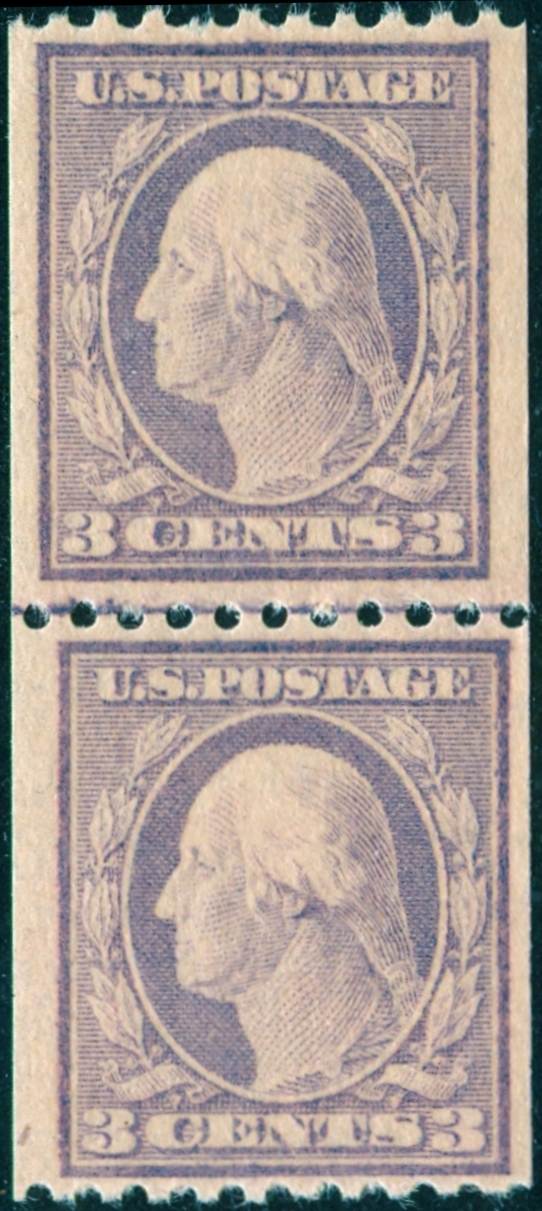
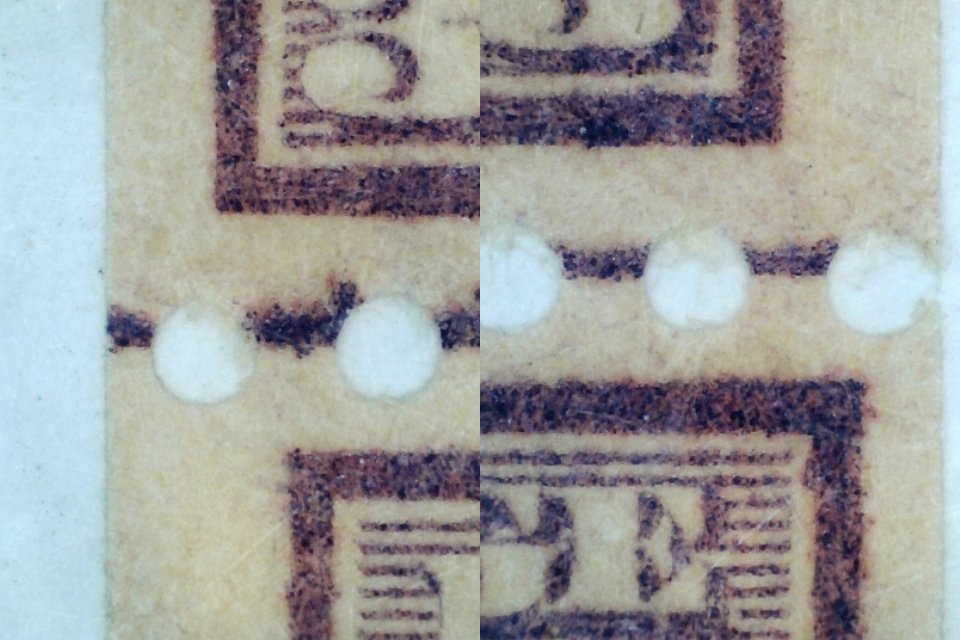
Canadian engraved coil stamps have similar misalignments - they're collected as "jump strips" in the Unitrade catalogue. In some of the later Elizabethan issues, you'll also find listings for wide or narrow spacings - there is a change in the size of the blank space between stamps.
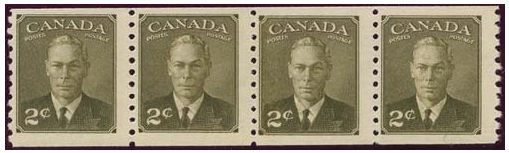
This KGVI jump strip also contains a plate flaw, the lower left ornament of the stamp immediately to the right of the jump is a bit wonky.
On these jump strips, there is no plate line - I wonder how that was avoided, surely ink must have gotten into the small gap on the edges of the plate (and surely there must have been a gap)?
OK, I got curious and dug through some books, and I found the answer in the Robin Harris specialized Centennials catalogue:
Quote:
The printing plate is curved and attached to the cylinder of a rotary press. Only one plate is attached to the press [...]. The plate prints on paper that is in a continuous roll. After the plate impression is transferred to the paper, the cylinder stops and the paper is jerked backwards to compensate for the distance from the bottom of the last row of stamps printed and the top of the first row of stamps that will be printed next when the cylinder revolves. The printing of roll stamps is comparatively slow because of the stopping of rotation of the cylinder after each impression to allow time for the adjustment of the paper. Normally the paper adjustment will be exact and there will be no visible misalignment between plate impressions. Occasionally, however, misalignment does occur and the distance between one row of stamps from one plate and the next row of the second plate impression may vary to a slight degree or the alignment of the rows may vary.
Ryan





 Posted 07/08/2011 9:01 pm