| Author |
 Replies: 15 / Views: 2,554 Replies: 15 / Views: 2,554 |
|
|
New Member
USA
4 Posts |
|
|
|
Is there a way to tell if a stamp has been re gummed ?
I see alot of advertisement for OG ,,how do you know if its original ?
Havoc
|
|
Send note to Staff
|
|
|
|
|
Pillar Of The Community
USA
2877 Posts |
|
|
On regummed classic stamps, the gum often looks too good to be true. It does not looked aged and cracked. The new gum may be mis-applied on the edges of perfs and along the edges of the holes. The color may be too light yellow or greenish looking. It takes some experience to recognize the difference and develop an eye for it. Still there are expert regummers who can fool the expert philatelists.
|
Send note to Staff 
|
|
|
Pillar Of The Community
Guatemala
1500 Posts |
|
|
Here are several suspects for being re-gummed. If anyone can make an opinion as to whether or not these are re-gummed, I'd appreciate the opinion. The first is an imperforate block of 4. It looks much too bad to be original gum. So bad, that if I am told that beyond doubt that it is re-gummed, I will soak it to remove the gum. 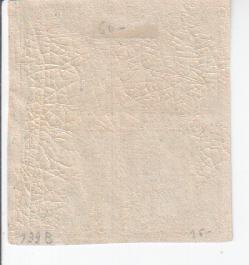 This second photo of four stamps appears to me to have at least 2 re-gummed. The one that I am almost sure is OG is on the bottom right.The 2 that I suspect are both on the left. The gum color looks too reddish on these two. 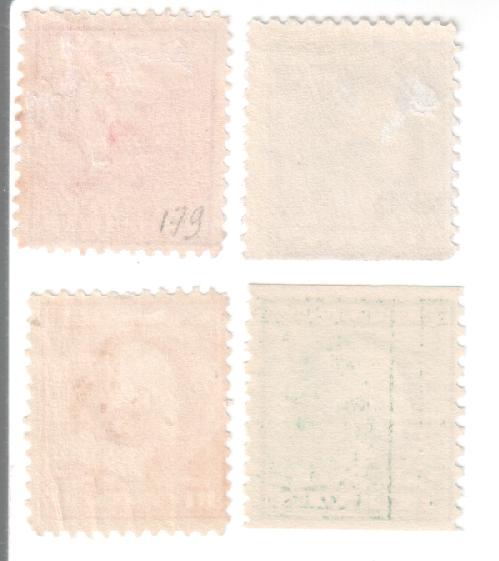 What think ye? Marty |
|
Send note to Staff
|
|
|
Pillar Of The Community
1092 Posts |
|
|
Pillar Of The Community
United States
1106 Posts |
|
|
I agree with t360's comments.
A stamp is gummed before it is perforated. Look at the perforations under a magnifying glass. You should see tiny areas around the perfs where the gum is missing. This is due to the perforating machine slightly tearing the paper fibers during the perforation process. During that process, small bits of the gum are removed around the perf.
I also look closely to see if the gum is covering something like a thin or a tear.
It's not easy and I'm sure I've been fooled more than once.
Dan |
|
Send note to Staff
|
|
|
Pillar Of The Community
2664 Posts |
|
|
Valued Member
Australia
312 Posts |
|
|
One point to consider is that stamps of the same series had the same gum applied the same way. So often the easiest way to check the gum on an uncommon or rare stamp is to check it against a common stamp issued in the same series. A 2c stamp that had millions of copies printed had the same gum applied as a 10c or $1 or $5 of the same set. Redistribution of the original gum is probably more common than completely new gum. This is done to remove hinge remnants - so the gum is liquified, the hinge remnants removed, and the gum redistributed and dried. The gum in this case will be altered and look different to its original state. The gum of early issue stamps (and these are the ones likely to be altered by regumming) was applied in one motion across the sheet, so you will get lines and gum skips running parallel. A stamp that has had its gum redistributed will not display this. I've only been collecting US for just over a month, so I can't say I'm familiar enough with the gum to hazard a guess on your stamps Marty. Plus it's difficult without seeing them close up. The bottom right one looks ok since it has the offset ink imprint, assuming it's on top of the gum and not under it.  Tinted gum is not necessarily an indicator of regumming, but again you really need to know what the gum looked like on that series. That colour may have been normal. High priced stamps are more likely to be regummed than cheaper issues, for obvious reasons. It would be unprofitable to regum common stamps. Balf |
|
Send note to Staff
|
|
|
Pillar Of The Community
USA
1881 Posts |
|
|
Havoc......
Balf is correct....except that for many stamps from 1900 up to about 1945, there were/are summer and winter formulas of gum so you can find series with gum that looks slightly different......there are also different patterns of gum breaker bars......long straight light bends to prevent the sheets of stamps from curling. Sometimes the spacing and direction of these breaker bars can be used to help identify some stamps, especially those from the 1930's & 40's.
|
|
Send note to Staff
|
|
|
Pillar Of The Community
United States
1106 Posts |
|
|
Quote:
Sometimes the spacing and direction of these breaker bars can be used to help identify some stamps, especially those from the 1930's & 40's For example, spacing of gum breaks is a good way to distinguish faked mint Kansas-Nebraska overprints. Dan |
|
Send note to Staff
|
|
|
Pillar Of The Community
Guatemala
1500 Posts |
|
|
Wonderful information here.  My knowledge of re-gummed stamps has expanded tremendously. Quote:
The bottom right one looks ok since it has the offset ink imprint, assuming it's on top of the gum and not under it. Isn't the reverse side ink stains from flat plate printing "applied" prior to being gummed? Although the imperf block of 4 is not all that valuable,(Scott #481) it seems to me that the stamp has been re-gummed. Why do I say this? It appears that a very wet gum was applied in the re-gumming process since the face side shows the paper to be very deformed, almost like a rippling effect at the same location that displays the deformed gum on the back.  That being said, I could very well be wrong, in that the gum obtained the "alligator skin" effect due to inadequate storage which may have caused the rippled "skin" effect. If anyone would like to see a much more enlarged photo, let me which stamp, and I'll post it. I'm also curious about Tina's gummed on both sides stamp. Has that happened at any time? Marty If anyone wo |
|
Send note to Staff
|
|
|
Pillar Of The Community
Guatemala
1500 Posts |
|
|
Quote:
spacing of gum breaks is a good way to distinguish faked mint Kansas-Nebraska overprints Some time ago I bought some of the higher value Kansas- Nebr. overprints. I could see in the ebay photo that something was wrong with the gum, so I bid accordingly and really, I hardly paid anything for them. I'm sure everyone else noticed it but I took a chance and bought them. Upon receiving them they were definitely re-gummed. (Overprint dimensions are correct and no typewriter impressions but further checking would be needed to confirm their genuineness). The stamp paper appear discolored from the re-gumming. I soak the stamps and as I had hoped the soaking did pull the browned gum out of the paper and the stamps are now nice and white. Marty |
|
Send note to Staff
|
|
|
Valued Member
United States
127 Posts |
|
|
Yes, like Marty, I'm curious about the stamp of Tina's gummed on both sides. Really educational here, but the two-sided gum's a puzzle. |
|
Send note to Staff
|
|
|
Pillar Of The Community
USA
3315 Posts |
|
|
Quote:
there were/are summer and winter formulas OK, I didn't know this. It explains some things. Thank you! |
|
Send note to Staff
|
|
|
Pillar Of The Community
United States
1106 Posts |
|
|
Quote:
The red stamp in this picture looks to have gum on both sides I know few details about foreign stamps but I did manage to put gum on both sides of a US stamp.  I had two mint stamps that were stuck together. In an early experiment with a sweat box, I left them in way, way too long and the gum from the top stamp transferred to the top of the underside stamp. Maybe that's what happened here? Dan |
|
Send note to Staff
|
|
|
Valued Member
Australia
312 Posts |
|
|
Quote:
Isn't the reverse side ink stains from flat plate printing "applied" prior to being gummed?
The fact that the ink impression on the rear is offset (you can see the frames from two adjacent stamps) leads me to believe that this was caused by laying the gummed sheet on top of another sheet when the ink was still slightly damp after printing. Of course my knowledge of US stamps is still limited - most of my knowledge is more applicable to Australia and production here involved printing on paper that was pregummed. I'm not sure if all US stamps were printed pregummed or at what stage they started to. My Scott US Specialised is still in the mail  Perhaps someone else can help with this info? Balf |
|
Send note to Staff
|
|
|
Pillar Of The Community
Guatemala
1500 Posts |
|
|
I'm not sure about recent gummed US stamps but I understand that US sheets are printed first and then gummed. The stamp in question here is the bottom right coil. It is a flat press printing and not offset. The ink residue on the back of the stamp remains after gum is removed, indicating that it was indeed printed prior to having gum applied. This faint ink impression on used early US stamps with no gum is one of the ways of ruling out rotary press printings.
It is quite interesting to hear that Australia gums the sheet prior to printing so I can easily understand how you came to your conclusion that the coil has original gum.
Marty |
|
Send note to Staff
|
|
| |
Replies: 15 / Views: 2,554 |
|




 Posted 01/13/2008 8:49 pm


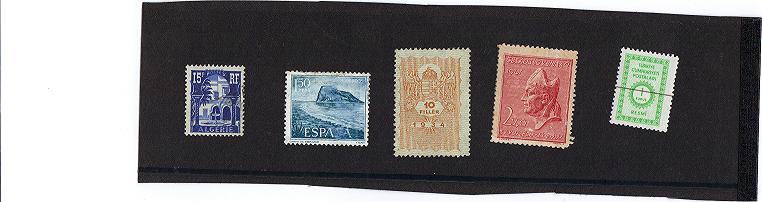 The red stamp in this picture looks to have gum on both sides and the gum looks good ,it confused me alot


