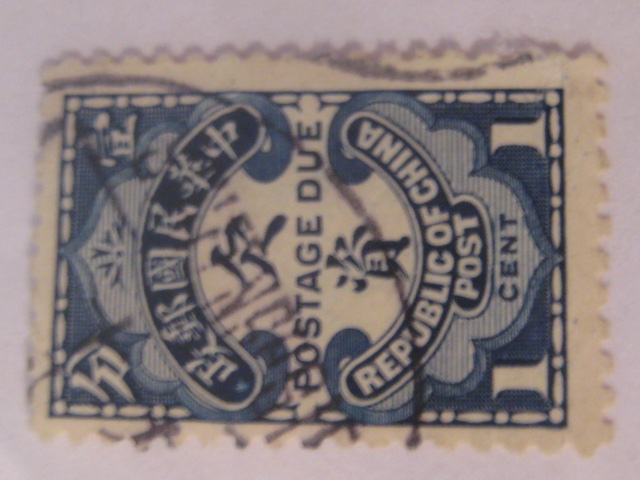
SueStamps, first of all, 'Postage Due'
does mean that extra postage has to be paid. Just who collected it varies from country to country: sometimes the postman collected it, sometimes you'd have to go to the local post office to pay the money and pick up your item.
Your Chinese stamp in fact has 'Postage Due in
both English and Chinese. (The Chinese is the two vertical characters on either side of the English words 'Postage Due'.)
Most countries have given up using them by now, though I think one or two may still be doing it. The US collectors will be able to tell you when the US stopped using these stamps.
Finally, here is an example of an Australian Postage Due stamp

(and the front of the postcard is quite charming:)

The T/10 handstamp was applied in England, indicating underpayment by 10 Gold Centimes. (Gold Centimes/Francs were an artificial currency used by members of the Universal Postal Union to allow other member countries to convert amounts into their own local currencies.) The T1d. stamp was applied in Australia, indicating 1 Penny postage due, and the Australian 1d Postage Due stamp was applied, and probably cancelled by the postman when he collected the money owing.
(An architect with his office in Collins Street in Melbourne probably wouldn't have minded the penny too much. Collins Street is one of the main and most expensive streets in the City

)





 Posted 09/21/2011 7:20 pm