| Author |
 Replies: 10 / Views: 5,014 Replies: 10 / Views: 5,014 |
|
|
Pillar Of The Community
United States
987 Posts |
|
|
|
Does the salvage with numbers add value to stamps? I've been tearing the selvage off. I've not seen in Scott's catalog or the P.O. catalog any added value. Just wondering.
|
|
Send note to Staff
|
|
|
|
|
Bedrock Of The Community
United States
12128 Posts |
|
|
"Value" is a very subjective term. If you have single stamps with a plate number attached in the selvage, I'd keep it that way, as there are some specialists that would consider them highly desirable, particularly with the older US issues. You may be interested in this link to a website for the "American Plate Number Single Society" which encourages the collection of these specimens: http://www.apnss.org/intro.htm |
Send note to Staff 
|
|
|
Pillar Of The Community
United States
677 Posts |
|
|
For posting in my album, I may take the selvedge off to make all the stamps on the page appear uniform and neat.
However, for duplicates that I may trade, I'd leave the selvedge on. You can always take it off, but you can't put it back on. Leaving it on may be a benefit to keep the perfs protected and also may come in handy if they help in showing the extent of any tagging. Also on some of the stamps that came in dry print/wet print varieties, the selvedge may help to determine if it is wet or dry since the selvedge would be a white border that may show the wet print ink better than the main part of the stamp.
Dave N.
<>< |
|
Send note to Staff
|
|
|
Pillar Of The Community
United States
858 Posts |
|
|
To me, salvage is a royal pain. If you are dealing with 19th century or early 20th century, leave the salvage on. From 1940 onward, I remove all salvage. I don't like the way it looks in the album. There are exceptions, like the tabs on Israel stamps, but for US stamps for the last 60 years I remove it, or keep it on if I am trading the stamp. |
|
Send note to Staff
|
|
|
Valued Member
United States
488 Posts |
|
|
Pillar Of The Community
United States
3232 Posts |
|
|
It is called "selvage". I sometimes keep it if there is something interesting/important on it, such as a plate number.
sel·vage [ sélvij ]
1.nonfraying edge of fabric: an edge of a piece of fabric that is woven so that it will not fray
2.strip of material: an edge or strip of material included when manufacturing something such as a metal or plastic object or a sheet of postage stamps that allows it to be handled
3.lock plate: a slotted plate or surface through which the bolt of a lock passes
|
|
Send note to Staff
|
|
|
Valued Member
United States
302 Posts |
|
|
I keep mine on and move them to a separate area of my album.
Alternatively if its the only copy that you have you can fold back the selvage without tearing it away.
As Dave has said, plate numbers can be very useful for identifying stamps issued in mass quantity like the 2c Washington. |
|
Send note to Staff
|
|
|
Pillar Of The Community
United States
6667 Posts |
|
|
New Member
Canada
1 Posts |
|
|
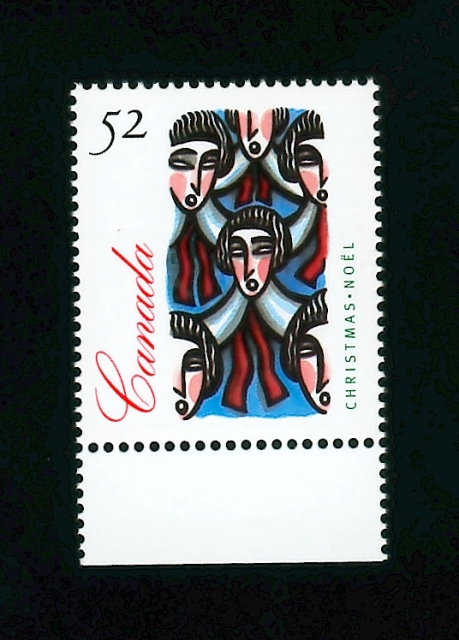 This is a rare stamp. Canada 1994 X-mas error #1534ii was printed by Canada Post in anticipation of a rate increase that did not happen. Does the bottom salvage matter ? |
|
Send note to Staff
|
|
|
Pillar Of The Community
1849 Posts |
|
|
Pillar Of The Community
United States
7239 Posts |
|
|
Selvage can identify the position of stamp on the sheet. For older German stamps, the top selvage can help identify whether the stamp is a rotary press, or flat plate printing. In older collections, selvage was commonly used for hinging stamps to pages.
Selvage will help a stamp to accommodate a complete cancel, where a stamp without its selvage cannot, in many cases. Since stamps are now self-adhesive and selvage-free, and since cancels tend to be electronic smudges, the attractive 'complete cancel' tends to be a thing of the past. |
|
Send note to Staff
|
| Edited by bookbndrbob - 04/21/2015 12:20 am |
|
| |
Replies: 10 / Views: 5,014 |
|




 Posted 11/24/2011 09:39 am


