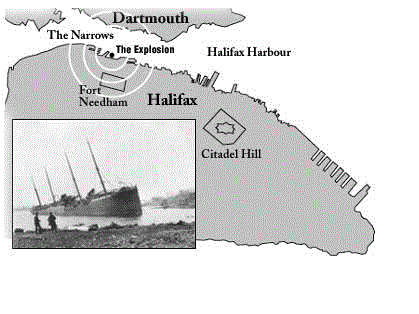
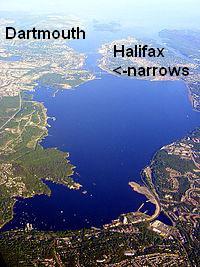
Halifax from the air facing the Atlantic Ocean to the south at top.
From Wikipedia:
http://en.wikipedia.org/wiki/Halifax_Explosion Quote:
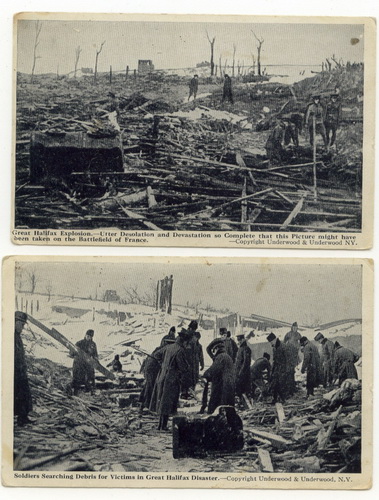
The next day brought a blizzard that dropped 40 centimetres (16 in) of snow on the community. Those who remained trapped in rubble, the injured, or those who had not been found or tended to, were often left in the bitter cold, adding to the loss of life. Rescuers were forced to work through the storm, and many people who were left homeless found shelter wherever they could. Houses left standing did not have windows after the blast, leaving survivors to use tar paper, carpets and other available materials to seal their homes from the elements. The snow, however, did aid firemen in ensuring any remaining fires were extinguished.
Quote:
Relief trains with doctors, nurses and supplies first arrived from Nova Scotia and New Brunswick towns within hours of the explosion and continued throughout the day and into the evening. The first outside relief train arrived via the Intercolonial Railway from Truro, Nova Scotia, 95 kilometres (60 mi) away, at about noon, followed by a Dominion Atlantic Railway relief train from Kentville, 100 kilometres (60 mi) away.[54] By nightfall, about a dozen trains had brought help from across the Maritimes, a day and a half ahead of American relief trains, including trains from Amherst, Nova Scotia (200 kilometres / 120 miles), Moncton, New Brunswick (260 kilometres / 160 miles) and New Glasgow, Nova Scotia (160 kilometres / 100 miles). These trains not only brought medical staff and supplies but also evacuated wounded to hospitals outside Halifax in towns such as Truro.[55]
Later, American support was strong, particularly from Massachusetts, with support trains bringing doctors, nurses, orderlies and much needed supplies to the effort. A relief train left from Boston, 1,100 kilometres (700 mi) away, at 10:00 PM on the day of the explosion. Relentlessly chugging through wintry terrain, it was delayed by heavy snowfall but reached Halifax a day plus a few hours later, at 3:00 AM on December 8, unloading much needed food, water, medical supplies, and some aid workers to relieve the Nova Scotia medical staff, many of whom had worked without rest since the morning of the explosion.
Quote:
In 1918, Halifax sent a Christmas tree to the City of Boston in thanks and remembrance for the help that the Boston Red Cross and the Massachusetts Public Safety Committee provided immediately after the disaster.[71] That gift was revived in 1971 by the Lunenburg County Christmas Tree Producers Association, who began an annual donation of a large tree to promote Christmas tree exports as well as acknowledge the Boston support after the explosion. The gift was later taken over by the Nova Scotia Government to continue the goodwill gesture as well as to promote trade and tourism.[72] The tree is Boston's official Christmas tree and is lit on Boston Common throughout the holiday season. Knowing its symbolic importance to both cities, the Nova Scotia Department of Natural Resources has specific guidelines for selecting the tree
2011 marks the 70th annual gift of a tree to Boston by Nova Scotians.






 Posted 12/10/2011 9:23 pm