Anyone? Anyone?... Bueller?
Nitrolures left a question out there which thus far hasn't been answered, so I'll take it upon myself to provide one. Yeah, I was that kind of student.
Sevens and nines have in common complete top and bottom lines, complete (more or less) left and right ornaments, incomplete plumes and missing balls. The difference is in the nines the one or both of the top and bottom lines has been
recut. Which is to say, an engraver went to the plate directly and used his cutting tools to reinforce the lines. A seven is type II of the 1851 1c Franklin design, and a nine is type IV. Sevens and nines are by definition imperforate
*; a perfed type II is a 20 and a perfed type IV is a 23.
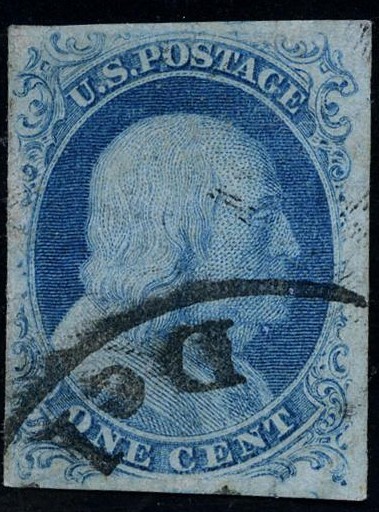
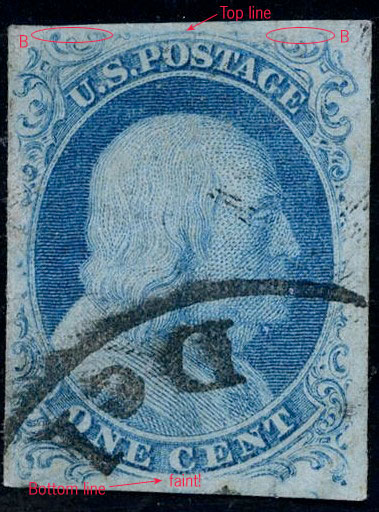
In looking at bunnyos' seven, we see a thin top line, and a very faint bottom line. So faint, that in this low resolution scan it appears to be missing.
Missing either the top or bottom line would make it an 8A (type IIIa). However, there are only a few positions with broken bottom lines, and the rest of this stamp does not look like those. For no extra charge, I'll throw in that this seven is relief "B," which we can tell because the ornaments at the top (circled with the ovals) are by and large complete.
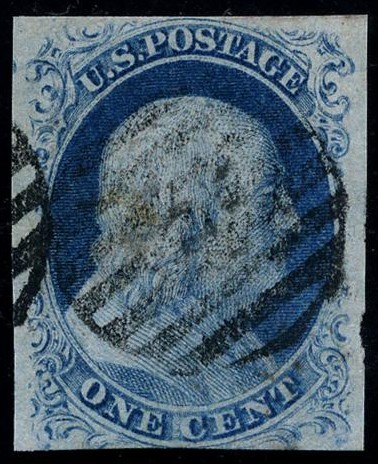
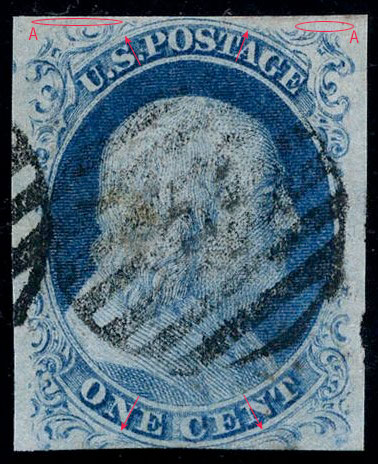
Looking at bunnyos' nine, we can see the top and bottom lines have parts that are heavier and darker--
bolder--than the rest of the line. This is the recutting. I have used arrows to point out the ends of the recut sections. An interesting thing about the type IVs is every recutting is different in where it starts and ends, which is how we know the recutting was done directly on the plate. This nine is relief A, the ovals showing the ornaments on the top are incomplete.





 Posted 01/07/2012 6:37 pm