Stamp Community Family of Web Sites
Thousands of stamps, consistently graded, competitively priced and hundreds of in-depth blog posts to read


Stamp Community Forum
 
Username:
Password:
Save Password
Forgot your Password?

This page may contain links that result in small commissions to keep this free site up and running.

Welcome Guest! Registering and/or logging in will remove the anchor (bottom) ads. It's Free!

Wax Paper Washington?

 
To participate in the forum you must log in or register.
Author Previous TopicReplies: 7 / Views: 3,102Next Topic  
Valued Member
United States
254 Posts
Posted 03/11/2012   7:12 pm  Show Profile Bookmark this topic Add peterc4 to your friends list Get a Link to this Message
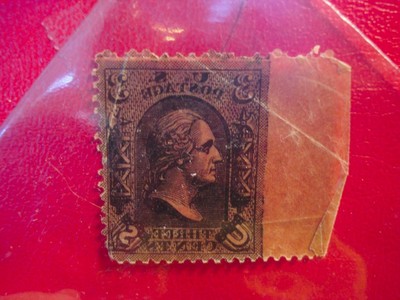
I stumbled on this - Anyone have any idea what this is??


Item # 160754492569 If you want to see the whole listing - not much information other than - reverse printed on what appears to be waxed paper.


Send note to Staff

Pillar Of The Community
Canada
6525 Posts
Posted 03/11/2012   7:17 pm  Show Profile Bookmark this reply Add jamesw to your friends list  Get a Link to this Reply
1867 Essays by Henry Loewenberg

Check out this page on SwedishTiger.

http://www.theswedishtiger.com/x186...wenburg.html

Very cool. Wish I had the dosh. I imagine the price will go up a bit in the next 4 hours with 9 bidders.
Send note to Staff  Go to Top of Page
Edited by jamesw - 03/11/2012 7:23 pm
Valued Member
United States
254 Posts
Posted 03/11/2012   8:16 pm  Show Profile Bookmark this reply Add peterc4 to your friends list  Get a Link to this Reply
Thanks for the info. I found it by accident, it seems pretty poorly described? Outside my area, but I'll keep an eye on it. Maybe it'll go cheap?
Send note to Staff  Go to Top of Page
Rest in Peace
United States
7097 Posts
Posted 03/12/2012   07:44 am  Show Profile Bookmark this reply Add I_Love_Stamps to your friends list  Get a Link to this Reply
It's a Henry Lowenburg essay on what I believe is called Goldbeaters skin. A type of experimental "onion skin" type paper but I believe it's actually calf intestine. It was an experimental paper to thwart the washing and reuse of postage stamps.
I believe I'm close to being correct on this one. I run across one too but sold it last fall.
Send note to Staff  Go to Top of Page
Edited by I_Love_Stamps - 03/12/2012 07:46 am
Pillar Of The Community
United States
3568 Posts
Posted 03/12/2012   09:22 am  Show Profile Bookmark this reply Add jhlovell to your friends list  Get a Link to this Reply
Very cool, and the crispness of detail is still amazing.
Send note to Staff  Go to Top of Page
Pillar Of The Community
United States
2547 Posts
Posted 03/12/2012   5:16 pm  Show Profile Bookmark this reply Add Russ to your friends list  Get a Link to this Reply
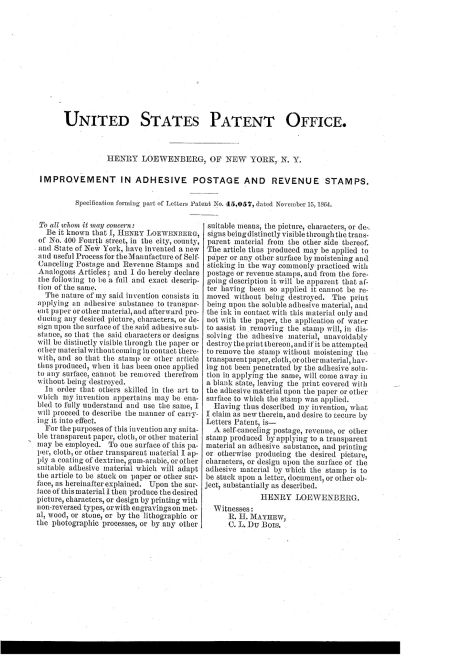
As previously stated this is an essay of the decalcomania process by Henry Loewenberg. Loewenberg received 2 patents for this process; 40,489 (Nov. 3, 1863) and 45,057 (Nov. 15, 1864). Both essays picture on this thread are from patent 45,057.

The original intent was that the stamp would be moistened, applied to the envelope and the facing paper removed leaving a "decal" on the envelope. However, the image was normally damaged with portions of the design still adhering to the facing paper.

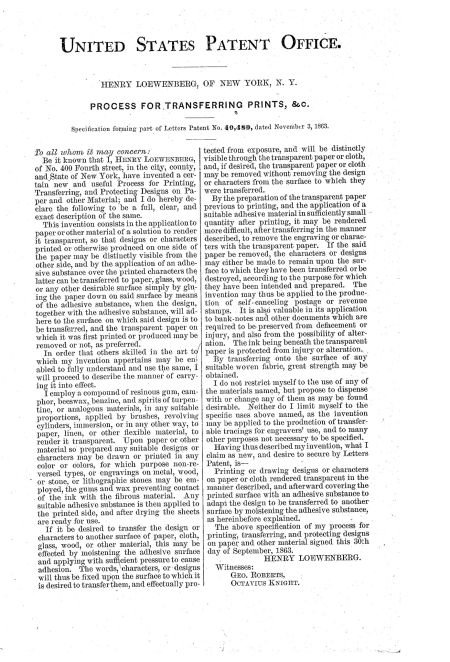
Patent 40,489

The process consisted of applying a solution of "resinous gum, camphor, beeswax, benzene, and spirits of turpentine" to goldbeaters skin or onionskin paper to render it transparent. The design was printed from non-reversed plates onto the paper and the gums and wax "preventing contact of the ink with the fibrous" paper. The adhesive gum is then applied over printing and the stamps can then be perforated and are ready for use.

The stamp was applied in the usual manner by moistening the gum and pressing it onto the envelope and, after being applied, the printing will be visible through the transparent paper. However, "the transparent paper… may be removed without removing the design or characters from the surface to which they were transferred."

The only essays that I have seen from this patent are the design of the 1853-1871 1c France stamps of Napoleon III.


Patent 45,057

Henry Loewenberg of New York, New York received the patent on November 15, 1864. The object of his process was to produce a stamp that "when it has been once applied to any surface, cannot be removed therefrom without being destroyed".

The process consisted of applying a coating of "dextrine, gum-arabic, or other suitable adhesive material" to one side of transparent paper. The stamp design or image is printed on the gummed layer with the design "distinctly visible through the transparent material from the other side thereof". This printing would be done with a non-reversed image plate. The stamp is applied to the envelope by" moistening and sticking in the way commonly practiced with postage and revenue stamps".

Since the printed image is applied directly to the adhesive gum, attempts to remove the stamp using fluids will cause the water soluble gum to soften and release portions of the printed image destroying the stamp. Attempts to remove the stamp without fluids will cause the thin paper to tear with portions remaining adhered to the envelope destroying the stamp.

Henry Loewenberg held patent 40489, November 3, 1863, for the transparent paper for this process. This paper was made by applying a solution of "resinous gum, camphor, beeswax, and spirits of turpentine" to goldbeaters skin or onionskin paper.

Numerous essays of the National Bank Note Co. 1861-1866 issues and Washington design were produced for this process. Essays were also produced for the French postal service. All essays were printed by the National Bank Note Co. This patent was adopted in 1866 for the production of Prussia 10sg and 30sg (Scott 21, 22).


Henry Loewenberg also received 2 other re-use prevention patents. one for starch surface paper and one for chemical paper.

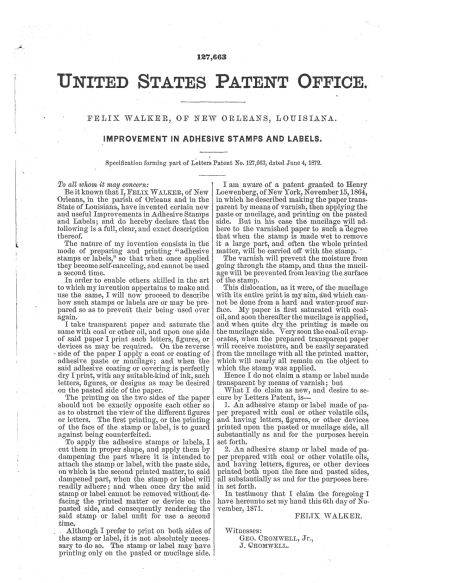
The Loewenberg was not the only decalcomania patents granted. Felix Walker also received a patent (Pat 127,663) for this process.

Patent 127,663

Felix Walker of New Orleans, Louisiana filed his application for patent in November, 1871 and received the patent on June 4, 1872. The object of his process was to produce stamps "so that once applied they become self-canceling, and cannot be used a second time".

This process is decalcomania printed on both sides. The process was to saturate transparent paper "with coal or other oil, and on one side of said paper print such letters, figures, or devices a may be required" with this being the face. The second side, or back, is gummed with mucilage, allowed to dry and then print "with any suitable kind of ink, such letters, figures, or designs as may be desired on the pasted side of the paper". The printing on the two sides of the paper should be arranged so that it does not overlap and obscure the image.

Attempts to remove the stamp for reuse would cause the mucilage, on which the second side is printed, to release from the back of the stamp.
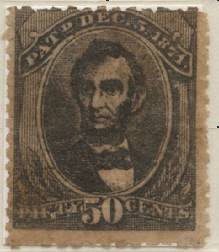


Walker essay
Send note to Staff  Go to Top of Page
Pillar Of The Community
United States
2948 Posts
Posted 03/14/2012   10:31 am  Show Profile Check Rileysan's eBay Listings Bookmark this reply Add Rileysan to your friends list  Get a Link to this Reply
... and now you know (pregnant pause) the rest of the story.


Great article, Russ!

Fast forward to the mid/late 20th century and Mr Loewenberg's patented process turns into iron-on t-shirt patches and temporary tattoos! Anyone want to paste some 19th century essays to their skin?
Send note to Staff  Go to Top of Page
Valued Member
United States
254 Posts
Posted 03/16/2012   8:03 pm  Show Profile Bookmark this reply Add peterc4 to your friends list  Get a Link to this Reply
Wow! Russ and everyone, thanks for the info.

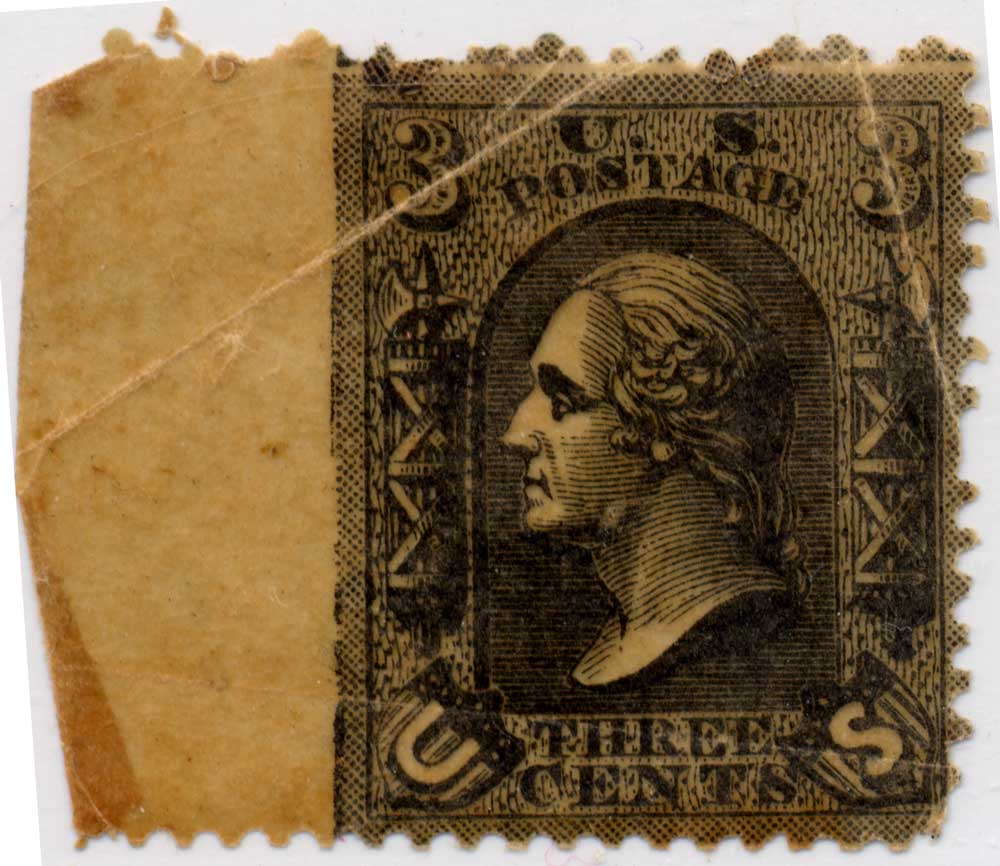
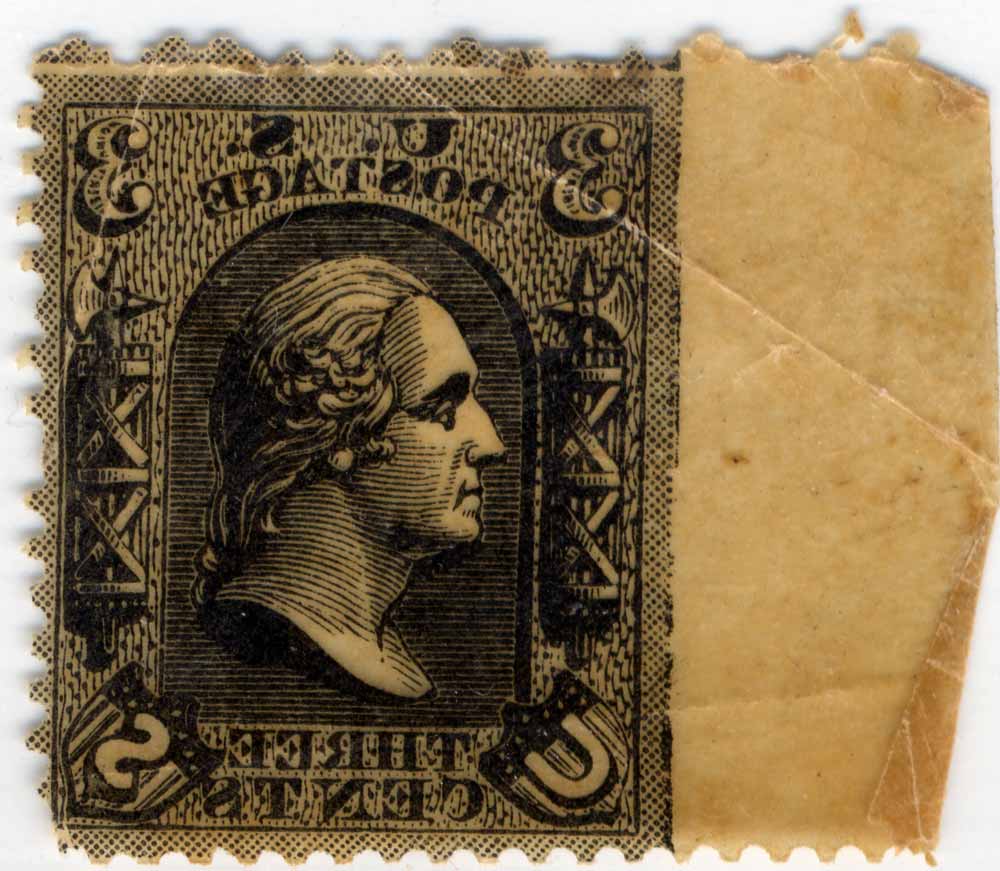
Quick update: I took a gamble and made a bid. I got the essay for 21$ which seems to be a "meh" deal according to my '94 Scott's. Anyway, pictures follow, scanned from the front and the back.


and the back:


Very "black" looking black ink. Not sure what exact version this is.

-p
Send note to Staff  Go to Top of Page
  Previous TopicReplies: 7 / Views: 3,102Next Topic  
 
To participate in the forum you must log in or register.

Go to Top of Page

Disclaimer: While a tremendous amount of effort goes into ensuring the accuracy of the information contained in this site, Stamp Community assumes no liability for errors. Copyright 2005 - 2026 Stamp Community Family - All rights reserved worldwide. Use of any images or content on this website without prior written permission of Stamp Community or the original lender is strictly prohibited.
Privacy Policy / Terms of Use    Advertise Here
Stamp Community Forum © 2007 - 2026 Stamp Community Forums
It took 0.3 seconds to lick this stamp. Powered By: Snitz Forums 2000 Version 3.4.05