From Wikipedia
"Catania ([ka#712;ta#720;nja] ( listen); Greek: #922;#945;#964;#940;#957;#951; – Katáne; Latin: Cat#259;na and Cat#301;na[1]) is an Italian city on the east coast of Sicily facing the Ionian Sea, between Messina and Syracuse. It is the capital of the homonymous province, and is the second-largest city in Sicily and the tenth in Italy.
Catania is known for its seismic history, having been destroyed by a catastrophic earthquake in 1169,[2] another in 1693, and several volcanic eruptions from the neighboring Mount Etna volcano, the most violent of which was in 1669.[2]
Catania has had a long and eventful history, having been founded in the 8th century BC.[2] In the 14th century and the Renaissance, Catania was one of Italy's most important and flourishing cultural, artistic, and political centers,[2] having witnessed the opening in 1434 of the first university in Sicily.[2] Today, Catania is one of the main economic, touristic, and educational centers in the island, being an important hub of industry, thus gaining the nickname, "European Silicon Valley".[2]
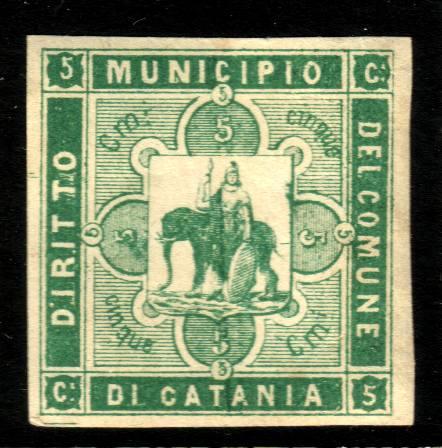
Around 900, when Catania was part of the emirate of Sicily, it was known as Balad-Al-Fil and Medinat-Al-Fil, Catania's two official Arabic appellatives. The first means "The Village or The Country of the Elephant", while the second means "The City of the Elephant".[6] The Elephant is the lava sculpture of Piazza Duomo's Fountain. Likely a prehistoric sculpture that was reforged in the Byzantine Era, it appears to be an talisman that was reputedly powerful enough to protect the city from enemies and to keep away misfortune, plagues, or natural calamities.
By the way, the elephant appears on Catania's arms.
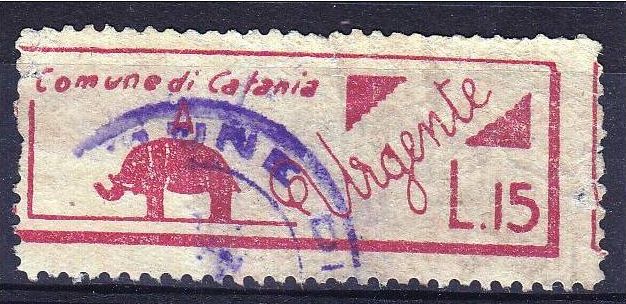
The word "Urgente" in Italian (like in most Latin languages) stands for "Express Mail"
|





 Posted 04/12/2012 4:16 pm