|
This page may contain links that result in small commissions to keep this free site up and running.

Welcome Guest! Registering and/or logging in will remove the anchor (bottom) ads. It's Free!
To participate in the forum you must log in or register.
| Author |
 Replies: 10 / Views: 2,343 Replies: 10 / Views: 2,343 |
|
|
Valued Member
United States
491 Posts |
|
|
When I first joined SCF, I remember some kind person shared with me that the straight-edge Bureaus (with guideline ink) 17c / 20c / 25c etc. cannot be the p10 1/2 x 11 because of the way they were printed. Is there some similar rule for the W-F rotaries? I have a number of WFs with straight edges and ink showing, so it might help me narrow down the possibilities more speedily? Any other such quick tricks (other than counting perfs of course  )? I'm looking at a giant pile of 1c with Louisville, KY, T205 precancels that I'd like to reduce to just the 2 or 3 I might actually need. Brunell says this type was issued on 1912, 1914, 1917, 1919 (=several different rotaries) and I am finding a lot of 10.5 perfs, which don't exist, so I need some cheats to get thru this. Thanks. |
|
Send note to Staff
|
| Edited by JanS - 05/11/2012 2:32 pm |
|
|
|
|
Pillar Of The Community
United States
6668 Posts |
|
|
Straight edges occur on every sheet of stamps as they are cut down from the original printing sheet. Most of the Washington / Franklins were printed from 400 or 200 Subject plates and then cut into panes of either 100 or 50. Example: http://www.1847usa.com/PlateLayouts...teLayout.htmCheck the cut lines as all stamps on the cut line will have a "Natural straight edge" |
Send note to Staff 
|
|
|
Pillar Of The Community
United States
2547 Posts |
|
|
My vote: rotary press w/f's do not have natural straight edges [unless they are the error imperfs].
ps: if your w/f's are coming up 10 1/2 gauge, get a new gauge :)
pps: after you have looked at a few thousand of these, your eye will distinguish the p12, p10, and p11 without much difficulty. Sometimes p10 rotary's and flat's can be tricky to tell apart. P11 1918 offsets are usually easy to separate from the flats. The one you want to be SURE you have right is the p11 flat (SC498) versus p11 rotary (SC544/545). |
|
Send note to Staff
|
|
|
Valued Member
United States
491 Posts |
|
|
I'm sorry, this stuff completely confuses me.  Meantime, I have perfed 46 stamps -- 44 are p10 (i.e. approx. 10.25/10.50 so I am rounding down because the p11 gauge fits the perfs worse than the p10). Two are p11 and flat printed. So the 2 are #498. The other 44, I have just finished measuring -- not one Rotary. Now I know chasa told me a while back that comparatively few Rotaries were precanceled, so that makes some sense. However, I'm also wondering ---- just how clear is the distinction in size between Flat Plate and Rotary on a 1c W-F when you measure it? I checked my US album for a comparison and found I have zero Rotaries in there -- is that because the difference is too small for me to see, or is it just chance? I don't know, but it doesn't seem that I have had any luck finding one in the past year, which is suspicious (but not 100% impossible). 43 of the ones I measured today were consistently dead-on 18.5 x 22-even, to my eye. The ONLY one that seems different measures more like 18 x 21.5 ... it is a much brighter green than the grayish cast of all the others and it has a SE with a visible guideline. What does this all mean?  It doesn't seem to fit the size of either Flat Plate or Rotary, it is definitely not p11 and the foil test does show an oval on it. Many thanks to anyone that can enlighten me on any of these issues.  |
|
Send note to Staff
|
| Edited by JanS - 05/11/2012 9:20 pm |
|
|
Valued Member
United States
491 Posts |
|
|
chasa: Thanks. For Louisville, per Brunell, there are no p11 Rotaries in T-205. Yea! Therefore, I am comfortable in this instance that my p11s are in fact #498s. [They measure right, too, but as you can see my faith in my mm scale is not great.] Funnily enough, the gauge I am using is brand new, out of the envelope this morning.  The one I've had for about 35 years is wearing out on the numbers 9.5, 10, 10.25 and 10.5 (not the dots, just the numbers, but it still makes it harder to use), so I splurged. [Pause while I compare the new/old gauges to see if there's any difference ... nope, the dots on both line up perfectly] I think I am just having trouble reading some of the ragged perfs. So I think that leaves me with: are the rotary/flat size differences easy to spot and why is my bright green SE p10 measuring smaller than expected? |
|
Send note to Staff
|
| Edited by JanS - 05/11/2012 9:39 pm |
|
|
Pillar Of The Community
United States
2547 Posts |
|
|
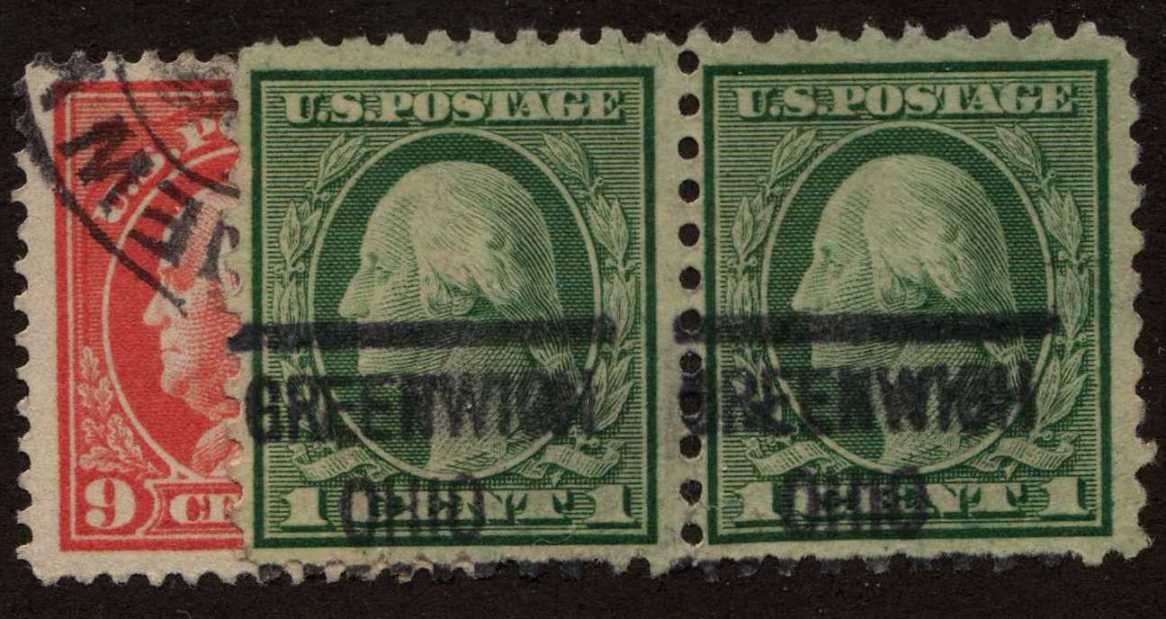
Counterintutively, the best way to measure size is not with a ruler. Compare with a known flat plate stamp, here with a 9 canter. The wide rotary's (SC545 & SC546) are more than a frameline wider. 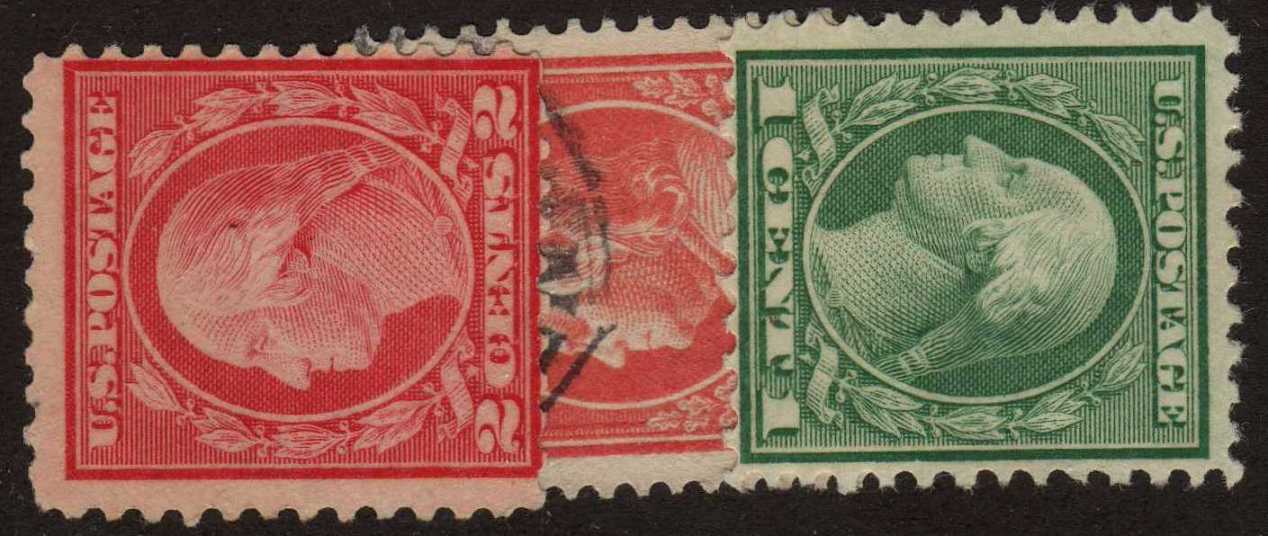 |
|
Send note to Staff
|
|
|
Pillar Of The Community
United States
2547 Posts |
|
|
Bedrock Of The Community
United States
12128 Posts |
|
|
I know I'm changing the subject, but those Greenwich, Ohio precancels made me look up the history of that town (which I never recall hearing much about before) and came up with this summary, confirming that the town was named after Greenwich, Connecticut: Quote:
There are approximately 1476 persons living within the Greenwich Village corporation area of about one square mile.
While centrally located in a major industrial district bounded by Mansfield, Akron, Cleveland and Toledo, Huron County is primarily an agricultural region, with about 80% of the land area in farms. But, because of small average size of these farms (about 160 acres), nearly 75% of the farm operators handle these chores on a part-time basis and work the remaining time in industry or retail business.
History
The devastation wrought upon New England communities by British Red Coats during the Revolutionary War played a major part in the future settlement of the Greenwich area and surrounding land.
After their homes and farms had been burned out, many New England families were given grants of land by the United States Government in this North Central section of Ohio (Huron and Erie Counties) - now known as "The Firelands."
Greenwich Township received its name from Greenwich (Fairfield County), Connecticut, where most of the "sufferers" had resided.
The first settler in the township was Henry Carpenter, who came from Ulster County, New York in 1817.
The village of Greenwich was incorporated in 1879. |
|
Send note to Staff
|
| Edited by wt1 - 05/11/2012 11:34 pm |
|
|
Valued Member
United States
491 Posts |
|
|
OK, so yes, the difference should be quite clear. I had vaguely read about doing this -- someone online suggests cutting the corners off a common stamp of each type to create a template ... which I'd never do, even if I had a rotary to go by ...  Could I use a Bureau rotary (for comparison, not cutting!)??? Here are scans of my brighter green 1c with a typical grayish green one behind. I'm not very expert at lining them up, but I think you can still see that the bright one is smaller in both dimensions - about 1/2 mm each way. So what do you think is going on? Even if I am mis-measuring with my ruler, why is the bright green one smaller in both directions? And surely my (larger) gray-greens can't all be rotary? Or maybe the variation by .5 mm is within the margin for both being flat press, but one is a 424 and one a 462?? (which?) 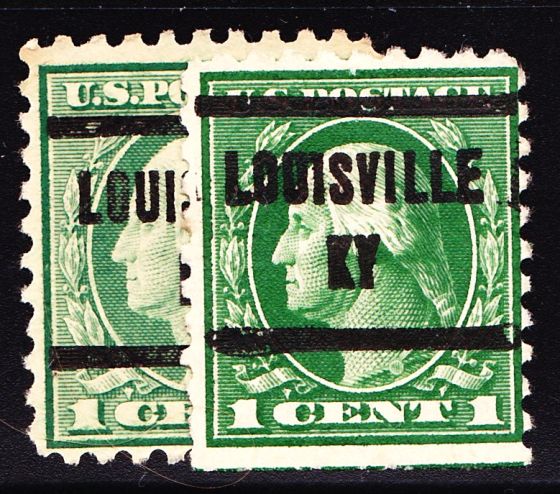 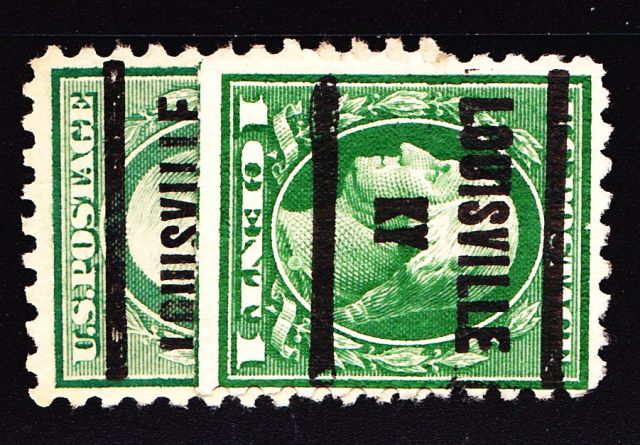 |
|
Send note to Staff
|
|
|
Pillar Of The Community
United States
2547 Posts |
|
|
Valued Member
United States
491 Posts |
|
|
Wow. OK, thanks chasa. That means my stack of gray-greens are all 543s, then, because they all line up together. Maybe I *should* chop one of them up as a template for the future!
|
|
Send note to Staff
|
|
| |
Replies: 10 / Views: 2,343 |
|
|
To participate in the forum you must log in or register. | |
 Newbie.help With Stamp Identification (J29) Inherited These Stamps, Are They Genuine? APS Membership Discount Metropex Stamp Show: Roseville, Minnesota October 23-24 Weird Covers, 1885,1886, And 1982 For Users Of Two-Post Blue International Albums What Is Your Experience With Binders. New Member Posting Image Of Avatar, Front And Back Of U2 Cut Square, Market Value Or References? Working On An Offline Collection George Washington 3 Cent 1861 With Print On The Back Hello From The Netherlands - New Member Then And Now, From Old Postcards New Member Wanting To Add An Avatar Sparks Auction Fees? 163 VF Nyfm Vertically Ribbed 163 XF Quartered Cork, Labeled Jumbo 136 VF Quadruple Split H Grill Nashville Philatelic Society-Your Invitation To Our Auction Night Meeting Monday, October 26, 2026 Nashville Philatelic Society-Your Invitation To Our Meeting Monday, October 19, 2026 Christmas Around The World 2026 C.e. In The Large Queen Cancel A More Condensed Album Page Experiment. US Scott #3 Postmarked Or Fake? Linn's Is Back - The Newspaper Is Back In Print Lots Of 1867 Grills On Sale Ajman Michel 1292A (1294A?) Newbie.help With Stamp Identification (J29) Inherited These Stamps, Are They Genuine? APS Membership Discount Metropex Stamp Show: Roseville, Minnesota October 23-24 Weird Covers, 1885,1886, And 1982 For Users Of Two-Post Blue International Albums What Is Your Experience With Binders. New Member Posting Image Of Avatar, Front And Back Of U2 Cut Square, Market Value Or References? Working On An Offline Collection George Washington 3 Cent 1861 With Print On The Back Hello From The Netherlands - New Member Then And Now, From Old Postcards New Member Wanting To Add An Avatar Sparks Auction Fees? 163 VF Nyfm Vertically Ribbed 163 XF Quartered Cork, Labeled Jumbo 136 VF Quadruple Split H Grill Nashville Philatelic Society-Your Invitation To Our Auction Night Meeting Monday, October 26, 2026 Nashville Philatelic Society-Your Invitation To Our Meeting Monday, October 19, 2026 Christmas Around The World 2026 C.e. In The Large Queen Cancel A More Condensed Album Page Experiment. US Scott #3 Postmarked Or Fake? Linn's Is Back - The Newspaper Is Back In Print Lots Of 1867 Grills On Sale Ajman Michel 1292A (1294A?)
Czech Stamp Engravers 1851-57 12c Washington Newbie.help With Stamp Identification (J29) What Did You Do Philatelically: Today Or Recently? Collecting By Engraver Soviet Union Stamp Engravers Spain Stamp Engravers On The Road Again - Eye To Eye With The Local Postal Authority Inherited These Stamps, Are They Genuine? For Users Of Two-Post Blue International Albums What Is Your Experience With Binders. APS Membership Discount Children On Stamps Lets See Your Souvenir Sheets! World Post Day And International Letter Writing Week Christmas Around The World 2026 Working On An Offline Collection What Is The Strangest Or Most Unusual Stamp Material You Own? Weird Covers, 1885,1886, And 1982 Gems And Minerals Metropex Stamp Show: Roseville, Minnesota October 23-24 New Member Posting Image Of Avatar, Front And Back Of U2 Cut Square, Market Value Or References? Hello From The Netherlands - New Member Lakes, Marshes, Mangroves, And Wetlands On Stamps Show Your Film And Music Star Stamps Pushing 330,000 All Different Worldwide Stamps In One Collection .
Disclaimer: While a tremendous amount of effort goes into ensuring the accuracy of the information contained in this site, Stamp Community assumes no liability for errors. Copyright 2005 - 2026 Stamp Community Family - All rights reserved worldwide. Use of any images or content on this website without prior written permission of Stamp Community or the original lender is strictly prohibited.
Privacy Policy / Terms of Use Advertise Here |
| Stamp Community Forum |
© 2007 - 2026 Stamp Community Forums |
| It took 0.39 seconds to lick this stamp. |
 |
|
|
|


 Posted 05/11/2012 2:19 pm