| Author |
 Replies: 20 / Views: 4,356 Replies: 20 / Views: 4,356 |
|
Valued Member
United States
110 Posts |
|
|
Has anyone ever seen something like this? I came across this while transferring stamps from an old album I acquired. It looks as if it was due to the sheet having been set on top of the previous sheet right after printing and the ink from the sheet below was transferred to the back of the sheet above. 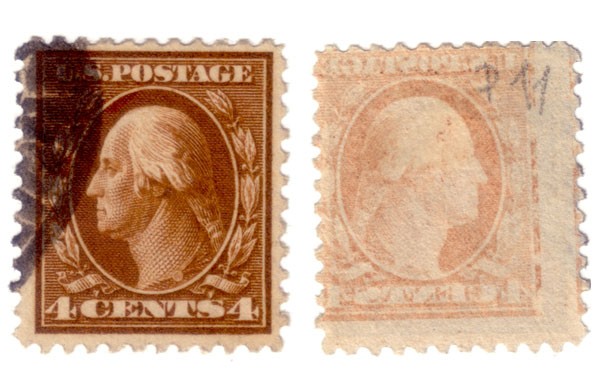 |
|
Send note to Staff
|
| Edited by tbirdfour - 08/05/2012 2:06 pm |
|
|
|
|
Rest in Peace
United States
7097 Posts |
|
|
Yep! I have a couple Franklin 20¢'rs like that. That's exactly right too. |
Send note to Staff 
|
|
|
Pillar Of The Community
United States
6668 Posts |
|
|
TB4, that is called an offset. It comes from laying fresh sheets of Stamp on top of each other before the ink has dried. Not sure if they carry a premium on price, but it certainly makes for an interesting item in the collection. |
|
Send note to Staff
|
|
|
Valued Member
United States
110 Posts |
|
|
That is what I thought it was. Thanks for confirming it for me. I will need to mount this one back side up. :) |
|
Send note to Staff
|
|
|
Valued Member
Ireland
169 Posts |
|
|
I have got a similar pair of #496 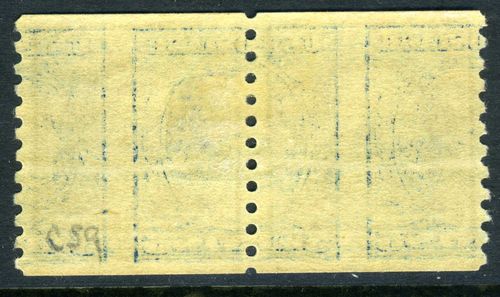 |
|
Send note to Staff
|
| Edited by Gladiators001 - 08/09/2012 1:01 pm |
|
|
Pillar Of The Community
United States
1497 Posts |
|
|
I believe the preferred term for this phenomenon is set-off. Offset is a type of printing.
Regards, Robert |
|
Send note to Staff
|
|
|
Pillar Of The Community
United States
6668 Posts |
|
|
Quote:
I believe the preferred term for this phenomenon is set-off. Offset is a type of printing. Copied from 1847.com The gum on the flat plate wet-printings was applied by the Bureau after printing the sheet of stamps, while the sheets used for the flat plate dry-printings were pre-gummed. The wet-printings, with the gum applied after the printing, have a thicker layer of smooth gum that may appear slightly yellowish and show grooves, whereas the pre-gummed sheets used for the dry-printings, with gum applied by the paper manufacturer, is nearly clear with a rough texture and never shows the cracks and grooves of the BEP applied gum. The rolls of paper provided for the printing of rotary press stamps were not pre-gummed, so any difference in gum will not distinguish wet- and dry- rotary press printings. The fact that the gum was not applied until after the printing on the wet-printings on flat plate stamps had the inadvertent side-effect of adding offsets to the back of sheets placed on the stack above the newly printed sheet. The sheets of thicker, stiffer paper used with the flat plate dry-printing stamps were pre-gummed by the manufacturer, limiting any offset to the gum on the sheets above and not to the stamps themselves. Thus, used flat plate stamps with offset marks have a high chance of being wet-printings. |
|
Send note to Staff
|
| Edited by stallzer - 08/09/2012 2:57 pm |
|
|
Pillar Of The Community
United States
6756 Posts |
|
|
The term "offset" is correct. It can refer to either the printing process (by design), or the process by which that image appeared on the back of the stamp (unintentional). It can be a little confusing, which is why I usually refer to the latter as a "backside offset" to distinguish it from offset printing.
Gladiators001, sorry but I do not believe your rotary press coil pair is an example of backside offset. What is more likely is that it is gum damage. Sometimes when improperly stored, coil stamps in the roll will get slightly stuck together. As the coil is unwound, part of the ink from the stamp underneath gets removed and stuck to the gum of the stamp above it in the roll. Examine the gum carefully for gum disturbance/damage. In a true backside offset, the image of the stamp will be UNDERNEATH the gum, not on the gum. |
|
Send note to Staff
|
|
|
Pillar Of The Community
United States
1497 Posts |
|
|
The transfer of wet ink to the back of the sheet above it is setoff. Source: www.stamphelp.comOFFSET: (Print appearing on the gummed side of stamps). Imagine, with reference to the gravure diagram above, if there is no paper between the cylinders. The ink/image is then transferred to the impression cylinder. Next time paper passes through this is transferred from the impression cylinder onto the reverse side of the paper, in mirror image/reversed, gradually fading away with each revolution. THIS IS NOT SETOFF. SETOFF: This is where the finished sheets coming off the printing press, are still wet. When stacked some of this wet ink smudges onto to reverse of the sheet above. Printers sometimes spray a fine white powder on to the sheets as they come off the press. This is to try and prevent this setoff happening. That's why some printing presses have the appearance of being snow covered. Gravure presses do not suffer with this problem very often, the solvents used make the ink dry very fast. Modern presses have UV/INFRA RED driers to help dry the ink faster, avoiding this problem. [Emphasis contained above is from the source, not added by me.] Cheers, Robert |
|
Send note to Staff
|
| Edited by Trainwreck - 08/09/2012 3:31 pm |
|
|
Pillar Of The Community
United States
6756 Posts |
|
|
Different places will use different terms. This would not be the first time. I believe "set off" is more often used in the UK (someone from across the pond will have to chime in). However, in the US, it is more often called an offset. This is actually the first time I've heard it called "set off" by someone in the US. Both terms are correct, but as I mentioned before, there does tend to be confusion over using the term "offset" because it can refer to 2 different things. Pilfered from Linn's Stamp Almanac: Quote:
Offset -- 1) A printing process that transfers an inked image from a plate to a roller. The roller then applies the ink to paper;
2) The transfer of part of a stamp design or an overprint from one sheet to the back of another, before the ink has dried (also called set off). Such impressions are in reverse. They are different than stamps printed on both sides.
The writer of the Stamphelp site appears to be from UK. |
|
Send note to Staff
|
|
|
Pillar Of The Community
United States
1497 Posts |
|
|
Linn's is not consistent with the terminology. I found two articles (3/31/08 & 4/28/08) in Linn's Stamp News where they referred to wet ink transfer to the back as setoff, and one article (11/21/11) where they referred to ink transfer from the impression roller as setoff too. It's a toss-up.
Cheers, Robert |
|
Send note to Staff
|
|
|
Pillar Of The Community
United States
6756 Posts |
|
|
Pillar Of The Community
United States
1497 Posts |
|
|
Pillar Of The Community
United States
6668 Posts |
|
|
I have not heard it called a "Set-off" before. So once again I get to learn something new in Stamps ! |
|
Send note to Staff
|
|
|
Pillar Of The Community
United States
2547 Posts |
|
|
Well this whole thing has me confused and upset or is that confused and setup? |
|
Send note to Staff
|
|
|
Pillar Of The Community
United States
6668 Posts |
|
|
Russ, I didn't think there was much of anything in US Stamps that confused you. May I inquire why it also upset you ? |
|
Send note to Staff
|
|
|
Replies: 20 / Views: 4,356 |
|




 Posted 08/05/2012 2:05 pm


 k
k

