| Author |
 Replies: 14 / Views: 1,977 Replies: 14 / Views: 1,977 |
|
|
Rest in Peace
United States
1225 Posts |
|
|
Recently, I bought a #24 off ebay with what looks like a curl over the N of Cents. However, I can't find a reference to it in Neinken's great book "The United States One Cent Stamp of 1851-1861" It has been suggested that this may be just a freak and it might be. However, it looks too much like a curl for me to just dismiss it as such. Its in the shape of the number 6 laying on its side and it continues into the blue area. There are curls that float around and I suspect that this may be what it is. My scanner isn't the best so it will be hard to see. So, before I send it off to Bill W. for his opinion, anyoneone want to take a guess of what it is? Even better would be a plate position. Art 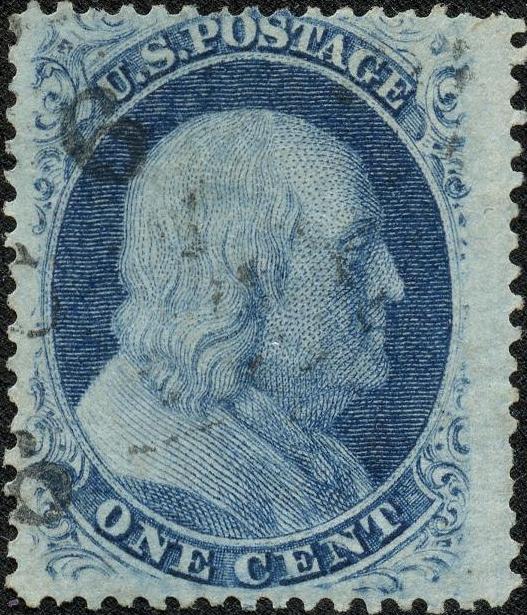  |
|
Send note to Staff
|
A well regulated Militia, being necessary to the security of a free State, the right of the people to keep and bear Arms, shall not be infringed. (The exact & entire wording of the 2nd Amendment to the U.S. Constitution) |
|
|
|
|
Pillar Of The Community
United States
2480 Posts |
|
|
Rest in Peace
United States
7097 Posts |
|
|
I bet Russ would know. Sinclair2010 too. They seem to our resident blue Franklin experts.  |
Send note to Staff 
|
| Edited by I_Love_Stamps - 10/18/2012 5:43 pm |
|
|
Pillar Of The Community
United States
2555 Posts |
|
|
I believe the stamp is 90R7 which proves the "curl" is not a real curl. |
|
Send note to Staff
|
|
|
Rest in Peace
United States
7097 Posts |
|
|
May I ask what causes an "authentic curl" then? Is it a cracked plate or a reworked die perhaps? I have seen these "curls" discussed here before and would like to know a bit about them please? Thank you much. -Jeff |
|
Send note to Staff
|
|
|
Rest in Peace
United States
1225 Posts |
|
|
Briefly, a curl is nothing more than foreign material; hair, fiber from a wiping rag or something, that has adhered to the plate prior to printing, in the transfer process more likely. Its significantly different from a crack or flaw in the respect that its the result from poor quality control or just people in a hurry to get the job done. I'm sure someone can give a more technical explanation. I'm at work so expect a quick answer.
Art |
|
Send note to Staff
|
A well regulated Militia, being necessary to the security of a free State, the right of the people to keep and bear Arms, shall not be infringed. (The exact & entire wording of the 2nd Amendment to the U.S. Constitution) |
|
|
Pillar Of The Community
United States
4106 Posts |
|
|
Rest in Peace
United States
1225 Posts |
|
|
You did... |
|
Send note to Staff
|
A well regulated Militia, being necessary to the security of a free State, the right of the people to keep and bear Arms, shall not be infringed. (The exact & entire wording of the 2nd Amendment to the U.S. Constitution) |
|
|
Pillar Of The Community
United States
2555 Posts |
|
|
A curl is caused by foriegn matter such as hairs, threads or other debris getting on the plate during the plate-making process. Sometimes only one position is affected, sometimes it is several. When the debris stuck to the transfer roll and survived, multiple positions would have curls that are not necessarily identical. The important thing is that they will be found on every stamp ever printed by the plate. |
|
Send note to Staff
|
|
|
Pillar Of The Community
United States
2555 Posts |
|
|
Pillar Of The Community
United States
2555 Posts |
|
|
Pillar Of The Community
United States
2555 Posts |
|
|
Here is my favorite "curl" item. This baby is staying in my collection for now. Position 41R8 "Curl over E" with centerline at left.  |
|
Send note to Staff
|
|
|
Pillar Of The Community
United States
1125 Posts |
|
|
Let me add a couple of things that (hopefully) won't confuse things.
The plate varieties listed in Neinken and other sources are constant for all stamps printed from a given plate. Generally speaking, they occurred during the creation of the plate where, in the case of the stamp right above, a foreign object (thread) got stuck on the transfer roller and created an extra groove in the plate. This groove gets filled with ink, and the curl is printed. The same occurs for double and triple transfers, where one image was laid down, partially erased, and then another put on top. You can sometimes see the remnants of the first image when the stamp is printed.
Some exceptions to this (there are always exceptions, aren't there...):
- Plate cracks that develop or are enlarged during the life of the plate. Early printings may not show the crack, but later ones do. The "big crack" variety got bigger over time.
- Double transfers that don't show - the opposite - as the plate wears, the fainter transfer wears away and you no longer can see it.
I think that what people are saying about your stamp is that it plates from position 90 of plate 7 - a position that is not known to have a constant variety associated. Therefore, your stamp likely is a "one off" - a thread or hair with ink on it was on the plate when that particular sheet was printed. It is a printing flaw, rather than a plate flaw.
Does that make sense?
Please, anyone, correct anything I might have said incorrectly.
Chip |
|
Send note to Staff
|
| Edited by chipg - 10/20/2012 09:24 am |
|
|
Pillar Of The Community
United States
6665 Posts |
|
|
Rest in Peace
United States
1225 Posts |
|
|
Winston,
I'll say he got a deal, he all but stole it.
Art |
|
Send note to Staff
|
A well regulated Militia, being necessary to the security of a free State, the right of the people to keep and bear Arms, shall not be infringed. (The exact & entire wording of the 2nd Amendment to the U.S. Constitution) |
|
| |
Replies: 14 / Views: 1,977 |
|




 Posted 10/17/2012 9:09 pm


