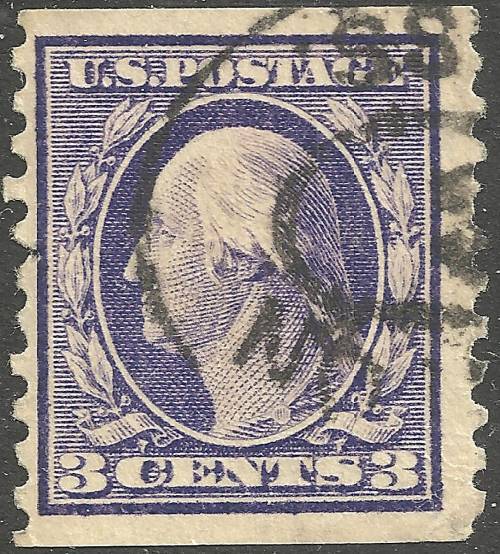
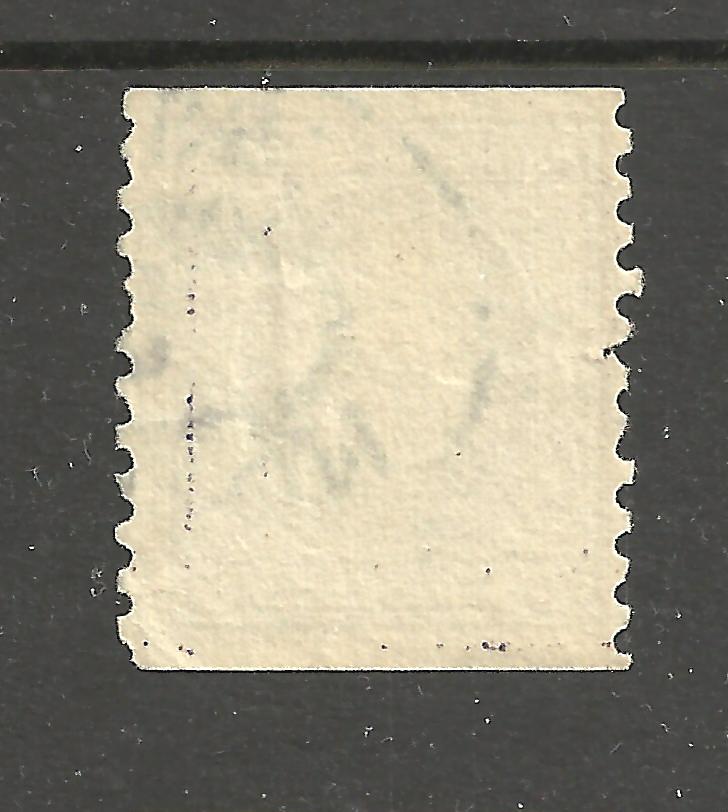
| Author |
 Replies: 10 / Views: 1,778 Replies: 10 / Views: 1,778 |
|
|
Moderator

United States
5106 Posts |
|
|
OK, I'm learning enough to be dangerous. Found this item and am trying to identify. I went to the 1847 website ( http://www.1847usa.com/washfrank/2c...2cType1.htm) and I tend to view as a Type 1. Here's some particulars: Single Line watermark (part of "S") Perf 10 Horizontal Stamp Design 19 mm wide x 22 3/4 mm high Stamp Width 21 mm + fraction Type 1 except for line between cheek and sideburn (5 lines joined) Color: I can never tell, but appears Carmine The stamp width is what bothers me, making it appear it could be a trimmed 425 or 425e, but then the stamp design is wrong. Is this just a slightly thin 450? Thanks. 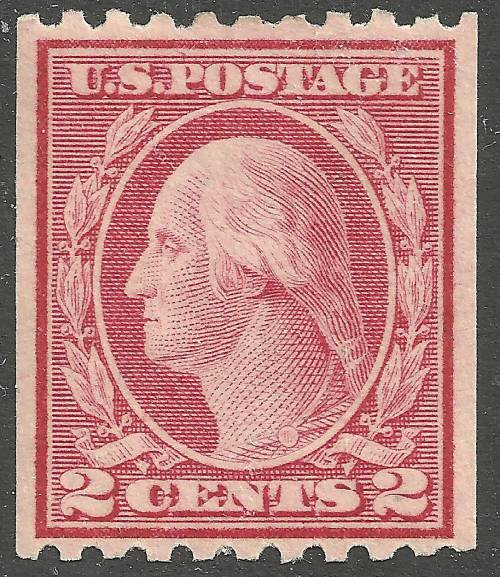 See additional question added later. |
|
Send note to Staff
|
| Edited by Partime - 03/09/2013 8:54 pm |
|
|
|
|
Rest in Peace
United States
7097 Posts |
|
|
Edit: I want to see a scan of the back quick? Or you could look- is there ink spots or any ink on the back? If there is then it's flat plate. Or I would suggest just measuring it and using the tolerances from the notes below to determine number.
Maybe this will help?
#444 Flat plate
Cautionary notation:
Both of the perf 10 flat plate coils, Scott 442 and Scott 444, are often faked, since they are in that gray area in which the cost of certification can often be more than the cost of the stamp. Particularly suspect are well-centered stamps and pairs with guidelines. On the other hand, if the guideline is genuine (use the foil test to check if the line is engraved) and the perforations are real, any guideline pair of these flat plate coils is genuine.
The obvious method of forgery would be to trim a fully perforated or large margined straight edge copy of the perf 10 stamp, Scott 425. A seasoned collector can often tell the difference between a genuine coil and a trimmed fake by feel alone, but the size of the stamp is often the key in determining whether the stamp was trimmed or not. Genuine vertical coils will measure about 21.5mm wide and genuine horizontal coils will measure about 25.0mm tall. The measurement is made from striaghtedge to straightedge. This is not fool proof, some genuine coils will measure smaller, but it is an excellent rule of thumb. If the coil measures more than .3mm smaller than the typical size, the coil is suspect.
The more dangerous fakes are made by perforating the imperforate sheet stock, in this case Scott 409, since the coil can be as wide as needed and will have the proper watermark. With all flat plate coils, the perforations need to be examined very closely.
#449 Rotary
Cautionary notations:
There is no type I rotary stock to manufacture these coils, either by adding perforations to an imperforate stamp or by trimming the perfs from a sheet stamp. The flat plate type I coils are sometimes confused with these, so make certain the coil is rotary. The type I vertical rotary coil is sometimes manufactured from the single-line watermarked type III vertical rotary coil, particularly by scraping away the last line in both the left and right ribbons. However, there are so many differences between the type I and the type III stamps detection is rather simple for anyone willing to take the time to examine the stamp closely. The same can be said for the unwatermarked type III vertical rotary coil, but the fake would have no watermark as well as many type III characteristics and be even less convincing.
|
Send note to Staff 
|
| Edited by I_Love_Stamps - 03/09/2013 7:38 pm |
|
|
Moderator
United States
5106 Posts |
|
|
Here's the back. No evidence of any ink spots. Gum, previously hinged. Stamp is engraved (I used a "tong" test.) Since it is on the tall side (height 22 3/4 mm) I eliminated 442 and 444. My wish list is a 449, but I think that is being a little hopeful since the color isn't quite right. Thanks for your input. 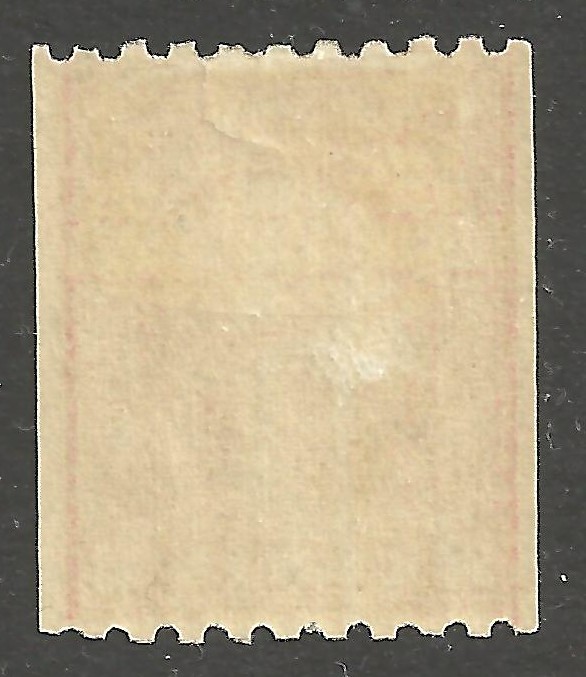 |
|
Send note to Staff
|
|
|
Pillar Of The Community
United States
2546 Posts |
|
|
my guess: this is a type-III with light printing in the ribbons which makes it look like type-I.
The hair shading is surely type-III SC450.
Also, the stamp should be dipped - it appears to be regummed over a tear at top.
|
|
Send note to Staff
|
|
|
Moderator
United States
5106 Posts |
|
|
Thanks to all. Chasa was able to figure it out. The light mark at the top was a slight tear, which helped to determine that there is NO watermark. Therefore, it is a Scott 488 -- and a damaged one at that. |
|
Send note to Staff
|
|
|
Moderator
United States
5106 Posts |
|
|
Pillar Of The Community
United States
2546 Posts |
|
|
SC345 has double line watermark so you can rule that out.
Telltale ink spots on reverse rule out rotary press.
So either SC445 or faked SC426. Good fakes are hard to discern from scans.
Perhaps only a professional expertization can give a conclusive opinion, I cannot.
|
|
Send note to Staff
|
|
|
Pillar Of The Community
United States
2546 Posts |
|
|
Personal aside - I bought my used SC445 from a respected NYC dealer 30 years ago.
I still wonder if it is OK.
I'd rather not send it for a certificate and have hard felings. Mine looks fine, so does yours. |
|
Send note to Staff
|
|
|
Pillar Of The Community
United States
1614 Posts |
|
|
Those perfs don't seem to lineup at all - Is that OK on a coil or is this one of the types that aren't supposed line up? |
|
Send note to Staff
|
|
|
Pillar Of The Community
United States
2547 Posts |
|
|
Based on the scan the perfs look fine. They appear to have pressure ridges on the top of the perfs and the alignment is good. The image below shows the alignment with 2 parallel lines added at the root of the perfs. 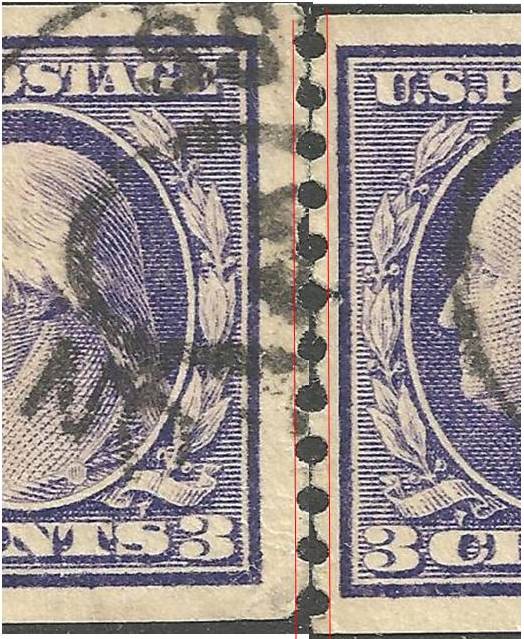 |
|
Send note to Staff
|
|
|
Moderator
United States
5106 Posts |
|
|
Russ. Thank you very much for the detailed perf analysis. I've tried to match them up with various types of software, but can never quite get it right. |
|
Send note to Staff
|
|
| |
Replies: 10 / Views: 1,778 |
|




 Posted 03/09/2013 5:41 pm