| Author |
 Replies: 13 / Views: 2,886 Replies: 13 / Views: 2,886 |
|
|
Pillar Of The Community
United States
2480 Posts |
|
|
I can't remember when I last made a revenue purchase. I saw this pair during a recent ebay drive-by -- didn't have an R90 so I made a bid and won the lot. The $5 has some issues and I wouldn't have bid on it had it not been on a complete document. The deed records the transfer of land in Cincinnati from George Schurman and his wife to the Cincinnati and Indiana Railroad Company. 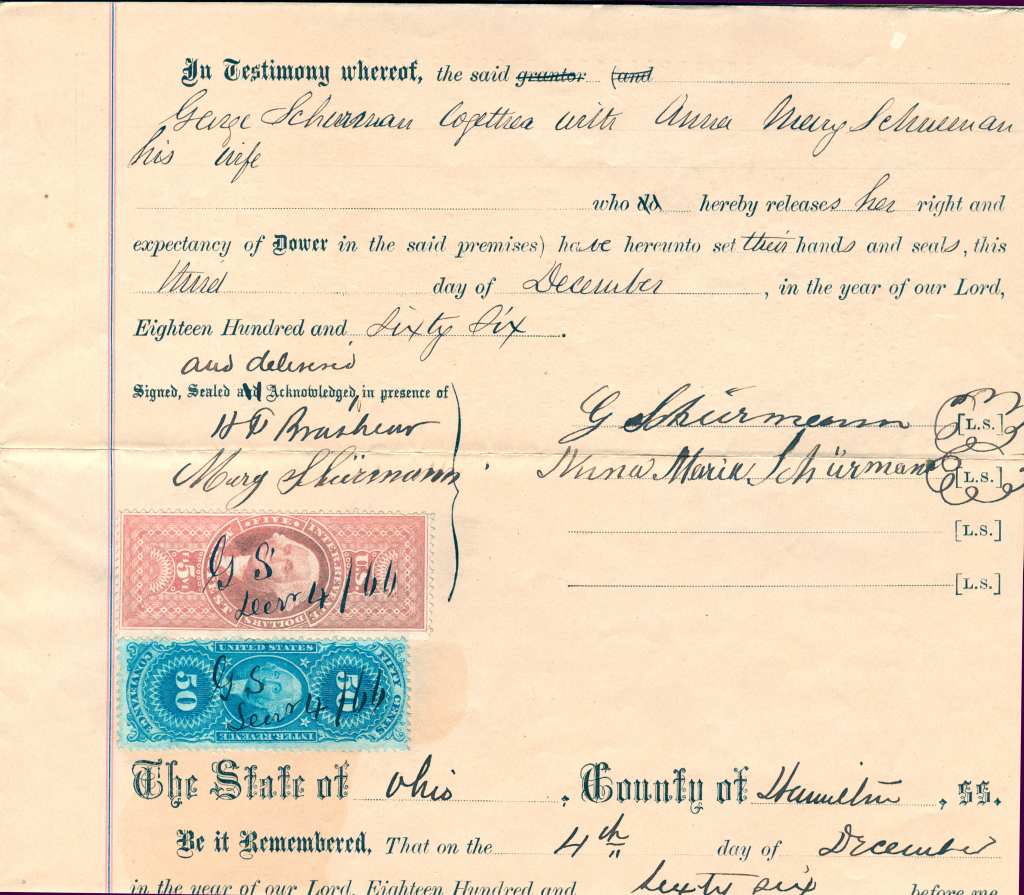 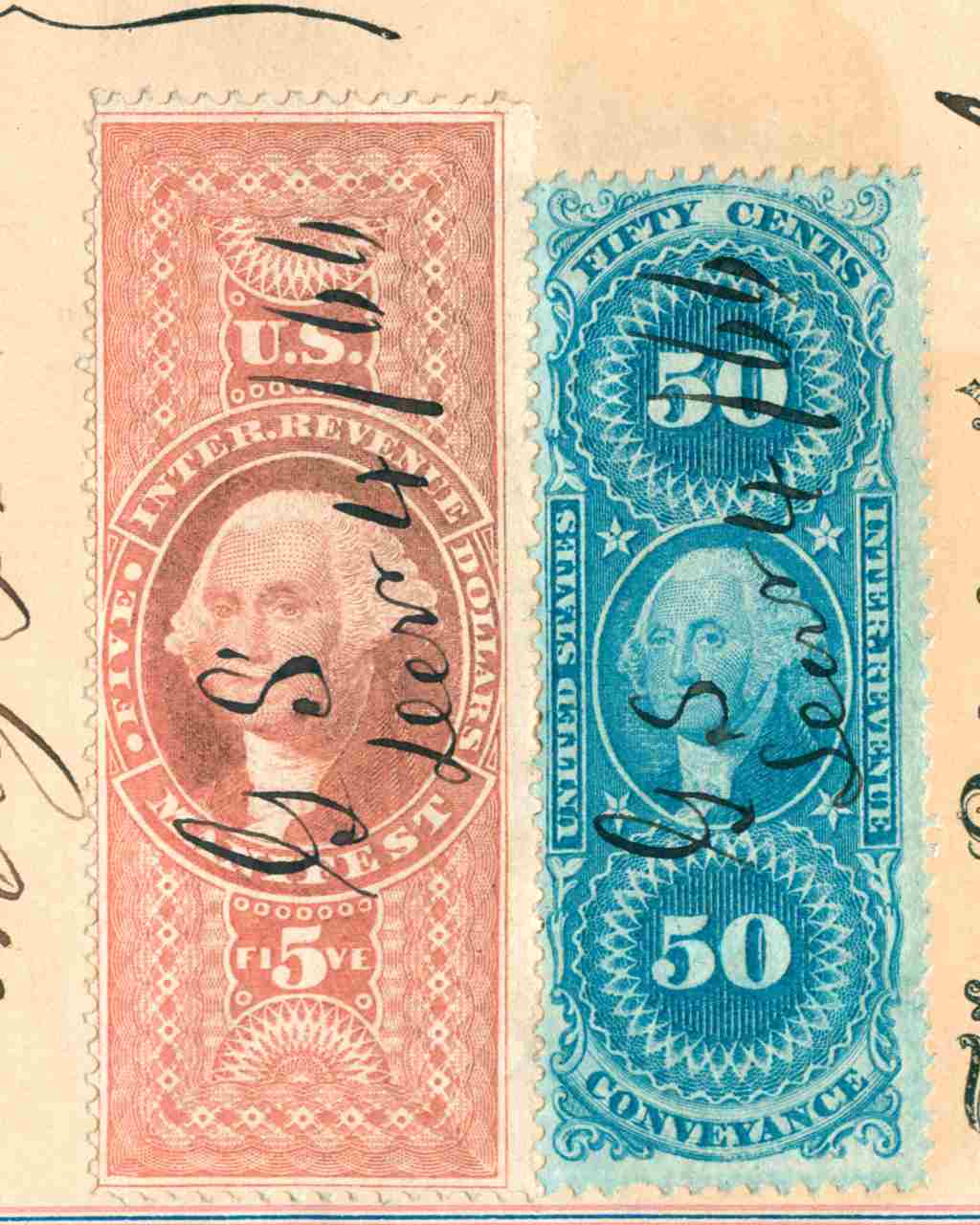 |
|
Send note to Staff
|
|
|
|
|
Rest in Peace
United States
7097 Posts |
|
|
Bedrock Of The Community
United States
12128 Posts |
|
|
Nice document and stamps.
As an aside, for all you legal people out there, I've always wondered what the [L.S.] means on the line where the signatures are placed. I know it's very common on legal documents, but does anyone know the reason for it? |
Send note to Staff 
|
|
|
Pillar Of The Community
United States
2480 Posts |
|
|
ILS, I was referring to the pulled perf at upper left. wt1, here is a definition from USLegal.com that describes the use of "L.S.": Quote:
Locus sigilli is a phrase that is most often abbreviated as "L.S." "Locus sigilli" is a Latin phrase meaning "the place of the seal." These traditional letters appear on the notarial certificates to show where the notary public's embossed seal should be placed or fixed. In case of a rubber-stamp seal; the seal should be placed near the abbreviation "L.S." but, not over it. This may also be used to indicate the signer, the place for fixing his signature. While a contract under seal was a formal contract at Common law, anything indicating a seal served the purpose under Modern law. However, pursuant to the Uniform Commercial Code, the use of seal is inoperative in a contract for sale of goods. |
|
Send note to Staff
|
|
|
Bedrock Of The Community
United States
12128 Posts |
|
|
Latin ... it figures! Thought it would be something simple like "legal signature" (which is essentially what it is.)
Thanks for the info. |
|
Send note to Staff
|
|
|
Pillar Of The Community
United States
521 Posts |
|
|
Valued Member
United States
42 Posts |
|
|
Pillar Of The Community
United States
2480 Posts |
|
|
Welcome to SCF Dan! The value of the transfer was $5300; just shy of $82,000 in 2012 dollars. 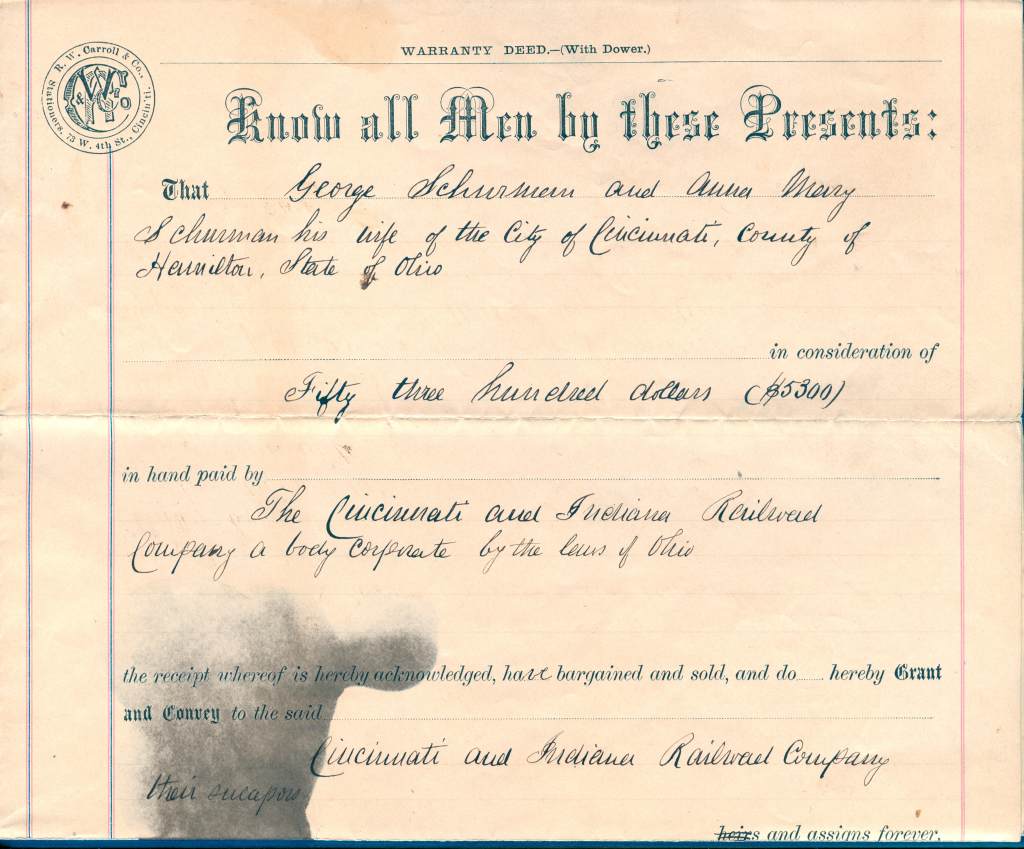 |
|
Send note to Staff
|
|
|
Bedrock Of The Community
United States
10839 Posts |
|
|
This type of document was called a Conveyance, and the tax rate in December,1866 was $1 for a value of between $500 and $1,000 and 50 cents for every $500 or fraction thereafter. This means the tax was $1+9X.50 = $5.50. |
|
Send note to Staff
|
| Edited by revcollector - 03/16/2013 8:11 pm |
|
|
Valued Member
United States
42 Posts |
|
|
Thanks for the info, revcollector. And I appreciate the welcome, tomiseksj! |
|
Send note to Staff
|
|
|
Bedrock Of The Community
United States
12128 Posts |
|
|
I'm not a lawyer and certainly have no idea what would have been considered the norm in 1866, but has anyone noticed that the document starts out "George Schurman, together with Anna Mary Schurman, his wife" ... then below it the signature of his wife is "Anna Maria Schurman"?
A technicality perhaps, but it seems to me that would make the deed faulty.
Futhermore, one of the witnesses is a "Mary Schurman", presumably a relative, which is not always accepted as a witness, which should generally be a disinterested party. |
|
Send note to Staff
|
| Edited by wt1 - 03/17/2013 3:08 pm |
|
|
Pillar Of The Community
United States
521 Posts |
|
|
I'm not a lawyer, but I work for one. We've had a couple of instances when the printed name of the Grantor does not match the signature - maybe a misspelling or someone signing with a middle name that wasn't printed. The deeds were accepted by the recorder, but we couldn't get title insurance until an affidavit was also recorded. |
|
Send note to Staff
|
|
|
Bedrock Of The Community
United States
10839 Posts |
|
|
Pillar Of The Community
United States
2480 Posts |
|
|
Quote:
A technicality perhaps, but it seems to me that would make the deed faulty. I think it safe to assume that the legal standards of almost a century and one-half ago were a bit more lax than they are today. The American society was probably also less litigious than it is today. Could the Maria-Mary difference be attributed to translation from German to English? |
|
Send note to Staff
|
|
| |
Replies: 13 / Views: 2,886 |
|




 Posted 03/15/2013 9:58 pm


