| Author |
 Replies: 12 / Views: 2,163 Replies: 12 / Views: 2,163 |
|
|
Pillar Of The Community
United States
611 Posts |
|
|
Here is a scan of 2 Scott 183 vermillion banknotes. There is a slight shade difference and a bit of difference in the paper. As you can see in the scan the stamp on the left the frame is taller. It measures 1.2 mm taller than the left one. I can't find any notes in Scott or Brookman books that had a change of height. What am I missing? The plates were used by both American and Continental printers. They didn't change them when printing on soft porous paper vs hard wove. 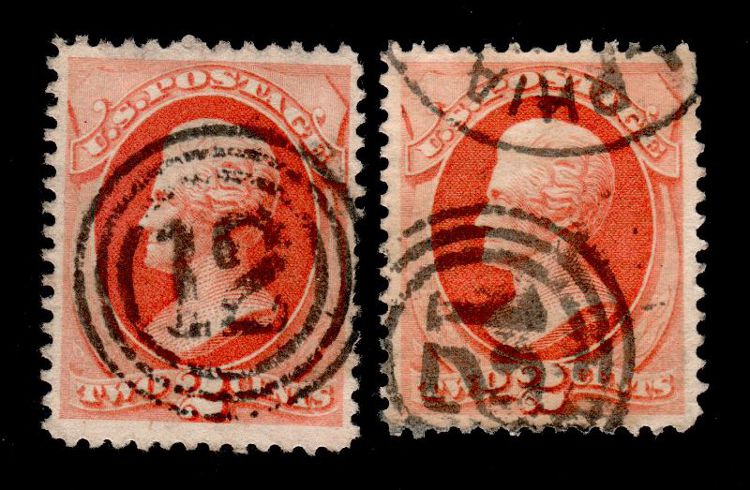 |
|
Send note to Staff
|
| Edited by 1847bill - 05/23/2013 9:02 pm |
|
|
|
|
Pillar Of The Community
United States
2555 Posts |
|
|
It is common for margin stamps to be taller than normal. Probably the vast majority of the super duper jumbo 1000000J stamps come from margin copies. |
Send note to Staff 
|
|
|
Pillar Of The Community
United States
611 Posts |
|
|
It does have nice margins, but I'm referring to the frame dimensions. The frame is 1.2 mm taller than the other banknotes and the oval vignette is 1 mm taller. |
|
Send note to Staff
|
|
|
Pillar Of The Community
United States
2555 Posts |
|
|
Oh! I think that is caused by differences in paper shrinkage as the sheet dried after printing. |
|
Send note to Staff
|
|
|
Pillar Of The Community
United States
611 Posts |
|
|
New Member
1 Posts |
|
|
Did you ever find the answer to your question about the difference in the overall size of the stamps? I have the same stamps and am wandering why they are different. I do not buy the shrinkage idea. I cannot find any additional information. I have looked at them under high magnification and different light sources and they look identical except for the size.
|
|
Send note to Staff
|
|
|
Bedrock Of The Community
United States
10862 Posts |
|
|
It's shrinkage. Remember we are discussing circa 1880 paper, very possibly from different manufacturers, possibly printed in different directions relative to the grain of the paper, probably with somewhat different moisture contents and different batches of ink. It would be much more amazing if every stamp were of identical size.
Plus extreme heat (such as boiling a stamp) can cause it to shrink as well. |
|
Send note to Staff
|
|
|
Pillar Of The Community
United States
1414 Posts |
|
|
A number of different Bank Note era issues have been noted as having vertical or horizontal grain. Shrinkage of hard paper was less pronounced, so the need to keep paper directions uniform was less important for setting up perforation machines. Because some soft paper stamps were printed by Continental Bank Note Company before the consolidation with American Bank Note Company, it would be interesting to try to find out if horizontal or vertical grain predominated at any given time. Some notes from Ron Burns on grills suggests that paper grain can help in determining if a grill is genuine or not.
Paper shrinkage is noticeable across the paper grain. Very little shrinkage will be observed in the direction of the paper grain.
Clark |
|
Send note to Staff
|
|
|
Pillar Of The Community
United States
1946 Posts |
|
|
The subject about which Clark is speaking, and the phenomenon that arises from it is variously called paper "grain" or as an earlier generation would have it, paper "mesh." Back in 1979 Lowell Cooper published an article in the American Philatelic Congress Book that discusses this phenomenon in some detail, and presents some statistics on it based on a non-technical examination of data from a collection formed 30 years earlier. [ Congress Book 45. "Some Notes Concerning Paper and Paper Mesh With Focus Upon the Bank Notes." (American Philatelic Congress, 1979) 145-157 ] With this reference you can access this article via the American Philatelic Research Library (APRL) of the American Philatelic Society either directly as an APS member or via inter-library loan through your local community library.
1847bill was quite wrong in dismissing paper shrinkage as a minimal effect, particularly when comparing two stamps whose mesh (grain) runs at right angles with respect to each other. The differences in height and width can be quite noticeable, even without fine measurement.
It is noteworthy, I think, that those who did not "buy" the shrinkage explanation did not "by" (that is, "write") a better explanation. It would have been interesting to see what facts they would contort to try to sell something else.
Now a question for Clark: You mentioned some notes by Ron Burns on a relationship between paper mesh/grain and authentication of a grill. Were those notes published? I know that in his article on grills in Opinions VII for the PF Ron discusses paper mesh in conjunction with the 11x14 "essay" grills. But there it was to establish the special chronological relation between the points up versus points down versions of this essay type. By the same token, there is now a note in Scott on the relationship between grill state and mesh characteristics that certainly was derived from Ron's work. I just can't find a reference to where he discusses it with the detail he usually provides. Can you fill in that gap with a reference, please? Or is his reconstruction of the relative chronology of paper types and grill types, the extent of it? |
|
Send note to Staff
|
|
|
Rest in Peace
United States
82 Posts |
|
|
regarding dimensions of stamps:
for what it's worth, this just came across a "quote of the day" website.
There are two possible outcomes: If the result confirms the hypothesis, then you've made a measurement. If the result is contrary to the hypothesis, then you've made a discovery. -Enrico Fermi |
|
Send note to Staff
|
|
|
Pillar Of The Community
United States
1946 Posts |
|
|
Fermi's quote might be well and good in the field of theoretical physics, but as an experimentalist he was very rigorous in his admission of evidence. Note his references to "result," which is not at the hypothetical end of a question. On the assumption that Fermi's quote was not a contribution to relativizing all knowledge, just how would you apply it to this case? What kind of new discovery?
Please do not think of my challenge as a rejection of possibilities. It is a call for evidence rather than speculation. Fermi himself would not have left the door so wide open that "discoveries" contrary to established principles would be possible. To propose that would have opened him to severe criticism, even ostracism, from the academy. So, in this case for example, a printing from a non-standard plate that was "never reported" would be a flight of fantasy and beyond reasonable expectation.
Within the limits of reality, what "new discovery" might we wish to see? |
|
Send note to Staff
|
|
|
Pillar Of The Community
United States
1414 Posts |
|
|
Quote:
You mentioned some notes by Ron Burns on a relationship between paper mesh/grain and authentication of a grill. Were those notes published? I am not sure if the full article in the Scott Catalog the year the H and I grills were separated contains additional detail. I no longer have that edition of the Scott US Specialized catalog. Otherwise, the note may be in the unpublished paper study or some other reference information filed away somewhere. Ron has been very helpful with the 1 cent and 3 cent American Bank note hard paper stamps and other puzzles. Clark |
|
Send note to Staff
|
|
|
Pillar Of The Community
United States
1946 Posts |
|
|
Thanks, Clark. I missed the 2013 cat, so I will check at the club library next week. Do you recall if they had put the article near the spot for the new listings, or did they just tack it on to the introduction, or something else? Just trying to narrow down the search.
As for the unpublished paper study, I've sensed from earlier posts that something like that is in the offing. Is that something close to publication? Or, are you looking for collaborators on some aspects? I'd love to hear more about it in another thread, or by direct email. |
|
Send note to Staff
|
|
| |
Replies: 12 / Views: 2,163 |
|



 Posted 05/23/2013 4:01 pm


