Stamp Community Family of Web Sites
Thousands of stamps, consistently graded, competitively priced and hundreds of in-depth blog posts to read


Stamp Community Forum
 
Username:
Password:
Save Password
Forgot your Password?

This page may contain links that result in small commissions to keep this free site up and running.

Welcome Guest! Registering and/or logging in will remove the anchor (bottom) ads. It's Free!

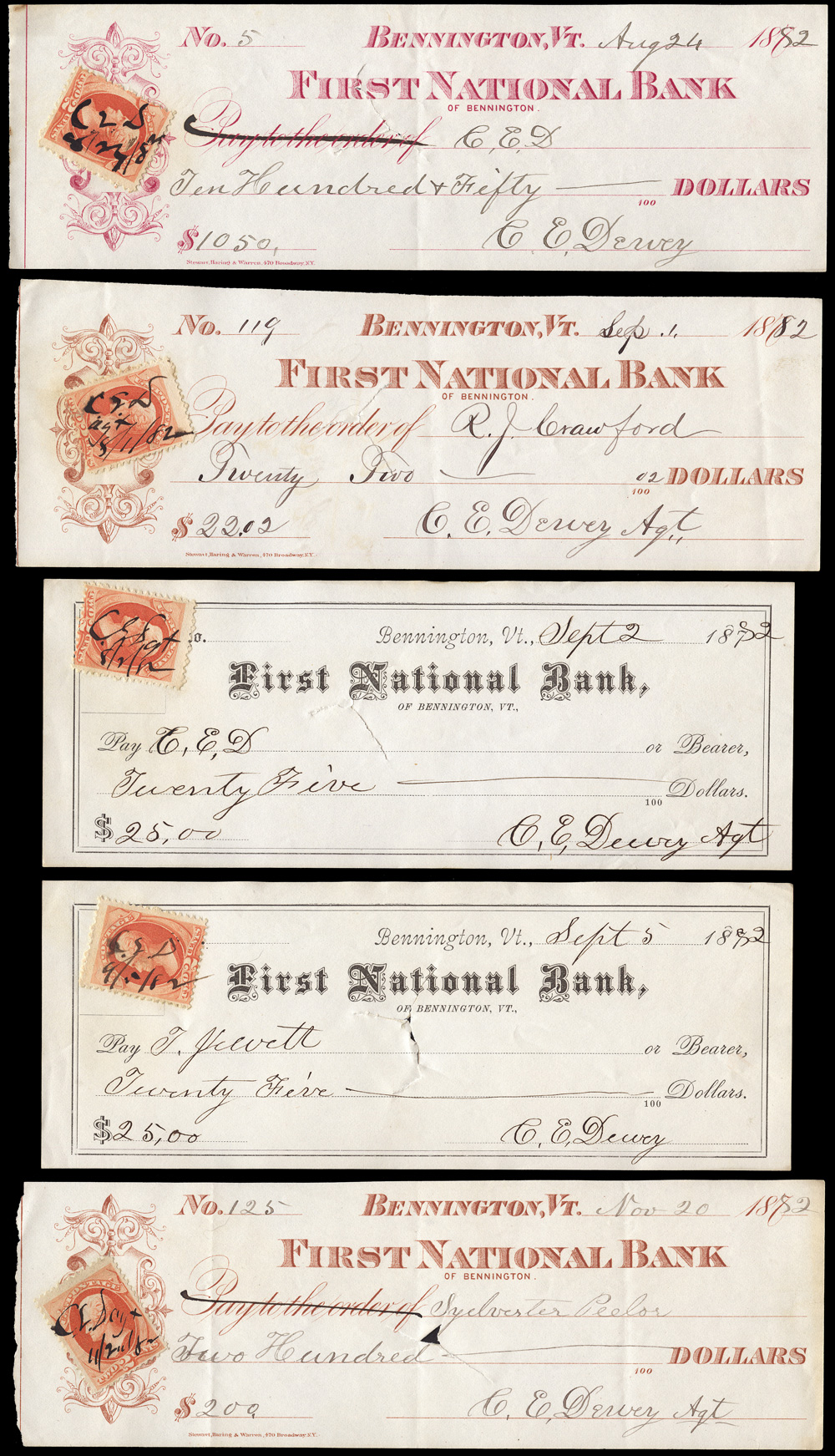
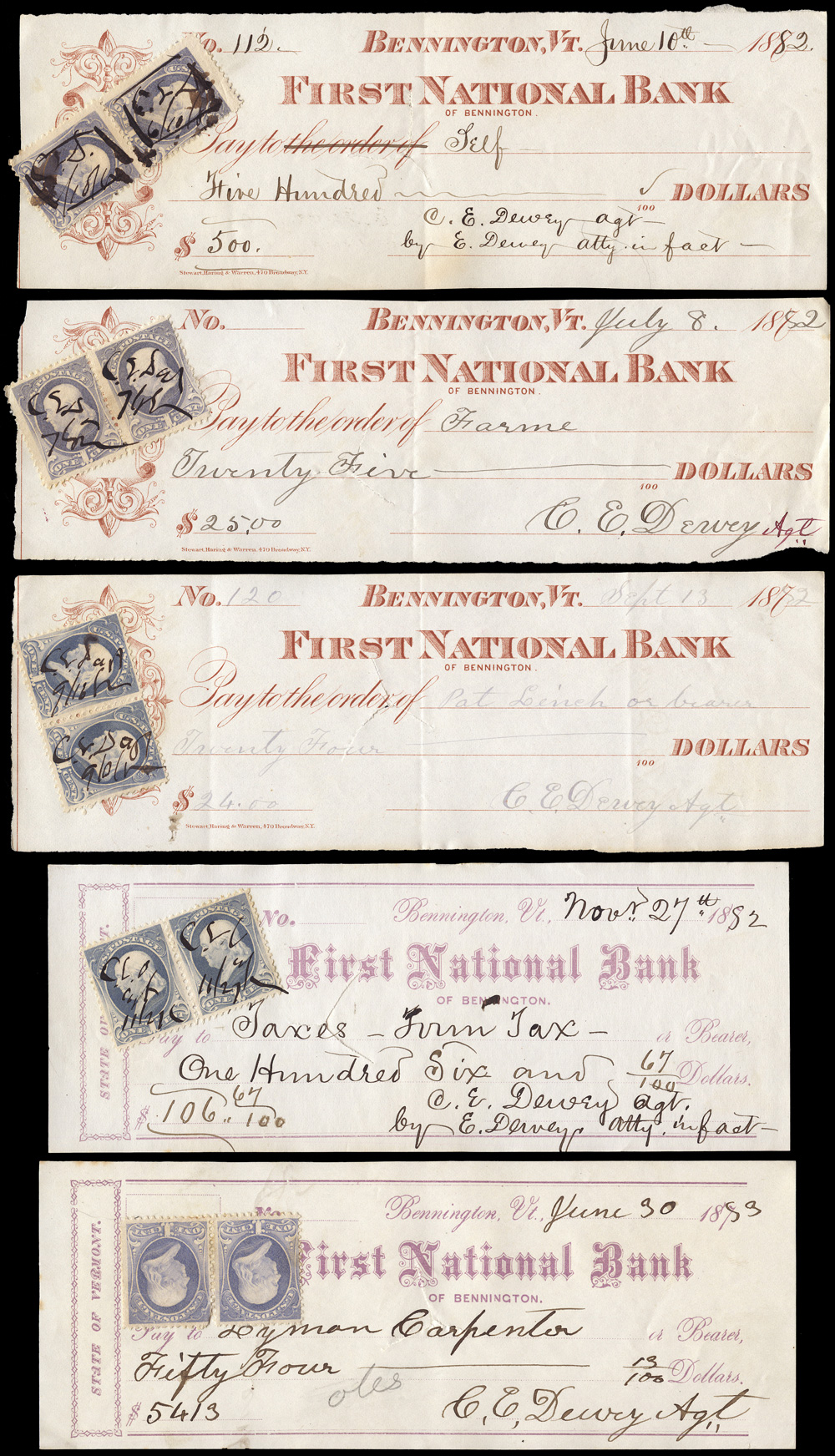
A Nice Group Of US Scott 183 And 206 Used Illegally

 
To participate in the forum you must log in or register.
Author Previous TopicReplies: 9 / Views: 1,856Next Topic  
Pillar Of The Community
United States
6433 Posts
Posted 04/13/2014   1:24 pm  Show Profile Check revenuecollector's eBay Listings Bookmark this topic Add revenuecollector to your friends list Get a Link to this Message
All used illegally as revenues by the First National Bank in Bennington, VT.


Send note to Staff

Pillar Of The Community
1515 Posts
Posted 04/13/2014   2:21 pm  Show Profile Bookmark this reply Add Jenny2U to your friends list  Get a Link to this Reply
Interesting items. Shortage of revenue stamps or did the bank not know any better? Is it unusual that postage stamps would be used as revenues during this period? Also why would "pay to the order of" be crossed out in several examples?
Send note to Staff  Go to Top of Page
Pillar Of The Community
United States
6433 Posts
Posted 04/13/2014   5:32 pm  Show Profile Check revenuecollector's eBay Listings Bookmark this reply Add revenuecollector to your friends list  Get a Link to this Reply

Quote:
Shortage of revenue stamps or did the bank not know any better?


Most likely the former, although the signatory is the same on all of the checks so it is possible that they didn't know any better.


Quote:
Is it unusual that postage stamps would be used as revenues during this period?


Using U.S. postage stamps for revenue purposes was illegal, unlike in many other countries. They are uncommon, but not rare. A common cover with either of these stamps would be a buck or two, whereas these particular documents are each $20-40 on average.

Older documents from the Civil War era with illegal usages can vary greatly in value, from $20-50 for a common 2-cent BlackJack or 3-cent George Washington used as revenue, all the way up into the $300-500 range, depending on the document and the stamp (or stamps) used. Things like the 1869 pictorials, grilled stamps, combination usages, etc. can make for scarce and more expensive documents.


Quote:
Also why would "pay to the order of" be crossed out in several examples?


That one I can't answer.
Send note to Staff  Go to Top of Page
Bedrock Of The Community
United States
10629 Posts
Posted 04/13/2014   5:34 pm  Show Profile Bookmark this reply Add revcollector to your friends list  Get a Link to this Reply
The bank did not put the stamps on, the taxpayer did, and the bank would not care since they were not responsible for the money. Plus no one in the government was likely to see these anyway unless they were needed for some kind of legal matter in court.
The "pay to self" had the pay to the order crossed out, the others were probably written and cashed immediately, although there might be some other unknown reason for it. It did not change the tax at all. .
Actually the two most interesting things about this group are one, the space of time involved here, several months; and two, the last check written on June 30, 1883 should be after the tax on checks was repealed. If I remember correctly that tax and several others involving stamps ended with the new tax law that went into effect on March 3, 1883, which also changed the rates for tobacco products which resulted in several provisional taxpaids among other things.
Send note to Staff  Go to Top of Page
Edited by revcollector - 04/13/2014 5:36 pm
Pillar Of The Community
United States
6433 Posts
Posted 04/13/2014   5:41 pm  Show Profile Check revenuecollector's eBay Listings Bookmark this reply Add revenuecollector to your friends list  Get a Link to this Reply
I was wondering if the final date digit on the last check might possibly have been miswritten, ie. it was actually June 30, 1882? The first check in that group is June 10, 1882, so this would fit the date range... moreso than June 30, 1883.
Send note to Staff  Go to Top of Page
Bedrock Of The Community
United States
10629 Posts
Posted 04/13/2014   10:29 pm  Show Profile Bookmark this reply Add revcollector to your friends list  Get a Link to this Reply
It's a 3, compare it to the checks that end in 2. Since they were written by the same person.........
Send note to Staff  Go to Top of Page
Pillar Of The Community
United States
6433 Posts
Posted 04/13/2014   10:31 pm  Show Profile Check revenuecollector's eBay Listings Bookmark this reply Add revenuecollector to your friends list  Get a Link to this Reply
Re: the end date of the tax and who would have applied the stamps, Ron Lesher posted the following on another board in response to this lot:


Quote:
My guess is that the bank was not applying the postage stamps, but rather the the agent who was signing the checks. Although we refer to this as an illegal use, I believe that such improper use would not have been prosecuted. There was no intent to evade the tax.

I note that one of the examples is dated June 30, 1883, the last day of the tax!
Send note to Staff  Go to Top of Page
Edited by revenuecollector - 04/13/2014 10:32 pm
Pillar Of The Community
United States
2953 Posts
Posted 04/14/2014   07:48 am  Show Profile Check Rileysan's eBay Listings Bookmark this reply Add Rileysan to your friends list  Get a Link to this Reply

Quote:
The bank did not put the stamps on, the taxpayer did, and the bank would not care since they were not responsible for the money.


I am unfamiliar with 19th century tax code, so forgive any obvious questions. Why wouldn't the bank be responsible for the application of tax labels? Wasn't the bank responsible for keeping a ledger of all transactions - which was what the basis for tax liability? Was it common practice for customers to provide and frank their own tax stamps? Who franked the stamps if not the bank?
Send note to Staff  Go to Top of Page
Moderator
Learn More...
United States
12330 Posts
Posted 04/14/2014   08:06 am  Show Profile Bookmark this reply Add 51studebaker to your friends list  Get a Link to this Reply
So for over a year Mr. Dewey (the agent?) bought postage stamps instead of the correct revenue stamps? I would have thought that an understanding of the tax procedures would be well understood by someone in this position?
don
Send note to Staff  Go to Top of Page
Valued Member
United States
495 Posts
Posted 04/14/2014   3:07 pm  Show Profile Bookmark this reply Add joe1225us to your friends list  Get a Link to this Reply

Quote:
Also why would "pay to the order of" be crossed out in several examples?


To me it is obvious. 'Pay to means' pay only to the named payee. 'To the order of' means whom ever the Payee directs the bank to pay to.
Send note to Staff  Go to Top of Page
  Previous TopicReplies: 9 / Views: 1,856Next Topic  
 
To participate in the forum you must log in or register.

Go to Top of Page

Disclaimer: While a tremendous amount of effort goes into ensuring the accuracy of the information contained in this site, Stamp Community assumes no liability for errors. Copyright 2005 - 2026 Stamp Community Family - All rights reserved worldwide. Use of any images or content on this website without prior written permission of Stamp Community or the original lender is strictly prohibited.
Privacy Policy / Terms of Use    Advertise Here
Stamp Community Forum © 2007 - 2026 Stamp Community Forums
It took 0.57 seconds to lick this stamp. Powered By: Snitz Forums 2000 Version 3.4.05