| Author |
 Replies: 7 / Views: 2,074 Replies: 7 / Views: 2,074 |
|
|
Pillar Of The Community
United States
2948 Posts |
|
|
I guess I don't understand the printing and then use of these cards. In the first scan you can see the bottom card is postmarked. Also you might see a name and address that was erased. 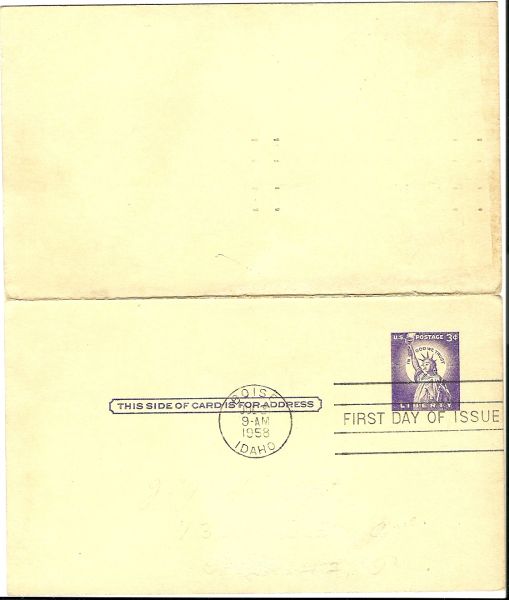 In the next scan I flipped the cards and you can see the top card is not postmarked or written on. 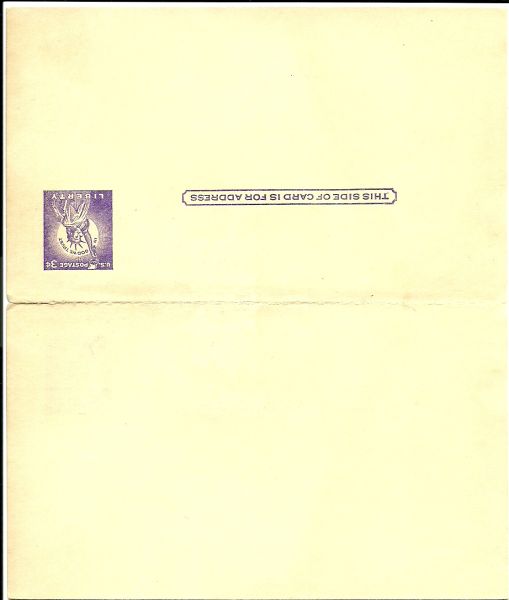 Is this common? |
|
Send note to Staff
|
|
|
|
|
Pillar Of The Community
Canada
6525 Posts |
|
|
looks like two postal cards (UX46, though Scott Specialized has their day of issue at August 1 1958, not July 3) stuck together. Since this is a first day of issue cancel, someone sent it to themselves (not uncommon) and the address was later erased. |
Send note to Staff 
|
|
|
Bedrock Of The Community
United States
12128 Posts |
|
|
If you look a little further in your Scott Specialized Catalog you will find that the scanned image is of a UY17 Reply Card issued on July 31, 1958 in Boise, Idaho. (So the first day cancel is correct.) Unfortunately, the catalog value is only $1. As 136,768 reply cards were processed with the FDOI cancel, it is quite common. |
|
Send note to Staff
|
| Edited by wt1 - 04/19/2014 11:48 pm |
|
|
Rest in Peace
United States
4052 Posts |
|
|
Rewinding a bit, the message-and-reply cards are issued as a pair, with perforations.
On the first trip, the message half gets a message (on its half of the back), an address, and a cancellation.
The reply half would usually have its return address filled-in by the sender; in commercial use, the reply half would often bear a pre-printed message.
The recipient would separate the two, do whatever needed to be done on the message side of the reply card, and post it.
Some of the interesting commercial applications included using message-and-reply cards to avoid unnecessary trips; eg, the fuel company might ask a farmer if his tank needed refilling that month, or an electric company might ask its rural customers to read their meter (so they could send them a bill) with, presumably, a periodic (?annual) visit to keep them honest.
Penciling the address onto a First Day item, and then carefully erasing the address, was common practice before people went even further nuts, and insisted that the FDC never bore an address in the first place; usually, this was achieved by the FD item travelling under cover.
Cheers,
/s/ ikeyPikey |
|
Send note to Staff
|
|
|
Pillar Of The Community
United States
2948 Posts |
|
|
Ahhhh ok. I actually didn't know that these, like the early postal cards, were used as a message and reply copy combo.
Thanks folks. |
|
Send note to Staff
|
|
|
Pillar Of The Community
Canada
6525 Posts |
|
|
Ah, I had initially thought of a letter sheet, which I believe has a response section, but failed to look further into the catalogue. Interesting |
|
Send note to Staff
|
|
|
Pillar Of The Community
United States
607 Posts |
|
|
jamesw, please tells us more about letter sheets with a response section. I don't remember any from the US. |
|
Send note to Staff
|
|
|
Pillar Of The Community
Canada
6525 Posts |
|
| |
Replies: 7 / Views: 2,074 |
|




 Posted 04/19/2014 10:21 pm


