| Author |
 Replies: 11 / Views: 2,784 Replies: 11 / Views: 2,784 |
|
|
Rest in Peace
United States
7097 Posts |
|
|
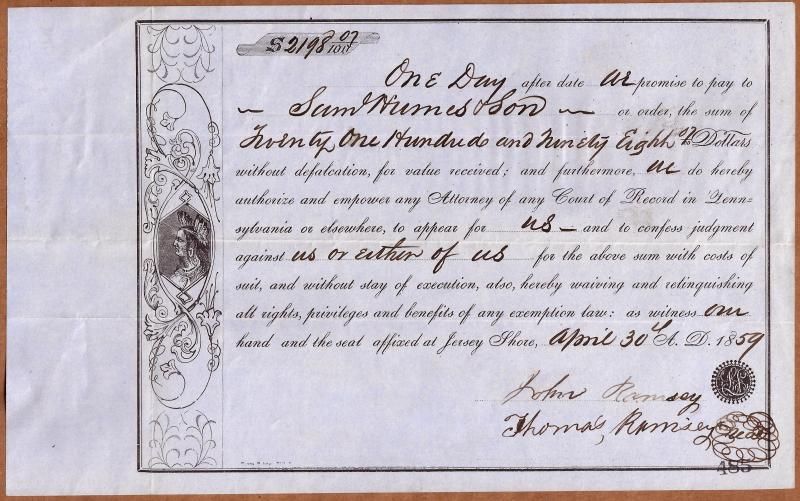
This morning while browsing an auction I ran across something odd. I found a hometown related item from 1859 with some prominent figures from Jersey Shore, Pa. on a Promise to pay document for a large sum of money. I think I know what it was for but a little more investigation will be necessary to confirm it. Here is the sellers image of this document. I like how there is an Indian on the left border to sort of hint at the idea of a revenue stamp. Anyway I thought this sort of neat and that you may like to see it. -Jeff  Description:Old 1859 - JERSEY SHORE - PA. - Promise to Pay Document - RAMSEY. Description:Old 1859 - JERSEY SHORE - PA. - Promise to Pay Document - RAMSEY.
SIZE: Measures about 6 1/8" x 9 3/4"
CONDITION: Overall Very Good - with original folds
100% Guaranteed old and original. |
|
Send note to Staff
|
|
|
|
|
Pillar Of The Community

United States
856 Posts |
|
|
I think it's neat too, Jeff.  In law, the document would be called a promissory note. A few years later, it WOULD have required a revenue stamp. Let us know what you find out from your research. I'm guessing a land purchase. |
Send note to Staff 
|
|
|
Bedrock Of The Community
United States
12128 Posts |
|
|
Interesting to note that Samuel Humes, the namesake of the company "Samuel Humes & Son" who issued the Promissory Note, had died about one month before the Note was issued. Not unusual, I guess, since the company (financial institution) was probably in business for sometime thereafter. It appears Hamilton B. Humes was Samuel Humes' son and probably inherited the firm after his father's death. Another curious thing is that the date on the Promissory Note (April 30, 1859) was a Saturday. Finally, the exact amount of the Note is also interesting: $2198.07 seems like quite an odd amount. (Maybe it was the net amount due after compounding interest, etc.). In any event, $2198.07 in 1859 is equivalent to about $56,188 in today's dollars. Not a small amount that far back, so it probably had to do with the purchase of property and/or a business. It would appear as though John Ramsey and Thomas Ramsey were brothers and were in the saw mill business in the area, which could help to further explain things. |
|
Send note to Staff
|
|
|
Rest in Peace
United States
7097 Posts |
|
|
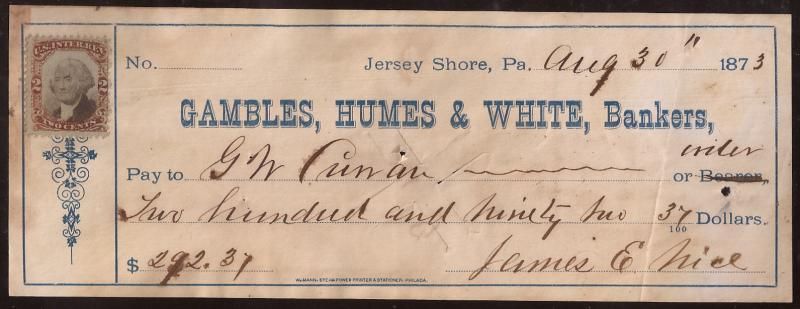
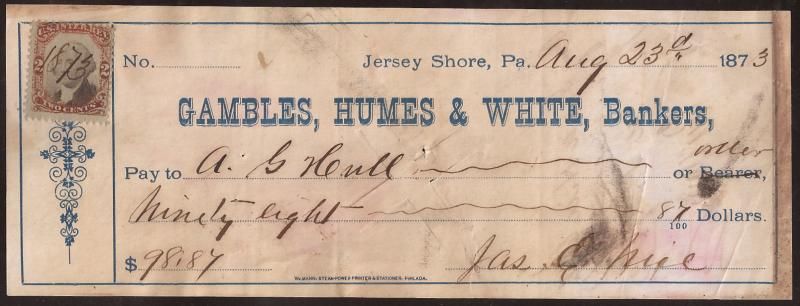
There are a few large structures n a little town called Ramsey village on the way up Pine Creek and the Ramsey Bridge (Rail Road bridge). I suspect the loan was to either build the bridge or to expand the mill. I, however cannot be sure which and probably will never know. The place where I thought I could find info told me most of those records was destroyed by a fire related to the 1936 flood in that area. Thank you for that information wt1 as it will be very helpful. Those bank checks I showed in another thread awhile back was from Samuel Humes also but they was his sons obviously as the checks was post 1861. Again, Thank You! |
|
Send note to Staff
|
|
|
Bedrock Of The Community
United States
12128 Posts |
|
|
One other detail is that there was an operating post office in the small town of "Ramseyville (Lycoming County), PA". According to Jim Forte's Postal History website, it was in operation from 1889-1915. The Postal Bulletin for May 25, 1915 suggests that when the post office was discontinued, mail was redirected to Jersey Shore. Could the Ramsey brothers noted in the original Promissory Note be the namesakes of that old post office? More research would be needed, I suppose. The location of the former Ramseyville Post Office is shown here based on an area map of 1892: 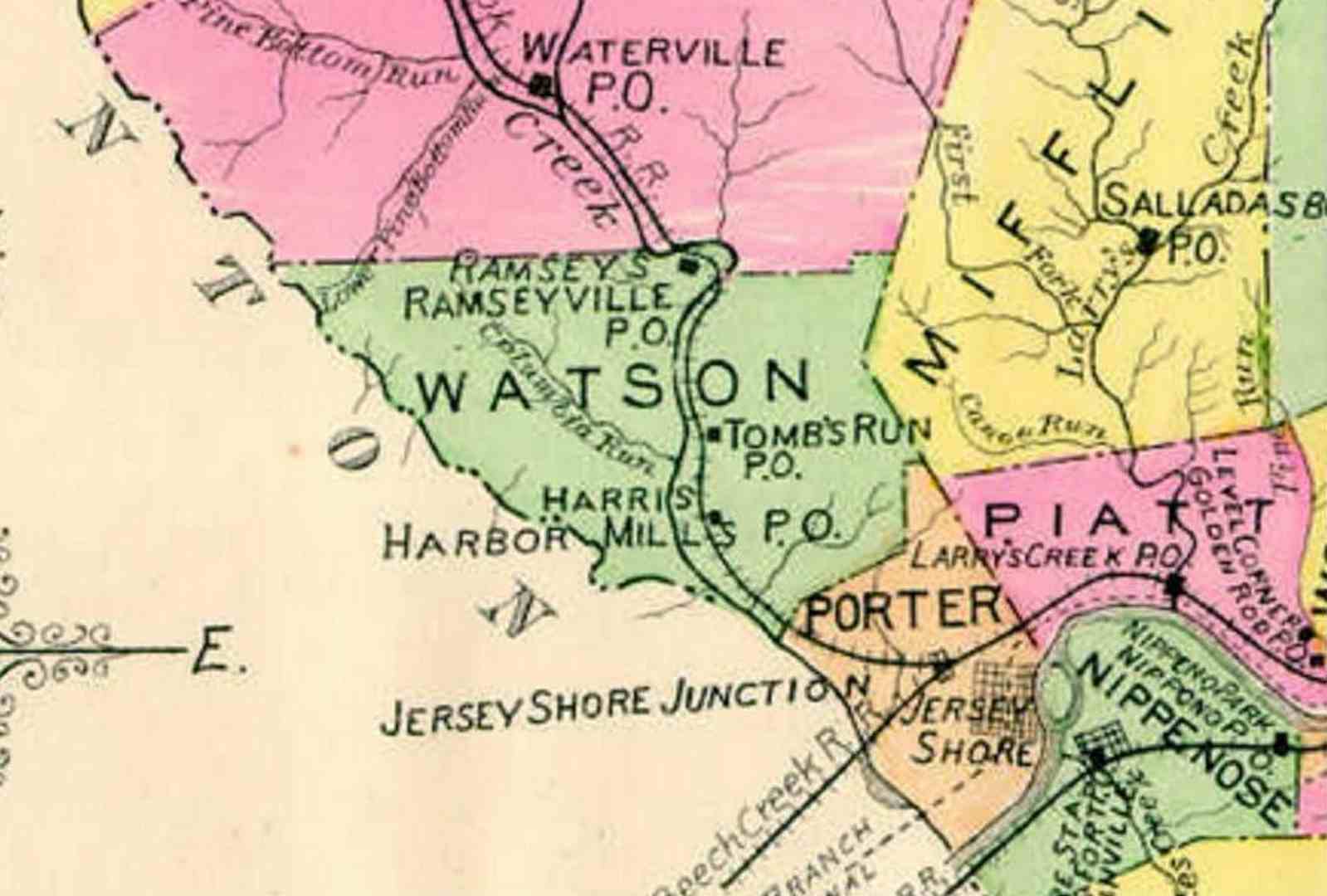 |
|
Send note to Staff
|
| Edited by wt1 - 09/05/2014 08:28 am |
|
|
Rest in Peace
United States
7097 Posts |
|
|
Rest in Peace
United States
7097 Posts |
|
|
Also, Ramsey (probably these guys' Father) was a wagonmaster for Washington, he was giving the land in pinecreek for his services. They were the first to operate a water powered sawmill on the creek. |
|
Send note to Staff
|
|
|
Rest in Peace
United States
7097 Posts |
|
|
Rest in Peace
United States
7097 Posts |
|
|
Has anyone noticed that on that Promise to Pay document on the lower right hand corner there is a little circular scribble or doodle but look a little more closely once -do you see it? Someone penned in the word " seal"  ha-ha. |
|
Send note to Staff
|
|
|
Rest in Peace
United States
7097 Posts |
|
|
I just noticed the James Nice signatures on those bank checks apply to another part of my collection...more research to come. |
|
Send note to Staff
|
|
|
Pillar Of The Community
United States
1868 Posts |
|
|
Regarding the handwritten "seal," for a long period of time the law required certain documents to be signed and sealed to be valid. The idea was that even if someone forged your signature, they were unlikely to possess your signet ring, required to make your unique wax seal, as you were that ring all the time. Over time, this requirement became archaic, and courts would accept a facsimile seal of this type. They were used for at least several decades and some documents today even include a space for them. Eventually the seal requirement was abandoned or written out of the law in most places.
Regarding the Saturday signing date, it should be kept in mind that the modern concept of the weekend is relatively new. At the time of this document, almost everyone worked six days a week, and those in unskilled jobs often worked seven. So, for people in the mercantile class, concluding a transaction on Saturday would not have been unusual. The document could be read to prove that for these people, in 1859 there were no weekends.
|
|
Send note to Staff
|
|
|
Pillar Of The Community
United States
856 Posts |
|
|
These days the seal has generally been replaced by the notary signature and stamp on documents (such as deeds) that still require that sort of thing.
Geez, on this board I should have thought to mention that "stamp" refers to the notary public's rubber stamp. |
|
Send note to Staff
|
| Edited by rustyc - 03/01/2015 1:40 pm |
|
| |
Replies: 11 / Views: 2,784 |
|




 Posted 09/04/2014 07:08 am