| Author |
 Replies: 9 / Views: 3,375 Replies: 9 / Views: 3,375 |
|
|
Rest in Peace
7742 Posts |
|
|
Hi guys...Your American stamps drive me crazy sometimes, cause there are so much variety in the stamps...haha Anyways, I think this is a Scott # 136....But, there are other numbers, 158, 169, 147, 194, 18, and 207...Yikes. Can anyone help...Thanks. Robert 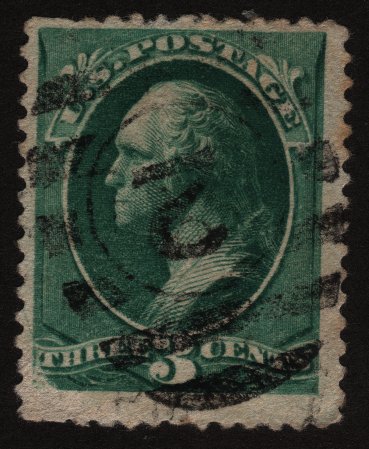 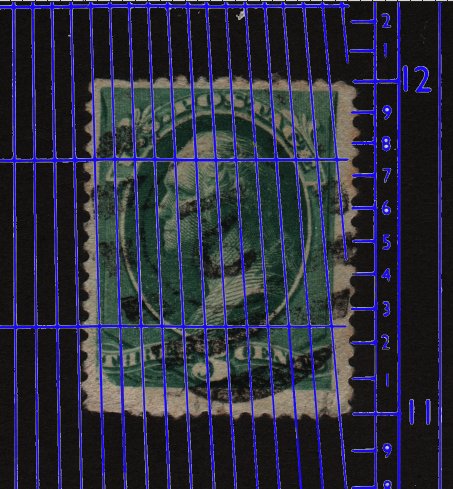 |
|
Send note to Staff
|
|
|
|
|
Pillar Of The Community
United States
1414 Posts |
|
|
The stamp is the re-engraved Scott 207 on soft paper. The horizontal line under "TS" of "CENTS" is visible. The extent of the shading to the left and right of the oval is reduced compared to the original version
[All of the remarks that follow would be the case if the stamp had not been re-engraved.]
For starters, it has the "secret mark" indicated by strong shading in the under part of the upper tail of the ribbon to the left of the numeral "3". It would then be either a 158 or 184. The color and appearance of the paper is consistent with American Bank Note era soft paper. The cancel is also a later killer cancel which did not exist while the National Bank Note 136 or 136A with grill or 147 without grill. The National Bank Note printings had hard paper and no "secret mark". Scott 158 was printed by the Continental Bank Note Company on hard paper. Continental printings on soft paper are lumped in with the American Bank Note printings as Scott 184 unless the cancel date is before Feb 4, 1879. The unlisted hard paper American Bank Note Company examples can only be identified by logo capture of the American Bank Note Company in the margin of the stamp or on the selvage. Special printings are extremely rare, generally not cancelled and are extremely unlikely to exist unless already identified as such.
Clark |
Send note to Staff 
|
| Edited by cfrphoto - 10/03/2014 10:21 am |
|
|
Rest in Peace
7742 Posts |
|
|
Pillar Of The Community
United States
2963 Posts |
|
|
Wert - I never cease to be amazed at your attention to detail - I admire your tenacity!
Clark covered the important shading/paper differences on this issue, but I wanted to point out something very important (and obvious) that you missed. Scott #s 134-144 all have grills. Most are easy to see with the naked eye, but sometimes they are faint enough to require other means of inspection. I have a couple thousand 3c banknotes and the first thing I do when sorting is to separate by grill / no-grill, then secret mark, then re-engraved, then paper. Being color-blind, I don't worry too much about colors.
Brian |
|
Send note to Staff
|
Brian Riley
APS 223349 |
|
|
Pillar Of The Community
United States
1414 Posts |
|
|
No point in looking for a grill on a 207. But I do have a nicely impressed fake grill on a re-engraved 1 cent 206. Fakers who added grills to bank note issue stamps sometimes started with a re-engraved American Bank Note stamp or one on the wrong paper, wrong color or a secret mark.
Clark |
|
Send note to Staff
|
|
|
Rest in Peace
7742 Posts |
|
|
Thanks Rileyman...I know I am a pain and a "fly specker...just born that way...haha |
|
Send note to Staff
|
|
|
Rest in Peace
United States
7097 Posts |
|
|
Quote:
Thanks Rileysan...I know I am a pain and a "fly-specker"...just born that way...ha-ha!
Hey maybe we are related somehow wert  |
|
Send note to Staff
|
|
|
Pillar Of The Community
United States
6668 Posts |
|
|
Pillar Of The Community
United States
1414 Posts |
|
|
It is probably a pair of 136 with late state H grills with some faintly impressed points in the top and bottom rows. It should be possible to see the grills more clearly in watermark fluid, lighter fluid like Ronsonol is best in this case because it does not evaporate quickly. Locating the exact boundaries of the grills and counting the vertical and horizontal rows could pay off because it is possible that this is a pair of 136A with I grills. Also read the note in the Soctt Catalog about vertical and horizontal paper mesh as it relates to early and late state grills.
Clark |
|
Send note to Staff
|
|
|
Pillar Of The Community
United States
1946 Posts |
|
|
I think I've seen this pair before, Stallzer. That's a rather distinctive plate crack, or whatever that is, on the right.
I would perform the fluid test that Clark mentions, but I expect you will find that this is a 136A I-grill pair. When comparing right and left to one another, there is a consistent pattern to the vertical count that makes me dubious of finding extra rows above or below. Counting the number of point columns is more difficult here for some reason, but it seems to come up with the requisite 11, and no more, pretty consistently too.
Do let us know if the fluid shows a different number of columns and rows of points than 11x13. Also, let us know the direction of the paper mesh if you know how to read that. I agree with Clark that this appears to be a late state grill (these stamps show what Ron Burns calls "reverse embossing") so if there is any substance to the notes in Scott by the two listed grill types, you should see horizontal mesh for this paper. Comparative measurements of design height with India proofs (meshless) or known samples of stamps should show these to be a bit shorter than vertical mesh stamps or the neutral India paper. But the height difference is a function of the degree to which these were effected by paper shrinkage, which may vary by exposure conditions, so that is not the only guide you want to look at. |
|
Send note to Staff
|
| Edited by essayk - 10/05/2014 4:21 pm |
|
| |
Replies: 9 / Views: 3,375 |
|




 Posted 10/03/2014 09:47 am


